Thunder Bay Crime Rate Rises 18 Per Cent: How Residents Can Protect Their Homes and Personal Safety
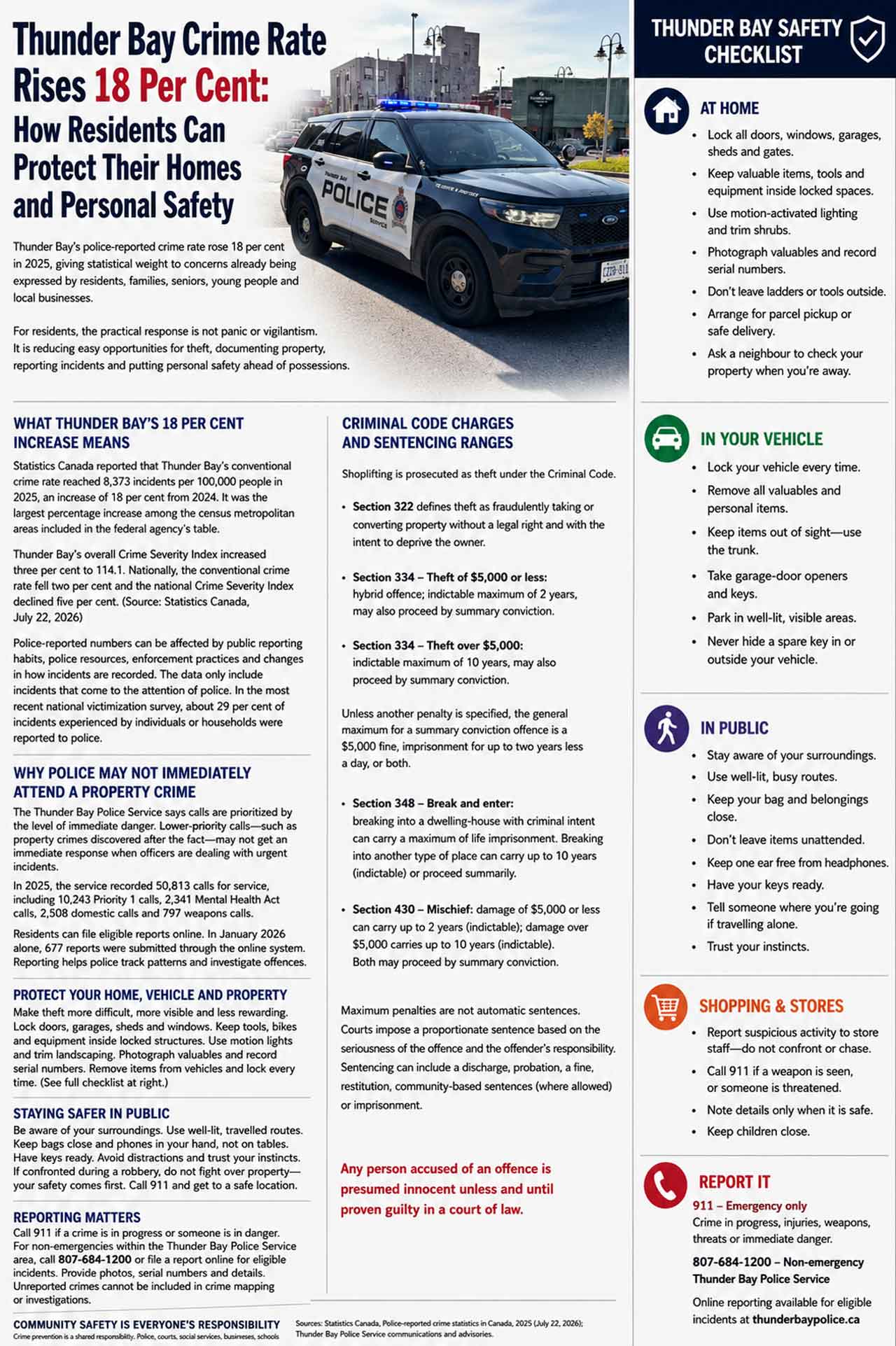
Thunder Bay – LIVING – Thunder Bay’s police-reported crime rate rose 18 per cent in 2025, giving statistical weight to concerns already being expressed by residents, families, seniors, young people and local businesses.
From social media posts, to many neighbourhoods in the city, the evidence of problems is quite apparent. At the base of the problem it is often addiction. Drug addiction is expensive and those caught in the brain-hold trap of addiction will do almost anything to get their daily fix.
Even simply going for a walk with your dog, or with young children means in too many cases being on the lookout for discarded needles, broken glass, and sometimes people who are panhandling. Outside many stores, people are asking for money. Thunder Bay in 2026 is not like it was a generation ago.
Social media posts regularly describe bicycles, tools, parcels, lawn equipment and other property being taken from yards, vehicles and garages. Businesses have also reported concerns about people leaving stores with unpaid merchandise.
The statistics require some context, however. Thunder Bay’s Crime Severity Index, which accounts for both the number and seriousness of offences, increased by three per cent. Police-reported statistics also exclude crimes that are never reported.
In 2025, Thunder Bay Police report that they handled 50,813 total calls for service.
This included
10,243 priority 1 calls
2,341 Mental Health Act calls
2,508 domestic calls
866 missing persons calls
797 weapons calls
445 impaired driving charges
For residents, the practical response is not panic or vigilantism. It is reducing easy opportunities for theft, documenting property, reporting incidents and putting personal safety ahead of possessions.
What Thunder Bay’s 18 Per Cent Increase Means
Statistics Canada reported that Thunder Bay’s conventional crime rate reached 8,373 incidents per 100,000 people in 2025, an increase of 18 per cent from 2024. It was the largest percentage increase among the census metropolitan areas included in the federal agency’s table.
Thunder Bay’s overall Crime Severity Index increased three per cent to 114.1. Nationally, the conventional crime rate fell two per cent and the national Crime Severity Index declined five per cent.
The two measurements describe different things. The conventional crime rate measures the number of police-reported Criminal Code incidents relative to population, excluding traffic offences. The Crime Severity Index gives greater weight to more serious crimes.
An 18 per cent increase in the crime rate therefore does not necessarily mean every type of crime increased by 18 per cent, or that 18 per cent more residents became victims.
Statistics Canada also cautions that police-reported numbers can be affected by public reporting habits, police resources, enforcement practices and changes in how incidents are recorded. The agency says the data only include incidents that come to the attention of police.
In the most recent national victimization survey cited by Statistics Canada, approximately 29 per cent of incidents experienced by individuals or households were reported to police. Reporting varied considerably by offence.
That makes neighbourhood posts and personal accounts important indicators of public concern, but they cannot establish the actual number of unreported thefts in Thunder Bay.
Why Police May Not Immediately Attend a Property Crime
The Thunder Bay Police Service says calls are prioritized according to the level of immediate danger.
Priority 1 to 3 incidents require an immediate response because someone may be in serious danger. Lower-priority calls can include offences discovered after the fact, information requests and reports where no suspect is present.
Police acknowledge that there are times when all available patrol officers are responding to urgent incidents while additional calls continue to arrive.
In 2025, the police service recorded 50,813 calls for service, including 10,243 Priority 1 calls, 2,341 Mental Health Act calls, 2,508 domestic calls and 797 weapons calls.
When a break-in or theft is discovered after the suspect has left, residents may be asked to file an online report instead of waiting for an officer to attend. Police say those reports remain useful for insurance purposes, intelligence gathering, identifying crime patterns and connecting recovered property to other investigations.
In January 2026 alone, 677 reports were submitted through the service’s online system.
A lack of immediate police attendance should not be interpreted as a reason to avoid reporting. Unreported incidents cannot be included in crime mapping, resource planning or investigations involving repeat offenders.

Protecting Your Home, Yard, Garage and Shed
Most property protection begins with making a theft more difficult, more visible and less rewarding.
Residents should:
- Lock exterior doors, garages, sheds, gates and accessible windows, including when someone is at home.
- Keep bicycles, tools, lawn equipment, generators and seasonal items inside a locked structure rather than in an open yard or carport.
- Install motion-activated lighting near entrances, garages, sheds and darker areas of the property.
- Trim shrubs or other landscaping that may provide concealment near doors and windows.
- Photograph valuable property and record serial numbers, makes, models and identifying marks.
- Keep receipts or other proof of ownership in a secure digital file.
- Avoid leaving ladders or tools outside where they could be used to enter the home.
- Arrange for parcels to be collected promptly or delivered to a secure location.
- Ask a trusted neighbour to check the property during an extended absence.
Police say thefts from sheds and garages often increase during warmer weather, particularly when doors are left unlocked or valuables are easy to access.
Experts recommend securing bicycles, tools and seasonal equipment and considering motion lights or alarms.
Security cameras should cover entry points and the immediate property rather than unnecessarily recording neighbouring private spaces. Residents can also register cameras with the Thunder Bay Police Service. Registration does not give police direct access to the camera; it tells investigators that potentially useful video may be available and allows the owner to decide whether to provide it.
Keeping Vehicles From Becoming Easy Targets
The safest assumption is that anything visible inside a parked vehicle could attract attention.
Police recommend:
- Locking the vehicle every time, including while paying for fuel or making a brief stop.
- Removing wallets, purses, electronics, cash, tools and personal identification.
- Keeping shopping bags and parcels in the trunk rather than on a seat.
- Placing property in the trunk before arriving at the destination so nobody sees it being stored.
- Removing garage-door openers and spare house or vehicle keys.
- Parking in a visible, well-lit area whenever possible.
- Checking that windows, the trunk and all doors are fully closed and locked.
- Never hiding a spare key inside the vehicle or outside the home.
Police say thefts from vehicles are frequently crimes of opportunity involving unlocked doors or property left in plain view. Garage-door openers and keys taken from a vehicle may also provide access to a residence.
Anyone who sees a person checking vehicle door handles should move to a safe location and contact police. Do not approach, chase or attempt to detain the person.
Staying Safer in Stores, Parking Lots and Public Places
Situational awareness does not require constantly being afraid. It means noticing surroundings and avoiding unnecessary distractions.
Residents should consider the following practices:
- Use well-lit, travelled routes and avoid isolated shortcuts, back lanes or unfamiliar park areas when alone.
- Keep at least one ear free when wearing headphones.
- Keep purses and bags closed, secured and close to the body.
- Avoid leaving a phone, wallet or bag unattended on a restaurant or food-court table.
- Use indoor bank machines or machines located in visible areas.
- Have keys ready before reaching a vehicle or doorway.
- Tell a family member or friend where you are going when travelling alone at night.
- Keep a charged phone available, particularly for seniors, young people and anyone unfamiliar with the area.
- Arrange a meeting point and check-in plan when family members separate inside a mall, event or public space.
People travelling into Thunder Bay from smaller Northwestern Ontario or First Nations communities for shopping, appointments or other services should plan transportation, parking and family check-ins before arriving, particularly when returning to hotels or vehicles after dark.
Police have warned about distraction thefts in which one person draws a victim’s attention while another takes a wallet, phone or other property. Tactics can include asking for directions, pretending to need help, starting an argument, spilling something or claiming that a vehicle has been damaged.
A stranger asking for assistance is not automatically committing an offence. Residents can remain courteous while maintaining personal space and keeping control of their belongings.
If confronted during a robbery, do not fight over the property.
Police advise victims to surrender the item, move to safety, call 911 and record a description only when it is safe to do so. Personal safety is more important than any wallet, bicycle, phone or vehicle.
What to Do When Witnessing Shoplifting
Statistics Canada reported 208,941 police-reported shoplifting incidents across Canada in 2025, an increase of 11 per cent from 2024 and the fifth consecutive annual increase. Those national numbers do not establish the extent of shoplifting at individual Thunder Bay stores.
Customers who believe they are witnessing a theft should not chase, block or physically confront the person involved.
Instead:
- Notify store staff, management or security.
- Move children and other vulnerable people away from the situation.
- Call 911 when a weapon is present, threats are being made, violence is occurring or someone is in immediate danger.
- Note clothing, direction of travel, vehicle information or other details only when it can be done safely.
- Do not follow the person into a parking lot.
- Avoid posting unverified accusations or identifiable photographs online.
Store employees should follow their employer’s safety and loss-prevention policies. Preserving surveillance video, transaction records, dates, times and accurate descriptions may be more useful to investigators than a physical confrontation.
When and How to Report an Incident
Call 911 when:
- A crime is in progress.
- Someone is injured or being threatened.
- A weapon is present.
- A suspect is still at the location.
- There is an immediate danger to the public.
For non-emergency incidents within the Thunder Bay Police Service jurisdiction, residents can call 807-684-1200.
The Thunder Bay Police Service’s online system accepts eligible reports involving theft, vandalism, fraud, traffic violations and missing identification. Reports can include photographs and video evidence.
After discovering a theft or break-in:
- Do not touch or unnecessarily move items around the scene.
- Photograph damage before making repairs.
- Save original security-camera files rather than only screen recordings.
- Write down the date, approximate time and missing property while details are fresh.
- Gather serial numbers, receipts and photographs.
- Contact financial institutions immediately when cards or identification are stolen.
- Notify an insurance provider where appropriate.
- Keep the police occurrence number for future reference.
Reporting also protects other residents. A bicycle serial number, piece of video or description that appears insignificant on its own may connect several offences or help identify recovered property.
Criminal Code Charges and Sentencing Ranges
Shoplifting is not a separate offence under the Criminal Code. It is recorded separately for statistical purposes but is prosecuted as theft.
Section 322 defines theft as fraudulently taking or converting property without a legal right to do so and with the intention of depriving the owner of that property.
Under section 334:
- Theft involving property valued at $5,000 or less is a hybrid offence. When prosecuted by indictment, the maximum sentence is two years in prison. It may also be prosecuted by summary conviction.
- Theft involving property valued at more than $5,000 is punishable by up to 10 years in prison when prosecuted by indictment, or it may proceed by summary conviction.
Unless another penalty is specified, the general maximum for a summary conviction offence is a $5,000 fine, imprisonment for up to two years less a day, or both.
Break and enter carries substantially higher maximum penalties. Under section 348, breaking into a dwelling-house with the required criminal intent can carry a maximum sentence of life imprisonment. Breaking into another type of place can carry up to 10 years when prosecuted by indictment or can proceed summarily.
Mischief involving damaged property valued at $5,000 or less can carry up to two years when prosecuted by indictment. Where the value exceeds $5,000, the indictable maximum is 10 years. Both may also proceed by summary conviction.
Maximum penalties are not automatic sentences. Courts must impose a sentence proportionate to the seriousness of the offence and the offender’s responsibility. Depending on the circumstances, the available sentencing range can include a discharge, probation, a fine, restitution, a community-based sentence where legally permitted or imprisonment.
Factors such as prior convictions, repeated offending, planning, the value of the property, damage caused, breach of court conditions, guilty pleas and repayment or return of property can affect the result.
Any person accused of an offence is presumed innocent unless and until proven guilty in a court of law.
Community Safety Without Fear or Vigilantism
Property crime creates more than financial loss. It can leave seniors afraid in their homes, prevent children from using bicycles or outdoor equipment and force families and businesses to absorb insurance deductibles and replacement costs.
Crime prevention cannot rest entirely on potential victims. Police resources, prosecution, courts, addictions and mental-health services, housing supports, youth programming, business practices and neighbourhood design all have roles in improving community safety.
Residents can help by reporting incidents, looking out for neighbours and sharing verified safety information. Concern about crime must not turn into vigilantism or the racial profiling of Indigenous people, young people, newcomers, unhoused residents or people experiencing addiction or mental-health challenges.
The goal is a Thunder Bay where residents remain alert without becoming isolated, where businesses protect employees without encouraging dangerous confrontations and where reliable reporting gives police and policymakers a more accurate picture of what is happening.