Two new Northeast fires are confirmed as OPP supports Northwest evacuations and road closures
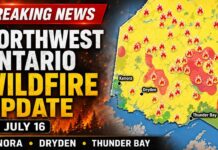
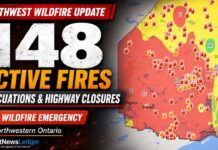
THUNDER BAY — Ontario fire officials confirmed two new wildland fires in the Northeast Fire Region on Wednesday, while Ontario Provincial Police continued supporting evacuations, enforcing road closures and protecting communities affected by major fires in Northwestern Ontario.
There were 41 active fires in the Northeast as of 6:32 p.m. EDT on July 22. Four were not under control, one was being held, three were under control and 33 were being observed.
In Northwestern Ontario, mandatory evacuations and access restrictions remain in place in several fire-affected areas. Highway 811 and a section of Highway 527 remain closed as emergency crews continue regional operations.
Residents and travellers should monitor official information because fire behaviour, evacuation instructions and highway conditions can change rapidly.
Two New Fires Confirmed in Northeast Region
Aviation, Forest Fire and Emergency Services reported the following new fires:
Cochrane 47 (COC047) is listed at 361 hectares and is located approximately 10 kilometres north of Missisa Lake. The fire is being observed.
Haliburton 23 (HAL023) is 0.1 hectares and is located on the east side of Highway 17, approximately 600 metres west of Holden Lake and 500 metres east of Smith Lake. The fire is not under control.
Although most active fires in the Northeast are being observed, new starts can demand aircraft, crews and equipment at a time when Northwestern Ontario is also dealing with significant fire activity and evacuations.
Provincial resources may be moved between fire regions according to threats to communities, infrastructure and public safety.
Wawa 17 Being Held Near Pic Mobert
Wawa 17 is now being held at 37.2 hectares.
The fire is located approximately 15 kilometres northeast of Pic Mobert First Nation and east of White Lake.
A fire classified as being held is not expected to spread beyond its current boundaries under the prevailing and forecast conditions, based on the suppression resources already assigned.
Continued monitoring remains necessary because wind, temperature and humidity can quickly alter fire behaviour.
OPP Supporting Northwest Evacuations
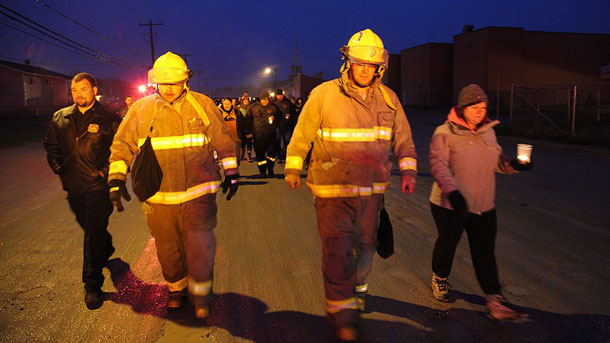
The OPP continues to assist the Ministry of Natural Resources with evacuation operations in several Northwestern Ontario communities threatened by wildfires.
People living under mandatory evacuation orders are being directed to leave immediately and move away from active fire areas.
Other communities remain under observation. Residents should be prepared to leave quickly should local authorities issue an evacuation alert or order.
The OPP North West Region has deployed Aviation Services, Emergency Response Team members, the Provincial Liaison Team and Operational Support personnel.
Officers are working with First Nations, municipalities, emergency-management organizations and policing partners to:
Assist with evacuations.
Enforce road closures.
Control access to fire-affected areas.
Keep emergency routes open.
Support public safety in evacuated communities.
The Provincial Liaison Team works with Indigenous communities and other affected groups to support communication and co-ordination during major incidents.
Highways 527 and 811 Remain Closed
The following routes remain closed in both directions, except for some local traffic leaving the affected area:
Highway 527 at the Highway 811 junction.
Highway 811.
Travellers should not attempt to bypass barricades or enter the area by logging roads, trails or other unofficial routes.
Road closures protect the public from smoke, flames, falling trees, damaged infrastructure and heavy emergency traffic. They also allow police, fire crews and evacuation vehicles to operate without unnecessary delays.
Drivers should check Ontario 511 before travelling in the region.
Implementation Orders Restrict Public Access
The Ministry of Natural Resources has issued implementation orders for some wildfire-affected areas under Ontario’s Wildland Fire Management Act.
These orders can restrict entry and activities in areas where a wildland fire presents a danger to people, property or emergency operations.
The OPP says unauthorized entry into an area covered by an implementation order may result in a charge carrying an $880 fine.
Failing to obey road-closure signs may result in a $110 fine and three demerit points.
The police release did not identify the specific statutory subsections that would apply in each case. These allegations would generally be prosecuted as provincial offences rather than Criminal Code offences.
The penalty available to a court depends on the specific charge and legislation. In the circumstances described by police, the stated consequences are set fines and, for the road-sign offence, demerit points. More serious conduct could result in additional charges if it creates other public-safety risks.
Anyone charged with an offence is presumed innocent unless proven guilty in court.
Public and Media Asked to Avoid Fire Scenes
Police are urging members of the public and media not to travel to wildfire scenes to take photographs or video.
Unnecessary traffic can interfere with evacuations and delay firefighters, police, ambulances, utility crews and other emergency personnel.
Residents and visitors are being advised to:
Follow evacuation orders and emergency instructions.
Avoid non-essential travel in affected areas.
Stay out of evacuated communities until authorities approve a return.
Monitor official fire, highway and community updates.
Keep roads clear for emergency vehicles.
Prepare essential belongings in case an evacuation is ordered.
People leaving their homes should bring medications, identification, important documents, mobile devices, chargers and supplies required by children, older adults, family members with medical needs and pets.
Residents should follow instructions from their First Nation leadership, municipality, police or local emergency-management authority.
Watercraft Must Stay Clear of Waterbombers
Boaters are reminded to move close to shore when a waterbomber approaches a lake or river.
A waterbomber will not scoop water when boats or other watercraft create a collision hazard.
Interrupting a water pickup can delay suppression work and force aircraft to search for another safe water source.
Boaters should remain clear until the aircraft has completed its operation and left the area.
Drones and other unauthorized aircraft must also be kept away from wildfires. The presence of a drone can force helicopters and waterbombers to leave the fire area, placing crews and the public at greater risk.
Outdoor Burning Rules Remain in Effect
Ontario’s legislated fire season runs from April 1 to Oct. 31.
Aviation, Forest Fire and Emergency Services encourages residents to compost yard waste or take woody debris to an approved landfill rather than burn it.
Where outdoor burning is permitted, fires may be lit no earlier than two hours before sunset and must be extinguished no later than two hours after sunrise.
Anyone burning outdoors must have enough water and appropriate tools available to control and fully extinguish the fire.
Municipal residents must also check with their local fire department for additional fire bans, permits or restrictions.
Outdoor burning is not permitted where a Restricted Fire Zone or municipal fire ban is in effect.
Why the Situation Matters Across Northern Ontario
Simultaneous fire activity in Northeastern and Northwestern Ontario places added pressure on provincial crews, aircraft and specialized equipment.
The impact is particularly serious for remote First Nations that have limited or no all-season road access. Smoke and changing weather can disrupt air evacuations, medical transportation and deliveries of food, fuel and other supplies.
Thunder Bay and other regional centres may also face increased demand for hotel rooms, health care, transportation, emergency shelter and culturally appropriate services for evacuees.
Wildfire emergencies can also affect forestry operations, mining exploration, tourism, power infrastructure and highway transportation across Northern Ontario.
Rainfall may temporarily reduce visible fire behaviour, but large fires can continue burning below the surface and become more active when conditions dry out.
Official Information and Emergency Contacts
For wildfire suppression and fire-management updates, consult Ontario’s official forest-fire information service.
For information about local emergency operations, contact the affected municipality or First Nation.
Health-related questions can be directed to:
Northwestern Health Unit: 1-800-830-5978.
Thunder Bay District Health Unit: 807-625-5900.
For community programs and general support, call 211.
For current highway closures, check Ontario 511 or call 511 or the Ministry of Transportation at 1-800-268-4686.
To report a wildland fire north of the French and Mattawa rivers, call 310-FIRE (3473).
To report a wildland fire south of the French or Mattawa rivers, call 911.
The public should call 911 only during an emergency. A compatible smartphone or smartwatch may be able to send a satellite SOS message when there is no mobile service, although availability depends on the device, location and service.