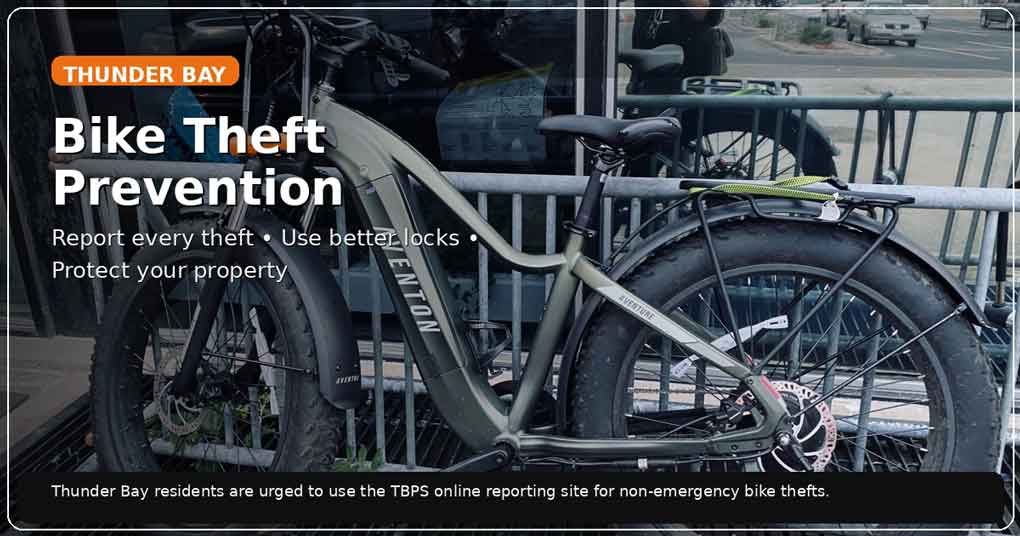
Thunder Bay Bike Thefts: Report Every Theft and Make Your Bicycle Harder to Steal
THUNDER BAY – LIVING – Thunder Bay residents have been using Facebook to post photos of stolen bicycles and abandoned bikes, ranging from costly e-bikes to children’s bikes. The posts are useful for alerting neighbours, but they are not a substitute for filing a police report. If thefts are not reported, police have less information to identify patterns, return recovered bikes or understand where thefts are happening.
Why reporting every theft matters
Residents who have had a bicycle stolen should report it to the Thunder Bay Police Service, even when the bike is old, inexpensive or unlikely to be recovered.
The Thunder Bay Police Service website lists an Online Reporting option and a Report a Crime link for non-emergency incidents. The service also lists 911 for emergencies and 807-684-1200 for non-emergency calls.
This matters because bike theft is often treated by residents as a nuisance crime.
That can lead to underreporting.
But every report adds information: the time, area, description, serial number, make, model, colour and any available images. If officers later recover abandoned bikes, those details can help connect property to the rightful owner.
Posting on social media can still help. A clear photo, the neighbourhood where the bike was taken, and the serial number can alert other residents and local bike shops.
But the police report still matters. A Facebook post cannot create an official file number for insurance, recovery or investigation.
What to do if your bike is stolen
First, report the theft through the Thunder Bay Police Service online reporting system if it is a non-emergency. Call the non-emergency line if there are details that need immediate police advice, and call 911 only if a theft is in progress or someone’s safety is at risk.
Second, gather the evidence before memories fade.
Owners should provide photos, the serial number, receipts, the brand and model, the colour, any stickers or accessories, and the location and time the bike was last seen. For e-bikes, include the make and serial numbers for the bike, battery and motor where available.
Third, notify neighbours, building managers and local online groups, but avoid direct confrontation if the bike is spotted. A person who sees a suspected stolen bike should record the location, take a photo if it is safe to do so, and contact police.
What to do if you find an abandoned bike
An abandoned bicycle may be stolen property. Residents should not assume it is free to take, strip for parts or move far from the location unless there is a safety reason. Take a photo, note the location, look for a serial number only if it can be done without damaging the bike, and report it to police.
This is especially important for children’s bikes. A small bike left in a park, laneway or behind a building may represent a family that cannot easily replace it.
Reporting found bikes improves the chance of returning them.
The best locks for Thunder Bay riders
The best practical lock for most riders is a hardened steel U-lock, also called a D-lock, used through the frame and at least one wheel to a fixed rack.
A heavy-duty chain lock is another strong option, especially for e-bikes and cargo bikes.
Cable locks should be treated as secondary locks only. They are convenient, but they are easier to cut and should not be the main protection for a bike left outside.
The City of Toronto’s bike theft prevention guidance recommends hardened steel U-locks or steel chains over cable locks and suggests using two different types of locks so thieves need more than one tool.
For higher-value bikes and e-bikes, riders should look for independent security ratings. Sold Secure, a lock-testing organization, rates bicycle security products from Bronze to Diamond, with Diamond intended for the highest-threat environments and Gold for high-risk environments.
A good rule is to spend enough on the lock to match the value of the bike. A $3,000 e-bike locked with a thin cable is an easy target. For expensive bikes, a Diamond-rated U-lock or heavy chain, paired with a second lock, is a stronger choice.
How to lock a bike properly
A strong lock only works if it is used correctly. Lock the frame, not just the front wheel. Lock to a solid rack or immovable object. Avoid signposts that can be lifted, small trees, loose railings or anything that can be cut or unbolted.
Using a U-lock or heavy-duty chain with a second lock, keeping the U-lock tight around the bike to reduce room for leverage, placing the keyhole downward, and removing lights, bags and quick-release accessories.
For homes, apartments and garages, the same rules apply. Bikes stolen from yards, balconies, sheds and common storage rooms are still thefts.
Keep bikes indoors where possible. In garages or storage rooms, lock bikes to a ground anchor, wall anchor or fixed object. For e-bikes, remove the battery when storing the bike for longer periods.
Register the bike before it is stolen
Owners should keep a record before anything happens. Photograph the bike from both sides, write down the serial number, keep receipts and record upgrades such as racks, child seats, lights or replacement wheels.
Bike registration can also help. Police say they recover hundreds of bikes a year but often have little information to determine who owns them.
What the law says about bike theft
Under section 322 of the Criminal Code of Canada, theft generally involves fraudulently taking or converting property without colour of right and with intent to deprive the owner of it, temporarily or permanently.
Punishment is addressed under section 334. Where the value of stolen property is more than $5,000, the offence may be prosecuted by indictment with a maximum penalty of 10 years in prison or by summary conviction.
Where the value is $5,000 or less, the maximum on indictment is two years in prison, while a summary conviction can carry the general summary penalty of up to two years less a day in jail, a fine of up to $5,000, or both.
Typical sentencing options depend on the facts, the person’s record, the value of the property, whether the bike was recovered, whether restitution is possible, and whether there are aggravating factors.
Courts may consider outcomes ranging from discharge, restitution, probation and fines to custody in more serious cases. There is no accused person identified in this article. Anyone charged with an offence is presumed innocent unless proven guilty in a court of law.
A community response starts with accurate information
Thunder Bay’s growing online conversation about stolen and abandoned bikes shows residents are paying attention. The next step is turning that attention into useful information.
That means reporting every theft. It means recording serial numbers before a bike disappears. It means investing in better locks. It means not buying suspiciously cheap used bikes. And it means treating an abandoned bicycle as someone else’s property, not as garbage.
For Thunder Bay families, students, workers and e-bike commuters, a bicycle can be transportation, recreation and a major household expense. Better reporting and better prevention will not stop every theft, but they can make theft harder, recovery more likely and the problem more visible.