Is it True Only Two MMIWG Calls for Justice Have Been Completed – Sadly Yes!
Anyone needing emotional support related to missing and murdered Indigenous women, girls, Two-Spirit and gender-diverse people can call the national MMIWG Crisis Line at 1-844-413-6649.
THUNDER BAY — The National Inquiry into Murdered and Missing Indigenous Women and Girls was a long, in-depth, and needed time. The report came up with recommendations in its final report.
Now, the funding has sunsetted, and much of the work remains incomplete.
Yes, the claim is substantially true, but it needs important context. Canada’s own federal reporting tool says only two of the Calls for Justice from the National Inquiry into Missing and Murdered Indigenous Women and Girls have been fully completed, while 82 are listed as pending.
After the National Inquiry was completed, a report was written, and then presented to Prime Minister Justin Trudeau in 2019.
In 2025 NetNewsLedger reported on the progress: Where do the MMIWG Calls for Justice Stand?
At that time, Ontario had released “Pathways to Safety: Ontario’s strategy in response to the Final Report of the National Inquiry into Missing and Murdered Indigenous Women and Girls” in May 2021
Fast facts: Did you know?
| 2386 | Total Number of Participants in the Truth Gathering Process |
| • 1484 Family Members and Survivors provided Testimony | |
| • 819 Individuals shared through Artistic Expressions | |
| • 83 Experts, Knowledge-Keepers and Officials provided Testimony | |
| 15 | Community Hearings |
| 9 | Knowledge Keeper, Expert and Institutional Hearings |
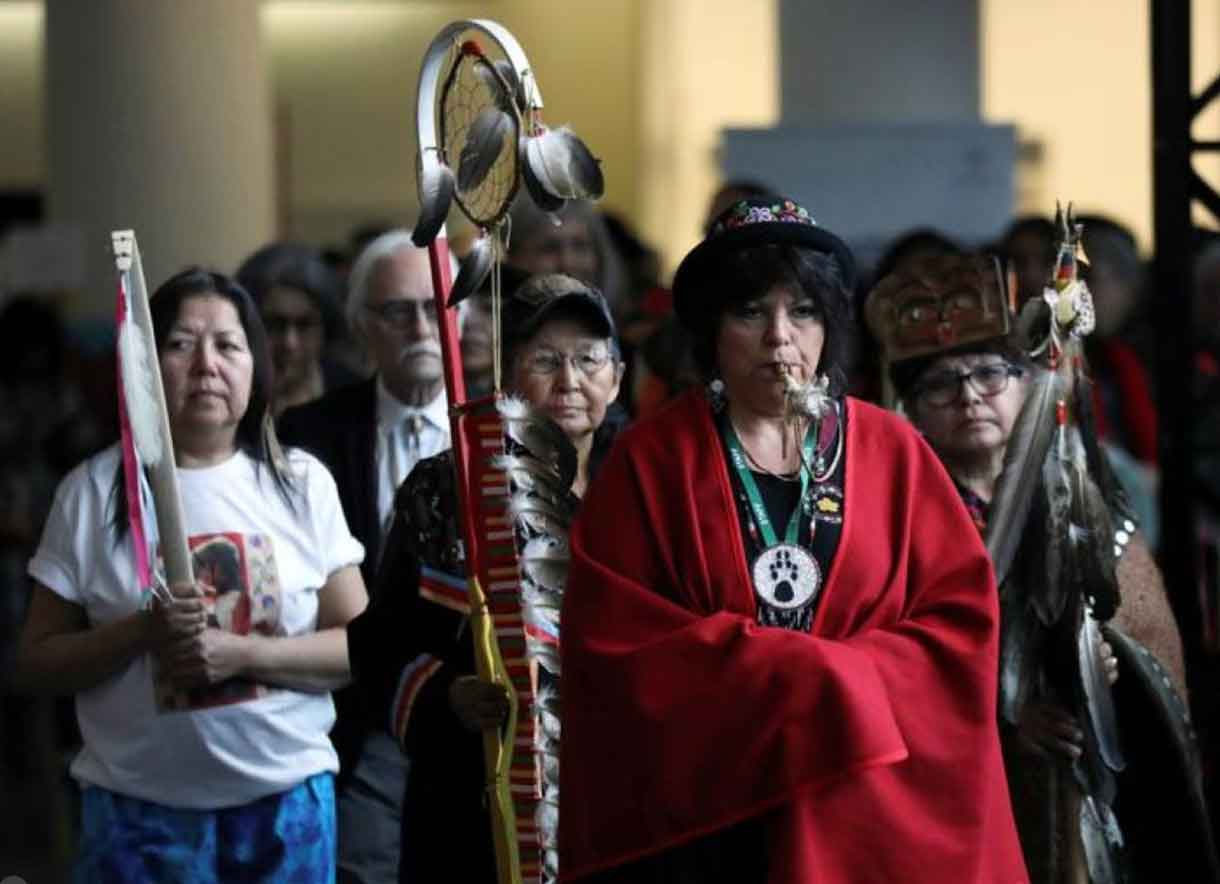
There was lots of fanfare, there were serious efforts and many many Indigenous families had shared their family tragedies at events across Canada.
Since then, it almost seems that much of the effort ended with the delivery of the report.
There are still women and girls going missing, there are still men and boys going missing.
For many, it seems that once the fanfare was over, the lights went out, and the report was carefully put on the shelf, only to gather dust.
Federal Tracker Shows Two Completed, 82 Pending
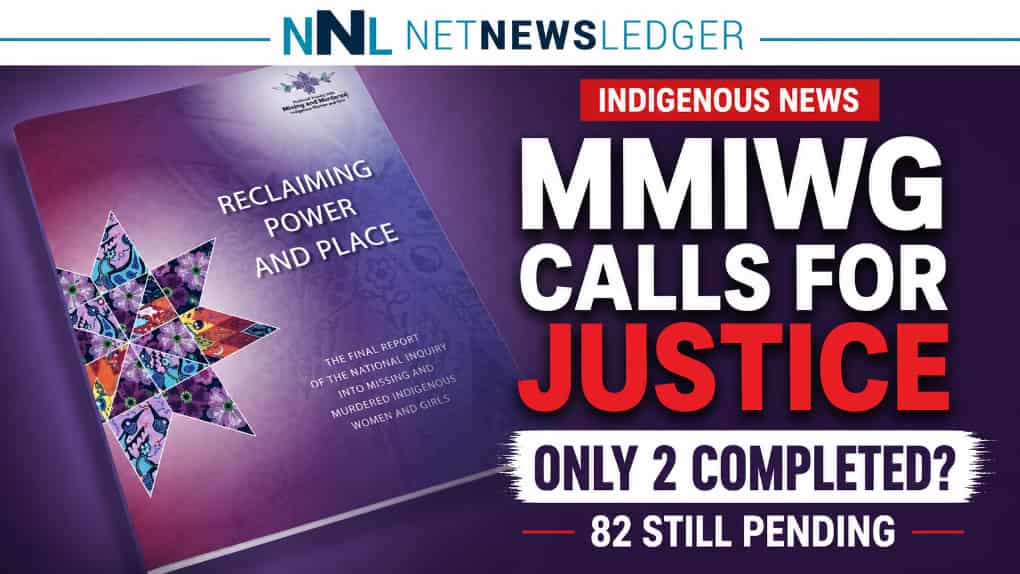
The National Inquiry’s final report, Reclaiming Power and Place, was presented to federal, provincial and territorial governments on June 3, 2019. It issued 231 Calls for Justice directed at governments, institutions, social service providers, industries and all Canadians.
Canada’s reporting tool says 138 Calls for Justice are “actioned,” meaning either complete or underway, while 82 are “pending,” meaning federal efforts have yet to begin.
The same tool reports only two of the Calls for Justice are currently fully completed.
The two completed items are Call for Justice 5.20, dealing with Indigenous-specific provisions of the Corrections and Conditional Release Act, and Call for Justice 5.23, creating a Deputy Commissioner for Indigenous Corrections.
The truth is also that “82 haven’t even been started” is also accurate if understood to mean they are listed as pending federal action, not necessarily that no person or organization anywhere has done related work.
How Much Did the National Inquiry Cost?
The National Inquiry was initially allocated $53.8 million. Ottawa later provided another $38 million after the commission was granted a six-month extension, bringing total federal funding for the inquiry to $92 million.
That figure covers the inquiry process itself. It is separate from later federal spending announcements connected to shelters, victim services, data collection, policing, prevention, family supports and the National Action Plan.
Why Has Progress Been So Slow?
There is no single reason.
The Calls for Justice are broad and structural, touching policing, child welfare, transportation, justice, housing, health care, poverty, racism, resource development, education, media and public services.
But advocates have pointed to several recurring barriers.
First, there is no fully operating independent national oversight body with the authority and resources to measure progress across governments and institutions.
Federal reporting for 2024-25 says governments have been urged to establish an independent oversight mechanism and that work has included engagement and analysis, but the mechanism itself remains a work in progress.
Second, advocates say planning has been too vague. The Native Women’s Association of Canada has criticized the lack of a costed, actionable and measurable implementation plan, warning that without concrete targets and accountability mechanisms, it is difficult to measure whether funding announcements are producing real safety outcomes.
Third, public reporting can blur the picture. “Actioned” does not mean completed.
It includes calls where work is underway. That matters because a program announcement, consultation process or funding allocation may not yet mean families are safer, cases are solved faster, or communities have the services they need.
Fourth, funding instability remains a major concern. In April 2026, Indigenous leaders warned that some federal advocacy funding had sunsetted as of March 2026, creating uncertainty for organizations involved in family support, advocacy and tracking progress.
Finally, Canada still faces serious data gaps. A federal 2024-25 data report says there is a “critical lack of data” on key factors related to Indigenous people and the MMIWG2S+ crisis, including missing-person reporting and policy implementation.
Why This Matters in Thunder Bay and Northwestern Ontario
Thunder Bay is a regional hub for many northern and remote First Nations. People travel here for school, medical care, courts, child welfare matters, employment, shopping, shelter services and transportation connections.
That means slow implementation of the Calls for Justice has direct local consequences. Gaps in housing, safe transportation, addictions treatment, mental health care, policing, child welfare, emergency shelter space and family supports can all affect safety in Thunder Bay and across Northwestern Ontario.
For families and survivors, the central question is no longer whether the crisis has been studied. It has. The question is whether governments and institutions will set clear deadlines, fund long-term Indigenous-led services, publish measurable results, and accept independent accountability for the work still unfinished.
Why “Actioned” Does Not Mean Completed
The government’s use of the word “actioned” can be confusing. In this tracker, “actioned” includes Calls for Justice where work is underway as well as the two that are complete.
That distinction matters. A call can be marked as in progress even if families, survivors and communities are still waiting for visible results. The federal government also acknowledges that many Calls for Justice require sustained work over many years.
How Many Indigenous Women and Girls Have Gone Missing Since the Report?
There is no complete, reliable national number publicly available for Indigenous women and girls who have gone missing since the final report was delivered in 2019. That data gap is itself part of the problem.
Canada’s National Centre for Missing Persons and Unidentified Remains says its data is based on CPIC missing-person entries, and not all missing-person reports are entered into CPIC.
The centre also cautions that reports can include repeat runaways and other duplicate-related issues, although algorithms are used to reduce duplication.
A cautious estimate can be made for 2022 through 2025, because those federal fast fact sheets include Indigenous identity and sex breakdowns for adults and children. Using those published percentages, approximately 31,000 missing-person reports involved Indigenous women and girls over those four years.
This should not be read as 31,000 unique people, because missing-person statistics can include repeat reports involving the same person.
For context, the federal data shows about 7,962 reports involving Indigenous women and girls in 2022, about 8,016 in 2023, about 7,522 in 2024 and about 7,486 in 2025, based on the available adult and child totals and Indigenous-female percentages published by Canada’s Missing.
Comparable Indigenous-specific breakdowns were not published in the same way in the 2019, 2020 and 2021 fast fact sheets, making a full 2019-to-2025 total unreliable.
The Violence Remains a National Crisis
Statistics Canada reported that between 2009 and 2021, 490 Indigenous women and girls were victims of homicide.
The homicide rate for Indigenous women and girls was six times higher than for non-Indigenous women and girls during that period.
That national pattern is why families, survivors and Indigenous leaders continue to call for measurable action, clear timelines and accountability, rather than progress reports that are difficult for the public to interpret.
Bottom Line
The claim is accurate based on Canada’s official tracker: only two Calls for Justice are fully completed, and 82 are still pending federal action.
The more precise way to state it is this: Of the 220 Calls for Justice tracked through the federal reporting tool, two are complete, 136 are in progress and 82 are pending as of June 3, 2025. The broader National Inquiry issued 231 Calls for Justice overall.
With funding having sunsetted for the work, it is hard to determine if the recommendations will ever be completed.
It was a promise made repeatedly by the Government of Canada that the work would be done. It is a promise that Canada needs to keep.