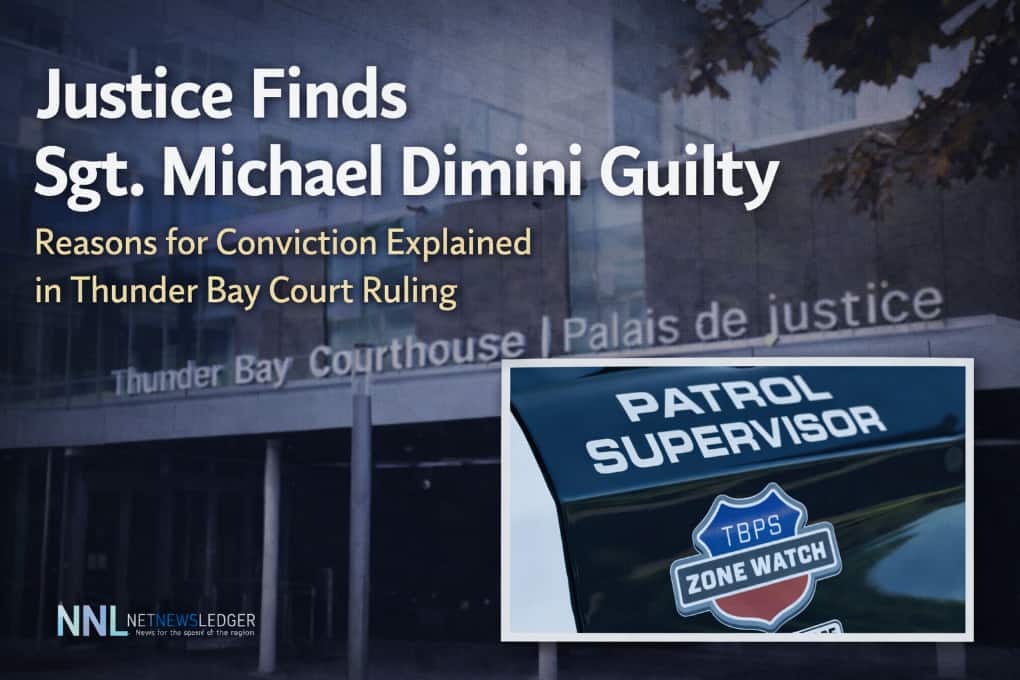
Former Thunder Bay Police Officer Michael Dimini Sentenced to Three Years in Prison
THUNDER BAY — Former Thunder Bay Police Service officer Michael Dimini has been sentenced to three years in prison for breach of trust and obstruction of justice, a penalty that goes beyond the 15- to 18-month custodial sentence sought by the Crown.
Justice Michael Block released the sentence Wednesday morning at the Thunder Bay Courthouse. The sentence follows Dimini’s Feb. 20 conviction in a case centred on an unlawful apartment entry, conflict of interest concerns and false police documentation.
Sentence Follows Conviction for Breach of Trust and Obstruction
Dimini, a former city police officer and sergeant, was convicted of breach of trust and obstruction of justice after a judge-alone trial.
The case arose from a Nov. 24, 2020, call involving a stolen television and tools. Court found Dimini, while working as a patrol sergeant, attended a keep-the-peace call outside his assigned zone. The matter involved the father of his common-law partner, creating what the court treated as a conflict-of-interest context.
Justice Block found Dimini did not have lawful authority to enter Apartment 14 at 230 Frederika Street without a warrant or consent. The court also rejected the later “fresh pursuit” explanation used to justify the entry, finding the narrative was false and connected to police records after the fact.
What the Court Found
The court found the situation was not a split-second policing mistake. Justice Block concluded Dimini used police authority to enter a private dwelling without lawful grounds, in a matter connected to his personal relationships.
The decision also found the unlawful entry led to arrests and a search that flowed from the improper use of police authority. In the obstruction finding, the court concluded the false “fresh pursuit” narrative was not an innocent error but an attempt to backfill a legal justification into police documentation.
That finding was central because police reports are relied on by Crown counsel, defence lawyers, courts and the public. False or misleading police records can affect bail decisions, disclosure, Charter litigation and the integrity of prosecutions.
Criminal Code Context and Sentencing Range
Breach of trust by a public officer is set out in section 122 of the Criminal Code. It applies when an official, in connection with the duties of their office, commits fraud or a breach of trust. The offence carries a maximum sentence of five years in prison if prosecuted by indictment, or a summary conviction penalty if the Crown proceeds summarily.
Obstruction of justice is addressed under section 139. For the broader obstruction provision, a person who intentionally attempts to obstruct, pervert or defeat the course of justice can face up to 10 years in prison if prosecuted by indictment, or a summary conviction penalty.
For summary conviction offences where no other penalty is specified, the general maximum penalty is a fine of up to $5,000, imprisonment for up to two years less a day, or both.
Dimini has now been convicted and sentenced at the trial level. Any appeal rights are separate from the sentence imposed. Any other individuals facing allegations in separate or related proceedings remain presumed innocent unless proven guilty in a court of law.
Why the Sentence Matters for Thunder Bay Police
The sentence lands heavily for the Thunder Bay Police Service because it involves the misuse of police authority by a senior officer, not an ordinary member of the public.
For residents, the case raises basic questions about lawful entry into homes, officer supervision, conflict-of-interest rules and whether police records can be trusted. Those issues go directly to public confidence in policing.
Thunder Bay police have already faced years of scrutiny over governance, investigations and trust with Indigenous communities. The 2018 Broken Trust report made 44 recommendations and described a crisis of confidence requiring public reporting and oversight.
The Dimini sentence adds another pressure point. It reinforces the need for clear policies on conflicts of interest, careful supervision of frontline decisions, accurate report writing, strong disclosure practices and a culture where officers can challenge unlawful direction from senior members.
Impact on Public Confidence
The immediate impact is reputational. A police service depends on the public’s belief that officers will use state power lawfully and that official records reflect what actually happened.
When a court finds that a senior officer entered a home unlawfully and later supported a false legal explanation, the damage goes beyond one file. It can affect how witnesses, accused persons, complainants, defence lawyers and community members view police investigations more broadly.
For Thunder Bay, where policing remains under close public watch, rebuilding trust will require more than discipline after misconduct. It will require transparent reporting, consistent accountability and visible reforms that show the service has learned from the case.
What Comes Next
The three-year sentence marks a significant court response to police misconduct. Any further professional, employment or appeal-related steps are separate from the criminal sentence.
Mr. Dimini is currently planning an appeal of the conviction and the sentence.
For the Thunder Bay Police Service, the larger question is institutional: how the service ensures that lawful authority, Charter rights, conflict-of-interest safeguards and accurate documentation are treated as core policing duties, not technical details.