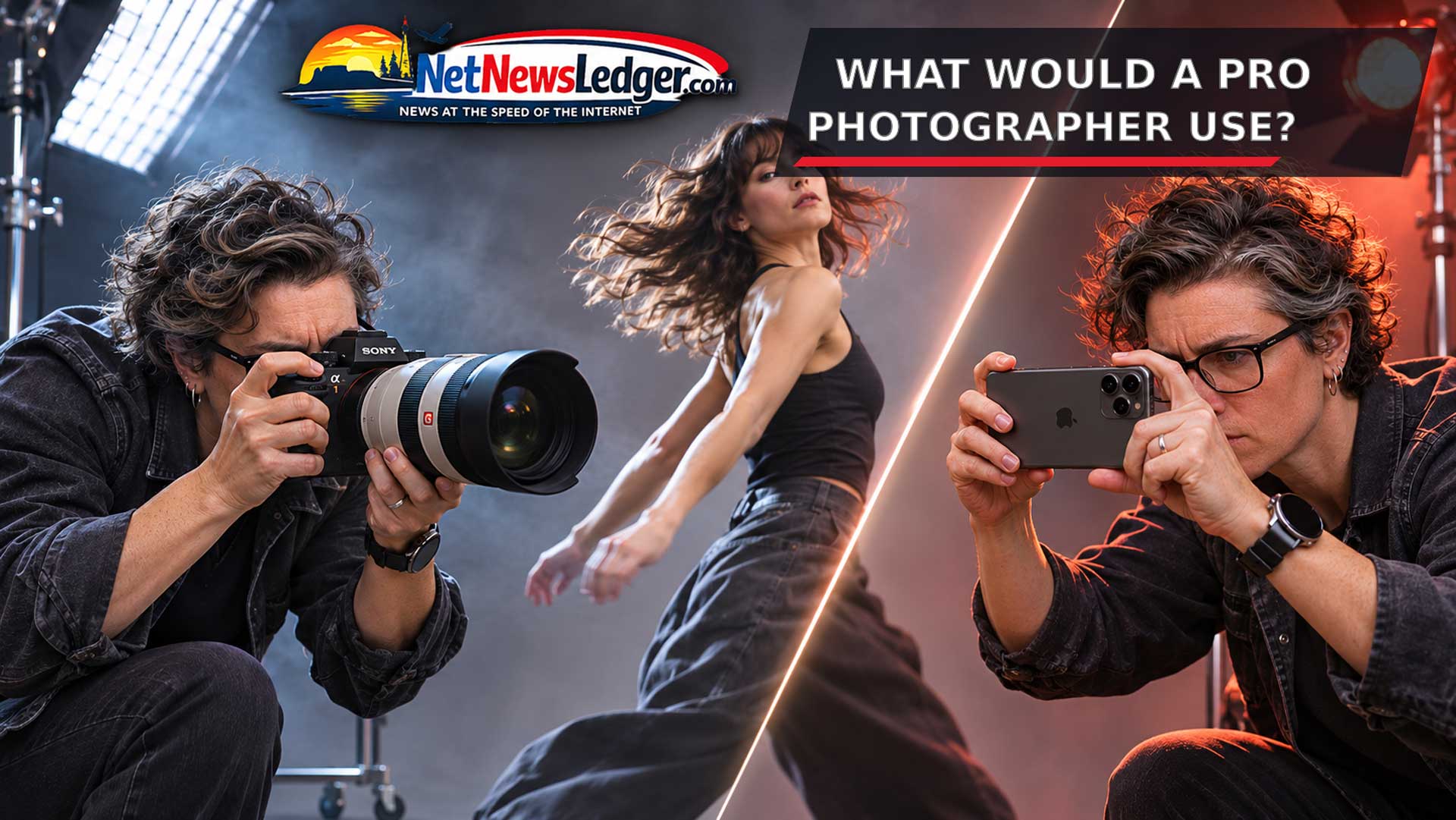
Apple and Samsung now offer RAW capture, sophisticated computational photography and remarkably capable video systems
But for most working photographers and filmmakers, a flagship phone is a valuable production tool rather than a complete replacement for a Sony or Canon mirrorless system
Thunder Bay – PHOTO TECH – As a photographer since 1976, I have had a range of cameras. I have ranged from a Minota SrT-201, the a Minolta XD5 and then an Olympus OM-1. Today my camera of choice are a pair of Sony’s, an A-9 and A-7 with a range of lenses from the 24-70 f2.8, 70-200 f2.8, and a 200-600 f4.0.
I have also had iPhones since the IPhone 5. Today I use an iPhone 15 pro max. Many of the weather shots on NetNewsLedger are taken on the iPhone. Some would argue the best camera is the one that is with you.
So what is the best camera for professional use?
The argument for abandoning the traditional camera has never been stronger.
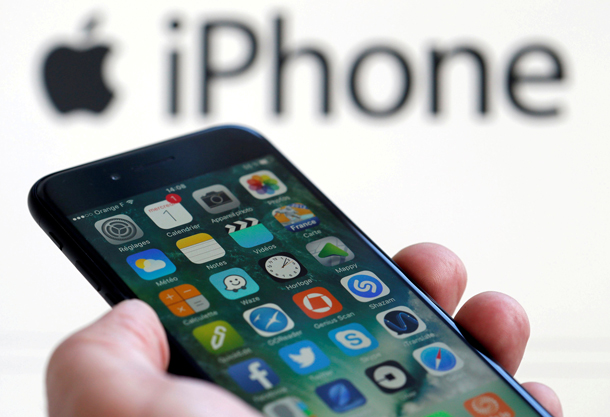
Apple’s iPhone 18 Pro Max carries three 48-megapixel rear cameras, variable aperture, ProRAW, ProRes RAW, Apple Log 2 and genlock. Samsung’s Galaxy S26 Ultra counters with a 200-megapixel main camera, two telephoto modules, 16-bit Expert RAW and 8K video.
Both are powerful computers, editing stations and communications devices that happen to contain multiple cameras. For everyday photography, social media and even some commercial assignments, they can produce excellent work.
But the question for a professional is not simply whether a phone can take a good picture. It is whether that phone can deliver the required image, with repeatable quality, under deadline and in conditions the photographer cannot control.
For most serious photographers and videographers, the answer remains clear: a phone can replace a camera for some jobs, but not the camera system as a whole.
Smartphones Have Become Serious Imaging Tools
The iPhone 18 Pro Max starts at C$1,899 and has a three-camera system covering 13mm, 24mm and 100mm-equivalent perspectives. The main 48MP camera offers selectable apertures of f/1.48, f/1.8, f/2.8 and f/4, while sensor cropping provides 48mm and 200mm “optical-quality” options.
Apple supports 48MP ProRAW stills, manual control over aperture, shutter speed and white balance, and video recording up to 4K/120p. More significantly for professional productions, the phone records ProRes and ProRes RAW, offers Apple Log 2 and ACES support, and can be genlocked with other equipment. The highest-quality 4K/120p ProRes recording requires external storage, but that capability places the phone well beyond casual mobile video.
The C$2,049.99 Galaxy S26 Ultra is similarly ambitious. It combines a 200MP f/1.4 main camera, 50MP ultra-wide, 50MP 5x telephoto and 10MP 3x telephoto. Samsung specifies 8K/30p and 4K/120p recording, while its Expert RAW application produces 16-bit Linear DNG files and gives photographers manual control over ISO, shutter speed, exposure, white balance and focus.
These phones are not toys. They are legitimate imaging devices with several clear professional advantages:
- They are small, discreet and almost always available.
- Computational HDR can handle difficult mixed lighting with little intervention.
- Stabilization makes handheld video immediately usable.
- Images can be edited, captioned and transmitted from the same device.
- Multiple cameras provide useful wide, standard and telephoto framing without carrying a bag.
- Cellular connectivity gives journalists and social-media teams exceptionally fast delivery.
A professional covering breaking news, shooting behind-the-scenes material or producing vertical video for immediate publication may reasonably choose the phone first.
What Sony and Canon Still Provide
The latest Sony and Canon mirrorless cameras illustrate why dedicated systems remain relevant.
Sony’s Alpha 7 V is a C$3,699.99 general-purpose hybrid with a 33MP partially stacked full-frame sensor and AI-assisted subject recognition. For photographers prioritizing resolution, the C$5,999.99 Alpha 7R VI uses a 66.8MP fully stacked full-frame sensor, shoots at up to 30 frames per second with autofocus and auto-exposure tracking, and offers up to 8.5 stops of stabilization at the centre of the frame. Sony also rates its new battery for up to 710 images using the rear monitor.
Canon’s newly available EOS R8 Mark II costs C$2,499.99 body-only. It combines a 24.2MP full-frame sensor, in-body stabilization, subject detection, 40fps electronic shooting and 6K-oversampled 4K/60p video. It is aimed at photographers and hybrid creators who want full-frame performance in a relatively compact body.
For video specialists, the C$3,199.99 EOS R6 V has a 32.5MP full-frame sensor, internal 7K/60p RAW, 7K/30p open-gate capture, uncropped 4K/120p, in-body stabilization and an internal cooling fan intended to support longer recording sessions. It can be paired with Canon’s RF20–50mm F4 L power zoom and the wider RF lens system.
The differences are not captured by megapixels alone. A phone may advertise 48MP or 200MP, but its individual camera modules use much smaller sensors and short, fixed lenses. Sony and Canon full-frame bodies provide a far larger light-collecting area and allow the photographer to select the appropriate lens for the assignment.
That translates into several practical advantages.
Interchangeable Lenses Change the Result
A phone provides several useful focal lengths, but it does not provide a true substitute for a fast 85mm portrait lens, a 100mm macro, a 400mm or 600mm wildlife lens, an f/2.8 sports zoom or a specialist cinema lens.
The iPhone’s 200mm option and Samsung’s 10x “optical-quality” setting rely partly on sensor cropping and processing. They can be effective in good light, but they do not deliver the same light gathering, subject isolation, focusing behaviour or fine-detail consistency as a dedicated telephoto lens.
Portrait mode can simulate shallow depth of field, often convincingly on a small screen. An optical system produces that depth transition naturally, including around hair, translucent objects and overlapping details that computational segmentation can misinterpret.
A professional camera also allows the photographer to choose aperture for optical reasons rather than simply exposure. That affects diffraction, starbursts, depth of field and the rendering of out-of-focus areas.
Control and Consistency Matter More Than Convenience
Phones are designed to make decisions automatically. That is usually an advantage, but it can become a limitation when a series of images must match.
Computational processing may blend multiple exposures, alter local contrast, reduce noise, sharpen faces or select frames from a burst. The result can be attractive while being less predictable from one exposure to the next.
Mirrorless cameras give the operator direct, persistent control over shutter speed, aperture, ISO, focus behaviour, drive mode, flash synchronization and colour settings. Physical dials and buttons can be operated without looking away from the viewfinder, with gloves, in rain or while following fast action.
The larger grip, electronic viewfinder and dedicated controls also matter during a four-hour event or a full day on location. A thin touchscreen is wonderfully portable, but it is not always the most efficient interface for tracking a bird, photographing a hockey game or adjusting exposure while filming from a shoulder rig.
Video Is Where the Phone Comes Closest
The iPhone 18 Pro Max is particularly credible as a professional video camera. ProRes RAW, Log recording, genlock and external 4K/120p recording are serious capabilities. For a documentary filmmaker, mobile journalist or small social-production team, the phone may be the best camera for shots requiring discretion or access.
The Galaxy S26 Ultra likewise combines 8K capture, Log-capable professional video tools and multiple focal lengths in a 214-gram device.
However, dedicated cameras retain advantages in sustained production. The Canon EOS R6 V includes active cooling, interchangeable lenses and a body designed around prolonged recording. Sony and Canon systems accept dedicated microphones, XLR interfaces, monitors, timecode equipment, filters, larger batteries and rigging hardware.
A phone can also be rigged with a cage, external drive, microphone, power bank, filter system and cooling accessory. Once all of those are attached, however, much of the phone’s size and cost advantage begins to disappear.
Reliability Is Part of Image Quality
A professional is being paid not only for visual judgement but also for bringing home the files.
Phones combine the camera, communications device, navigation system, editing platform and personal data terminal in one battery-powered object. A damaged port, overheated device, full storage volume, incoming call or depleted battery can affect the entire workflow.
Dedicated camera bodies use removable batteries and memory cards. Higher-end models may provide redundant card recording, wired flash control, weather-resistant controls and service programs designed for working photographers. A second body can share the same lenses, batteries and settings.
That redundancy is not exciting, but it matters at weddings, commercial productions and one-time events where a reshoot is impossible.
When a Professional Might Use Only a Phone
A phone can be a rational primary camera when the final work is intended mainly for social media, mobile viewing or rapid online publication. It can also be ideal for:
- Mobile journalism and live reporting
- Behind-the-scenes coverage
- Location scouting and visual notes
- Travel work requiring minimal equipment
- Vertical short-form video
- Discreet street or documentary photography
- Web product images under controlled lighting
- Shots in confined locations where a larger camera attracts attention
There are also photographers whose style is inseparable from the phone’s immediacy and computational rendering. Their work is no less professional because of the tool.
But a phone-only approach becomes harder to defend for wildlife, professional sports, weddings, large commercial campaigns, high-end portraiture, architectural assignments, studio flash work, long interviews and productions requiring extensive lens or audio integration.
The Cost Argument Is More Complicated Than It Looks
A C$1,899 iPhone 18 Pro Max is less expensive than a Sony Alpha 7R VI and one professional lens. It also replaces several other devices and will be purchased by many people regardless of its camera capabilities.
That makes the phone’s incremental photographic cost very low.
A mirrorless camera, however, is a modular investment. Lenses can remain useful through several camera generations. Batteries and cards can be replaced in the field. The body can be selected for resolution, action, low light or video without discarding the entire optical system.
For a professional, the relevant calculation is not simply purchase price. It is whether the equipment can complete enough paid assignments, reduce failures and produce results the client cannot easily obtain elsewhere.
The Verdict
The iPhone 18 Pro Max and Galaxy S26 Ultra are capable enough for genuine professional work. In some fields, particularly mobile journalism, social production and documentary work, a phone may be the most appropriate primary camera.
But they do not make mirrorless cameras and lenses unnecessary.
A Sony Alpha 7R VI, Alpha 7 V, Canon EOS R8 Mark II or EOS R6 V provides a broader optical system, more consistent manual control, stronger ergonomics and a workflow designed around sustained image-making. Those advantages become more important as subjects move faster, light levels fall, output sizes grow and the cost of a missed shot rises.
A professional photographer may absolutely use a phone. Many should use one more often. But for most working photographers and filmmakers, the phone belongs beside the camera rather than in place of it.