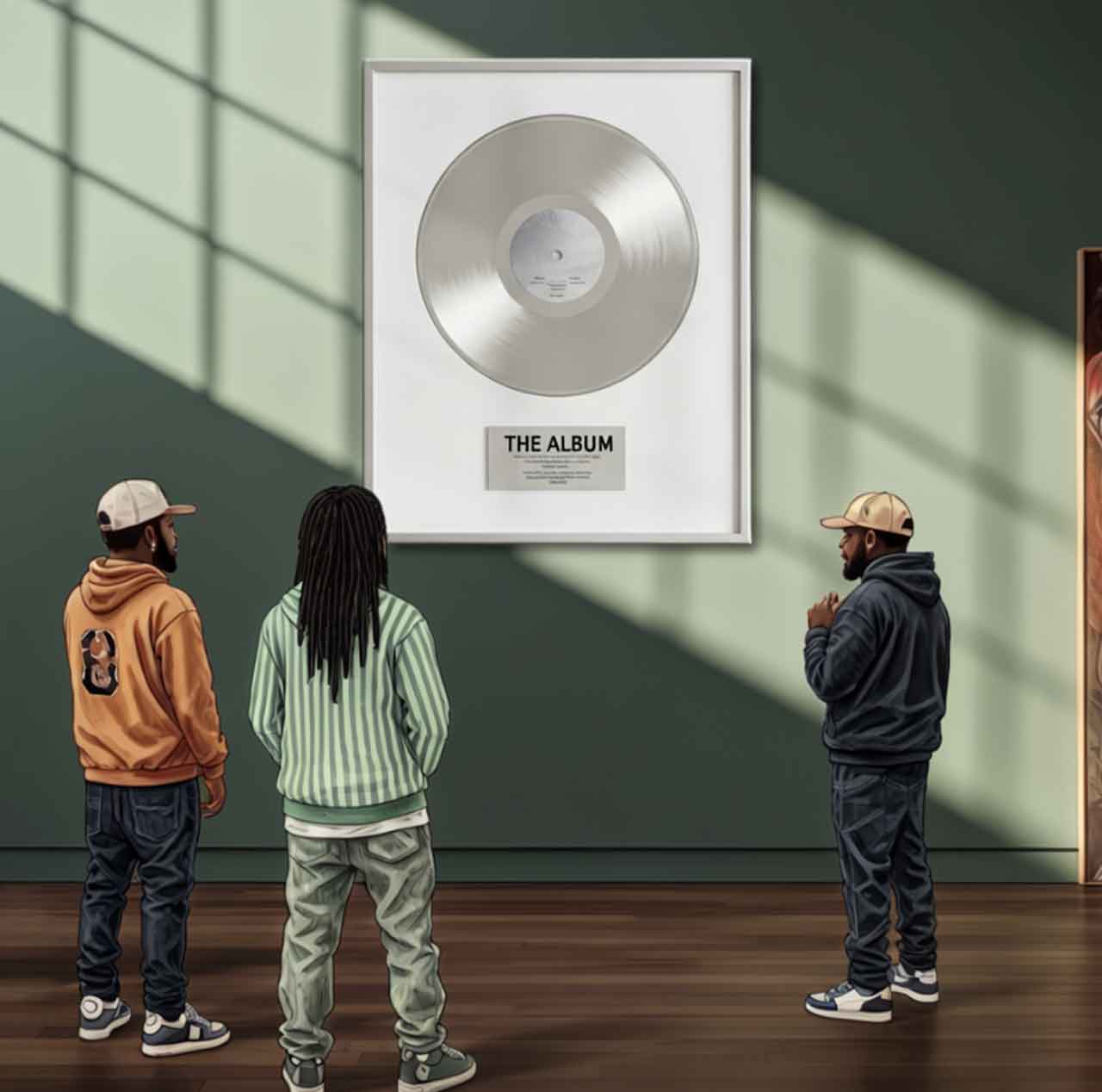
The Album doesn’t arrive until November. But months before anyone can stream it, $420,750 has already been raised around the project — and the explanation could point toward a radically different future for independent music.
There is a number sitting next to Ceno’s new album that, at first glance, doesn’t make much sense.
$420,750.
The album isn’t platinum.
It isn’t gold.
It hasn’t debuted at Number One.
It hasn’t debuted anywhere.
It hasn’t even been released.
Ceno’s forthcoming project, The Album, isn’t scheduled to arrive until November 6, 2026.
Yet somehow, months before release day, hundreds of thousands of dollars have already gathered around it.
To understand why, you have to look somewhere most music fans probably wouldn’t think to look.
Not Spotify.
Not Apple Music.
Not Billboard.
A platform called Imblem.
Open the page for The Album and it initially resembles something closer to a financial dashboard than an album preorder.
There is a price.
$30.
There is an open.
A 24-hour high.
A 24-hour low.
A market cap.
And then there is that number again:
Volume: $420.750K.
But scroll farther.
That’s where the story changes.
Under “Funding Progress,” Imblem doesn’t describe the $420,750 as streams, royalties already earned or some estimated future valuation.
It says:
$420,750.00 raised.
And suddenly this stops looking like merely an unusual album rollout.
It starts looking like an experiment in what an album can become before it is released.
The $30 Clue
Ceno had already hinted publicly that something unusual was happening.
In an Instagram post under @ceno700, an image of the Imblem milestone declared the project “up $420k before it’s released” and thanked those who had invested.
Without context, the claim sounds almost unbelievable.
Thirty dollars into an unreleased album?
Hundreds of thousands raised?
What exactly is being bought?
The Imblem page provides more of the answer.
A Creative Unit for The Album is listed at $30. The platform says 30 percent of royalties go to holders, while 70 percent are retained by the creator.
Then comes another detail.
The term isn’t listed as a year.
Or five years.
Or 30 years.
It says:
Perpetual.
That word changes the nature of the proposition.
This isn’t presented as simply buying an album before everybody else.
It isn’t the familiar crowdfunding bargain of paying today for merchandise tomorrow.
Imblem appears to be attempting something different:
turning support for a creative project into an ongoing economic relationship.
And Ceno may have become an unusually visible test of whether audiences actually want that relationship.
Why $420,750 Matters
There is an important distinction here.
The page does not say Ceno personally earned $420,750.
It does not say The Album has already generated $420,750 in royalties.
It says $420,750 has been raised.
That distinction actually makes the story more interesting.
Because the money is arriving before the traditional product.
For most of recorded-music history, somebody had to take the risk first.
Artists needed studio time.
Producers.
Engineers.
Mixing.
Mastering.
Artwork.
Videos.
Marketing.
Publicity.
The money had to come from somewhere before anyone knew whether the record would succeed.
Historically, record companies helped solve that problem.
They supplied capital.
And because they supplied capital, they gained leverage.
Digital distribution weakened one part of that arrangement. Artists no longer necessarily need a major company simply to make their music available around the world.
Social media weakened another.
Artists can communicate directly with audiences.
But one enormous problem remained:
Who pays before the music starts making money?
Ceno’s $420,750 raises the possibility of a very different answer.
Maybe the audience can become part of that equation.
That’s Where This Becomes Revolutionary
The potentially revolutionary thing here isn’t the size of the number.
It’s the sequence.
The traditional sequence looks something like this:
Financing → Creation → Marketing → Audience → Release → Revenue.
Someone finances the artist.
The artist creates.
Money is spent marketing the work.
An audience is assembled.
The music is released.
Revenue hopefully follows.
But Ceno’s experiment suggests those stages don’t necessarily have to remain separate.
Capital can arrive while the audience is forming.
The people providing some of that capital can become the community.
The community can generate attention.
Attention can become marketing.
The music can eventually produce royalties.
And the platform’s stated royalty structure connects holders with a portion of those economics.
Instead of building the financial machine, fan community and marketing campaign one after another, an artist could potentially build them simultaneously.
That is a much bigger proposition than crowdfunding.
It is an attempt to reorganize the architecture surrounding an independent release.
There’s Another Layer
The financial component isn’t the only unusual thing buried on the page.
Imblem also describes something called Creative Unit Studio Exclusive.
Buy at least one active unit, the page says, and holders can unlock studio access.
What kind of access?
Live streams.
Process videos.
Early access.
Community Q&As.
Now the architecture becomes clearer.
This isn’t merely an attempt to connect an album with financial participation.
It combines relationships that used to exist separately.
Fan club.
Crowdfunding campaign.
Behind-the-scenes membership.
Album financing.
Royalty participation.
Community.
All centered around one creative work.
The Fan Who Has a Reason to Care
Imagine two people on November 6.
One discovers Ceno through an algorithm.
Maybe they listen.
Maybe they don’t.
The second has been watching The Album for months.
They financially participated.
They watched the funding number rise.
They saw studio material.
They joined the community.
They know part of the royalty structure is allocated to holders.
Which person is more likely to listen immediately?
More importantly:
Which person is more likely to tell somebody else?
That may be the hidden engine behind the entire model.
The modern music business has an abundance problem.
There isn’t a shortage of songs.
There is a shortage of attention.
Artists release into an ocean of music every day.
What if an economically aligned audience behaves differently from a passive one?
If some supporters become advocates because they are emotionally and economically connected to a project, the financing mechanism has simultaneously created a marketing network.
That starts sounding less like crowdfunding.
And more like a new kind of street team.
Then You Notice the Other Numbers
There are reasons not to get carried away.
The same page says the $420,750 raised sits against a $30 million goal.
This reminds anyone looking at the project that this remains an experiment.
A Creative Unit isn’t guaranteed to appreciate.
An album isn’t guaranteed to produce substantial royalties.
A market isn’t necessarily liquid simply because an asset is listed.
But those caveats don’t erase what has happened.
They make the experiment real.
November 6
There is still one enormous unknown.
The music.
No financial innovation can make somebody love a song.
Ceno still faces the same final test every artist faces.
When people press play, does The Album deliver?
Imblem’s own description presents a project moving between street reflection, emotional confession, wordplay, experimentation and introspection.
The public will make its own judgment in November.
But that is precisely what makes what has already happened so unusual.
Usually the music arrives first.
Then comes the market.
Ceno has created significant financial activity around the project before its scheduled release.
And that leaves the music industry with a question much bigger than $420,750:
What happens when the people waiting for an album aren’t merely waiting to hear it?
If Ceno’s model proves sustainable and repeatable, the revolutionary achievement won’t be that he found a new way to sell an album.
It will be that he helped demonstrate a new way to finance, launch, market and organize a community around one before it is even released.
Check out Ceno’s new project “The Album” here: https://the-album.com