Cat Lake First Nation Expands Economic Development Presence With New Dryden Natural Resources Office
DRYDEN, Ont. — Cat Lake First Nation has expanded its economic development presence in Northwestern Ontario with the opening of a new Far North Natural Resources office in Dryden, a move the Nation says will strengthen its ability to manage resource development, forestry, energy projects and economic partnerships connected to its traditional territory.
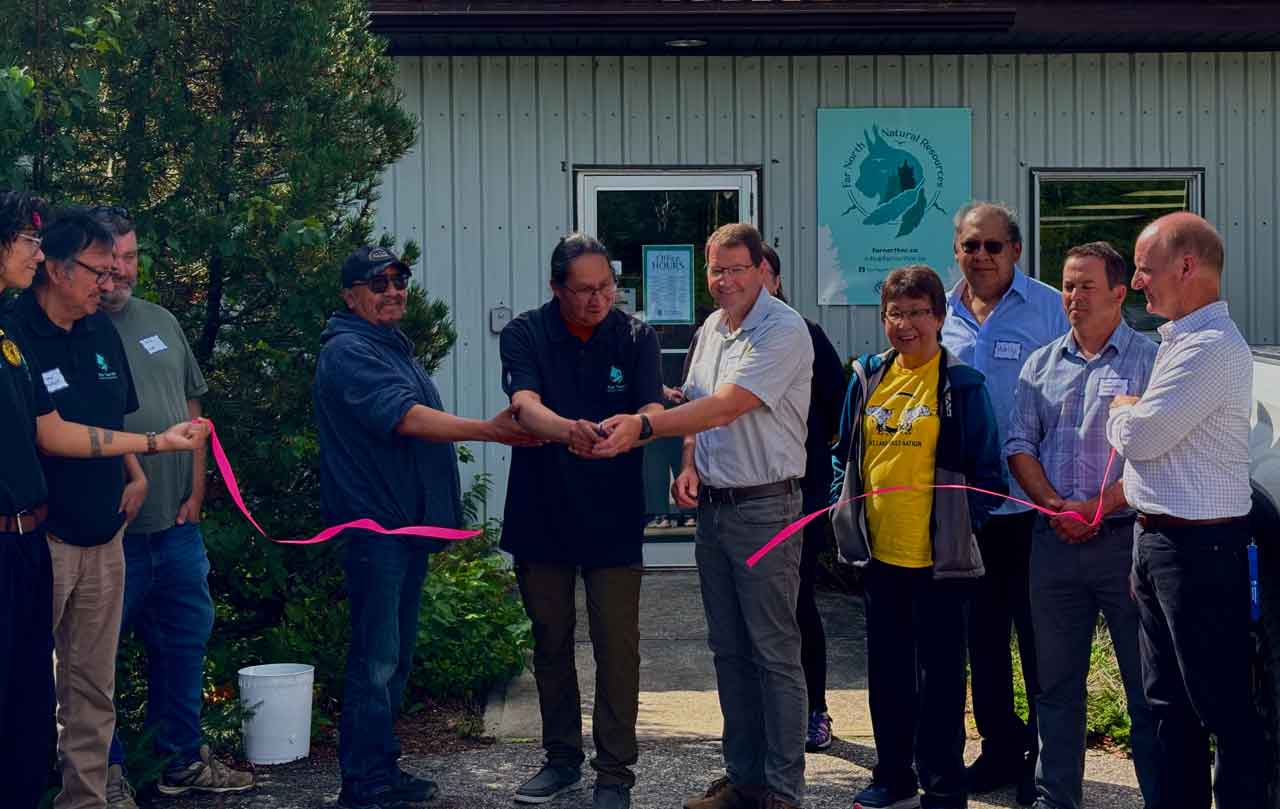
Cat Lake First Nation, Bizhiw-zaaga’iganiing Nitam Anishinaabeg, marked the opening of the office at 14378 Highway 17 East with an open house and ribbon-cutting ceremony on Aug. 26.
The expansion is part of a broader strategy centred on economic self-determination, Indigenous ownership and building the professional capacity needed to participate directly in forestry, bio-economy, energy and natural-resource development.
Chief Wesley: Focus Must Shift From Poverty Management to Wealth Creation
Cat Lake First Nation Chief Russell Wesley said the new office represents a deliberate move toward ownership and long-term economic development.
“Managing poverty is not the goal — the way forward for our people is through wealth generation, ownership of projects, and training our youth,” Wesley said.
That approach reflects a growing emphasis among First Nations across Northwestern Ontario on using resource development to build community wealth, develop local businesses and create careers for young people.
The challenge for Indigenous communities has often been that significant resource extraction has taken place within or near their traditional territories without creating equivalent levels of long-term local wealth.
Cat Lake’s approach seeks to change that relationship by developing the internal expertise required to negotiate, plan and participate directly in projects.
New Dryden Office Positions Cat Lake Closer to Regional Partners
The new office gives Cat Lake First Nation a physical presence closer to regional businesses, municipalities and federal and provincial government partners.
For a First Nation whose economic interests extend across a large traditional territory, having staff based in Dryden could make it easier to manage negotiations, technical planning, procurement and partnerships tied to resource development.
Cat Lake says the office will help advance its Cat Lake Bio-Economy Master Plan, community consultation work and regional resource-development partnerships.
The Nation is also building on a memorandum of understanding with Pikangikum First Nation connected to the Whitefeather Forest Initiative, an Indigenous-led forestry and stewardship model.
For Northwestern Ontario, the development reflects a broader shift in resource-sector relationships.
First Nations are increasingly seeking equity, ownership, employment and decision-making authority in projects affecting their lands rather than limiting participation to consultation or short-term contracting opportunities.
John Beardy Leads New Natural Resources Office
John Beardy has been appointed executive director of the new office.
Beardy previously served as director of business development for Windigo Community Development Corp. and brings experience in Indigenous economic development across Northern Ontario.
His mandate includes identifying and managing economic opportunities within Cat Lake First Nation’s traditional territory while helping develop partnerships intended to create benefits for the community and surrounding region.
“This new office and our forestry team give us the capacity to deliver projects on time, on budget, and in complete alignment with our community’s and regional values,” Beardy said.
Tracy Cote has joined the operation as finance procurement manager.
Cat Lake says Cote brings more than 20 years of experience in human resources and finance, along with knowledge of the regional economy.
Forestry Team Supports Bio-Economy and Land Stewardship Work
A specialized forestry team will support the Nation’s forestry, stewardship and bio-economy plans.
Registered professional forester Emmett Snyder joins the team as planning forester through a strategic secondment from the Whitefeather Forest Initiative.
Cat Lake says Snyder’s role will include combining Indigenous knowledge, forestry analytics and modern forest-management practices.
Camryn Bowler joins as junior forester, supporting geographic information systems, field data collection, operational work and forest-management planning.
The junior position is also intended to strengthen long-term institutional capacity by developing the next generation of forestry professionals.
That kind of expertise can be especially important as First Nations move toward becoming project owners and resource managers rather than participating only through outside consultants.
Energy Independence Part of Broader Economic Strategy
Cat Lake First Nation has also appointed Ay’Den D. Abraham as community energy champion.
The role will focus on renewable-energy and energy-efficiency projects aimed at improving the Nation’s energy independence.
Energy costs and reliability remain major challenges for many remote and northern First Nations.
Locally controlled renewable-energy projects can potentially reduce operating costs while creating training, employment and ownership opportunities.
For Cat Lake, energy development is being positioned as part of the same economic strategy as forestry and the bio-economy: building local capacity so the Nation can exercise greater control over development affecting its people and lands.
Why the Dryden Location Matters
Dryden is strategically located along the Trans-Canada Highway and serves as an important regional service, transportation and business centre.
Establishing a natural-resources office there gives Cat Lake easier access to forestry companies, professional services, government offices and other First Nations organizations operating across the Northwest.
It also gives the Nation a stronger regional presence as Northwestern Ontario prepares for potential expansion in mining, forestry, critical minerals, energy infrastructure and associated transportation projects.
Those developments are likely to increase the importance of Indigenous ownership, procurement and partnership agreements.
First Nations that have their own forestry, financial, legal, technical and project-management expertise are generally in a stronger position to evaluate proposals and determine whether those projects align with community priorities.
Bio-Economy Could Create New Forestry Opportunities
The Cat Lake Bio-Economy Project is intended to create more value from forest resources while supporting sustainable land management.
Bio-economy projects can include using forest biomass and residual material for energy, heating, manufactured products and other value-added uses.
For Northern Ontario, that can mean extracting greater economic value from forestry operations while potentially making use of material that would otherwise have limited commercial value.
For Cat Lake First Nation, the larger objective is to ensure the Nation has a direct role in determining how resources are developed and where the economic benefits flow.
The partnership with Pikangikum’s Whitefeather Forest Initiative may also provide important experience in Indigenous-led forestry planning and stewardship.
Regional Economic Development Through Indigenous Ownership
The opening of the Dryden office is more than an administrative expansion.
It represents an effort to build the professional infrastructure required for First Nation-led economic development.
Foresters, finance and procurement specialists, energy planners and economic-development staff provide the technical capacity required to negotiate with governments and industry on more equal footing.
That could produce benefits beyond Cat Lake.
Successful Indigenous-led forestry, energy and bio-economy projects can generate contracts for regional suppliers, create skilled employment and encourage additional investment throughout Northwestern Ontario.
The model also creates opportunities for First Nations to work with one another on projects rather than approaching each development independently.
Chief Wesley thanked Dryden Mayor Jack Harrison and senior municipal staff for helping Cat Lake First Nation secure the office lease.
As major resource-development decisions continue across Northwestern Ontario, the new office puts Cat Lake First Nation in a stronger position to participate not simply as a community being consulted, but as an owner, manager and economic partner.