Aug. 26 news: Canada-U.S. tariffs, Hormuz tensions, Ring of Fire roads and Thunder Bay updates
THUNDER BAY — Canada’s rapidly escalating trade confrontation with the United States leads the news Wednesday, Aug. 26, with Ottawa now putting precise numbers and products behind its promised retaliation against U.S. President Donald Trump’s tariffs.
Internationally, Iran and Oman are again discussing how to move commercial vessels through the largely closed Strait of Hormuz, while new diplomatic activity surrounding Russia’s war against Ukraine deserves close attention.
For Northwestern Ontario, the global stories come home quickly. Tariffs can affect forestry, mining equipment and household prices; disruption in Hormuz can move fuel and transportation costs; Ontario is increasingly treating Northern critical minerals as strategic leverage; and construction tied to the Ring of Fire continues to accelerate.
Locally, Wednesday begins with tragedy after a 19-year-old Thunder Bay woman died following Tuesday’s collision between a passenger vehicle and a tractor-trailer on Highway 11/17.
The NewsHawk Morning File — Wednesday, Aug. 26, 2026
The stories NetNewsLedger NewsHawks should have at the top of the file this morning are the Canada-U.S. tariff escalation, the Strait of Hormuz, renewed Ukraine diplomacy, Ontario’s increasingly aggressive response to Washington, Ring of Fire road construction, the continuing Northwest wildfire season and two serious Thunder Bay public-safety stories.
NATIONAL — Canada puts $27.6 billion in retaliatory tariffs on the table
Ottawa has now released the details of Canada’s next round of counter-tariffs against the United States.
Finance Canada announced Tuesday that tariffs of 15, 25 and 50 per cent will take effect Sept. 8 on U.S. goods representing $27.6 billion in imports.
The government says the tariffs are intended to match the latest U.S. measures dollar for dollar and rate for rate.
Products covered include goods in sectors such as steel, dairy, appliances, agricultural equipment, pulp and paper and electronics. Some fish and seafood products, cheese, clothing, machinery and other consumer and industrial goods are also included.
Ottawa also announced $7.5 billion in new and enhanced support measures for Canadian workers and businesses affected by the trade dispute.
This is no longer a negotiating threat.
The U.S. imposed its latest 50-per-cent tariffs on Canadian products on Aug. 22 after trade negotiations collapsed. Unless there is another political intervention, Canada’s response begins at 12:01 a.m. Sept. 8.
For Northwestern Ontario, watch agricultural and industrial equipment, electronics, steel products and other inputs used by mining, forestry, construction and small businesses.
Retaliatory tariffs are designed to put pressure on Washington, but Canadian importers initially pay Canadian tariffs. Depending on how businesses respond, some of those costs can eventually move through to customers.
That makes the trade fight both an export problem and an affordability story.
NATIONAL — Canada-U.S. dispute is increasingly about sovereignty, not simply tariffs
The breakdown between Prime Minister Mark Carney and the Trump administration is now wider than a disagreement over tariff percentages.
Carney says late-stage American demands included restrictions on Canada’s ability to negotiate future trade agreements, unacceptable treatment of Canadian-made medium- and heavy-duty trucks and proposals involving Canadian cultural and French-language policies.
Washington disputes Canada’s account and says Ottawa changed its demands after significant progress had been made.
The complete negotiating text has not been released, making it impossible to independently establish every detail of the competing accounts.
What is clear is that formal negotiations ended Friday and the two countries are now moving further into retaliation.
Trump has separately threatened tariffs of 50 per cent on Canadian cars, trucks and automotive parts beginning Jan. 1, 2027.
For the Northwest, the larger question is Canada’s freedom to diversify its economy.
If Ottawa’s goal is to sell more minerals, lumber, energy and other Canadian products to Europe and Asia, Canada’s ability to make independent trade agreements becomes highly relevant to future Northern Ontario development.
INTERNATIONAL — Iran and Oman work on a temporary route through the Strait of Hormuz
The most important international economic story for Northwestern Ontario remains the Strait of Hormuz.
Iran and Oman have restarted discussions aimed at establishing a temporary shipping corridor through the strategic waterway, which remains largely closed almost six months into the conflict involving Iran and the United States.
Reuters reports the discussions include a temporary navigation lane while the two countries work toward a more permanent arrangement.
The negotiations follow continuing danger at sea. An oil tanker was recently disabled in an attack off Oman, while Iran has threatened action against vessels it says have violated its rules for using the strait.
Washington has meanwhile imposed another round of economic sanctions intended to further isolate Iran.
Why should Thunder Bay care about a narrow waterway thousands of kilometres away?
Fuel.
Hormuz is one of the world’s most strategically important energy corridors. Serious disruption can affect global oil prices, which can eventually reach Northwestern Ontario through diesel, gasoline and aviation-fuel costs.
That matters disproportionately in a region where mines, forestry operations, trucking companies, contractors and remote First Nations depend heavily on transportation.
A temporary shipping corridor would reduce some pressure, but an agreement has not yet produced a normal reopening of the strait.
That distinction is important.
INTERNATIONAL — Watch renewed diplomatic activity around Ukraine
There are also unusual signs of diplomatic activity surrounding Russia’s war against Ukraine.
Reuters reports U.S. CIA Director John Ratcliffe travelled to Moscow Tuesday for meetings with Russian officials, according to U.S. media reports citing unnamed sources.
At the same time, Ukrainian President Volodymyr Zelenskyy says he sees a window through the summer of 2027 for meaningful U.S.-mediated diplomacy.
Ukraine has been working with American and European officials on a proposal that reportedly includes a ceasefire and an arrangement involving part of the eastern Donbas region. Russia continues to insist that any settlement recognize what Moscow calls the realities on the ground.
There is no peace agreement, and fighting continues.
Russian President Vladimir Putin has also issued a decree allowing the Russian government to temporarily take control of critical infrastructure where private owners fail to protect or repair facilities damaged by Ukrainian drone attacks. Ukraine has been expanding attacks against Russian oil, logistics and industrial targets.
For Canada, the story matters because Ottawa remains a major political and military supporter of Ukraine.
For Northwestern Ontario, there is also an economic connection. The war continues to influence global energy, fertilizer, commodity and defence markets, while European efforts to secure critical minerals increasingly overlap with Canada’s own mineral-development ambitions.
INTERNATIONAL — China continues building its position in the South China Sea
Another strategic story worth watching involves China.
Satellite imagery reviewed by Reuters shows new installations on an islet near Antelope Reef in the disputed Paracel Islands. Analysts told Reuters some structures could eventually support early-warning radar as China expands its military presence in the South China Sea.
The South China Sea carries an enormous volume of international commerce.
Further militarization matters to Canada because supply chains for electronics, manufacturing, shipping and critical minerals are closely connected to Asia.
For Northwestern Ontario, this is part of the larger reason governments increasingly describe nickel, lithium, copper and other minerals as strategic rather than simply commercial commodities.
Economic security and national security are becoming increasingly difficult to separate.
ONTARIO — Doug Ford says Trump can ‘kiss my ass’ — but the policy threats matter more
Ontario Premier Doug Ford continues to take one of the most confrontational positions of any Canadian leader toward Trump.
Ford told an Ottawa radio program Monday that the U.S. president could “kiss my ass,” then repeated the sentiment when reporters asked about it later that day.
The remark generated headlines, but the policy underneath the rhetoric matters more.
Ford says Ontario should be prepared to make the United States “feel pain” if Washington continues targeting Canada.
He has again raised the possibility of increasing the price of electricity exported to the United States and restricting American access to Canadian critical minerals.
Ford has said that as the confrontation escalates, everything should remain on the table.
That puts Northwestern Ontario directly into the discussion.
Ontario’s greatest undeveloped concentration of strategic minerals is in the North. The Ring of Fire contains significant deposits of chromite, nickel, copper and platinum-group metals, while lithium development is advancing elsewhere across Northwestern Ontario.
A dispute that began over tariffs is increasingly turning Northern Ontario’s natural resources into geopolitical leverage.
That raises a crucial question for the region: if critical minerals become bargaining power for Canada and Ontario, what role will the First Nations whose territories contain those resources have in determining how that leverage is used?
REGIONAL — Aroland road construction pushes Ring of Fire development forward
The Ring of Fire road network is moving from political promise toward construction.
Ontario and Aroland First Nation say work is underway on major upgrades to the Anaconda and Painter Lake roads.
The project involves 97 kilometres of roadway and the replacement of 62 culverts, with work intended to connect Highway 643 to proposed all-season roads leading toward the Ring of Fire.
Preliminary design and early work began in June.
Ontario says the expanded roads are scheduled to open by November 2030.
The province’s broader accelerated schedule calls for the Webequie Supply Road, where construction began in June, to open by November 2030. Ontario says construction on the Marten Falls Community Access Road is scheduled to begin this month and the Northern Road Link is targeted to begin construction in spring 2028, subject to approvals and consultation.
For Thunder Bay, this could eventually mean increased demand for engineering, construction, transportation, aviation, environmental services, mining supplies and professional services.
For First Nations, the picture is more complex.
Aroland, Webequie and Marten Falls have entered agreements or partnerships connected to various road projects. Other First Nations have different positions on the pace, environmental consequences and governance of Ring of Fire development.
Those distinctions matter. “First Nations support” should never be treated as though every Indigenous community has one position.
REGIONAL — Northwest wildfire emergency is easing, but it is not over
Northwestern Ontario’s extraordinary wildfire season remains an important regional story even as fire behaviour moderates.
The latest detailed Northwest Region update available entering Wednesday reported 64 active wildland fires as of the evening of Aug. 24.
Five were not under control, three were being held, 12 were under control and 44 were being observed.
The Rinker Lake Complex remains enormous.
Thunder Bay 36 was listed at approximately 301,240 hectares, Dryden 34 at 45,800 hectares and Dryden 35 at 30,158 hectares. All three remained classified as not under control in that update, although fire activity across the complex was described as low.
Ontario firefighters continue to receive assistance from crews from Mexico.
The number of active fires has fallen substantially from earlier in August, when the Northwest Region had more than 100 active fires.
That is encouraging.
But for First Nations that evacuated residents or lost homes and community infrastructure this summer, the story now shifts toward recovery, rebuilding and scrutiny of Canada’s and Ontario’s emergency-response systems.
NewsHawks should continue following housing, transportation, mental-health supports, infrastructure restoration and the return of evacuees — not simply the daily fire count.
LOCAL — 19-year-old Thunder Bay woman dies in Highway 11/17 collision
The most serious immediate local story Wednesday morning is a fatal collision on Highway 11/17.
Ontario Provincial Police say emergency crews responded at about 12:30 p.m. Tuesday to a collision involving a passenger vehicle and a tractor-trailer near Highway 11/17 and Mapleward Road.
A 19-year-old Thunder Bay woman was taken to hospital and pronounced dead.
Police had not publicly released her name early Wednesday or provided information establishing what caused the collision.
The highway was closed for several hours as police investigated and fully reopened Tuesday night.
OPP are asking anyone who witnessed the collision or has dash-camera footage to contact police.
This intersection and the broader Highway 11/17 corridor carry large volumes of local, commercial and Trans-Canada traffic.
Beyond Tuesday’s tragedy, road safety along Thunder Bay’s highway approaches remains an important transportation-policy issue deserving continued scrutiny.
LOCAL — Thunder Bay Police investigate sudden death in Waverley Park
Thunder Bay Police are separately investigating the discovery of a deceased person in Waverley Park.
Police were called to the park Tuesday morning, and several police vehicles were visible near a tent surrounded by police tape.
The incident is being investigated as a sudden death.
Police had not publicly provided information establishing the identity of the deceased or the circumstances of the death in the reporting available early Wednesday.
A sudden-death investigation does not by itself indicate criminal activity.
NewsHawks should watch for an update from Thunder Bay Police concerning whether the Major Crime Unit, coroner or other investigative resources have become involved and whether police believe there is any public-safety concern.
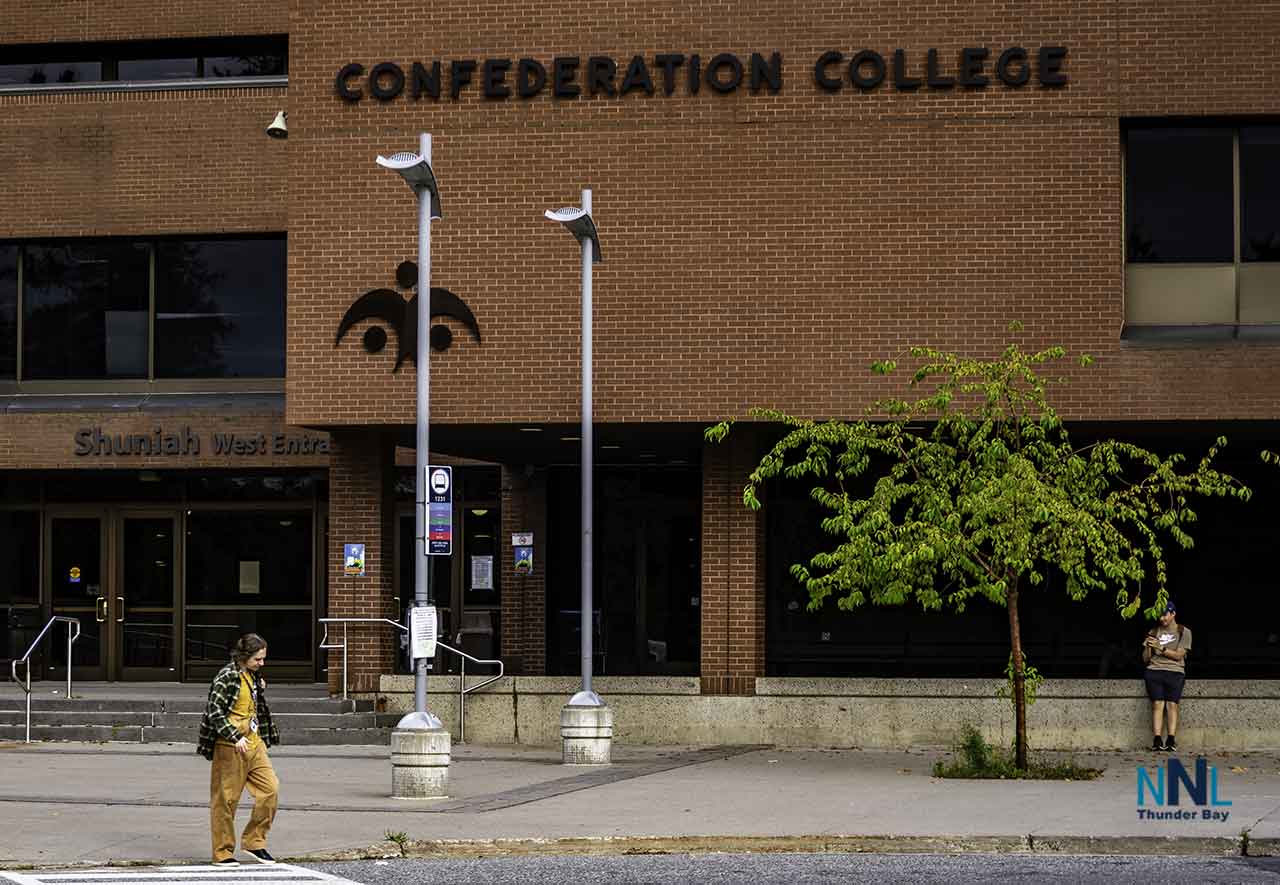
LOCAL/REGIONAL — Confederation College pressures deserve close attention
Another story to keep on the local and regional radar involves Confederation College.
This deserves sustained follow-up because Confederation College is not simply a Thunder Bay institution.
Its regional network connects learners in communities including Dryden, Fort Frances, Kenora, Greenstone, Marathon, Red Lake and Sioux Lookout to post-secondary education and workforce training.
The college has already faced significant financial pressure following changes to federal international-student policy, declining international enrolment and long-standing concerns across Ontario’s college system about operating funding.
Any further reduction in regional programming has consequences beyond education.
Northern communities depend on locally accessible training to develop nurses, personal support workers, skilled tradespeople, business workers and other professionals. Losing local education options can mean losing young people who leave their community for training and do not return.
That makes this an economic-development, health-care and population-retention story as much as a post-secondary education story.
THE NORTHWESTERN ONTARIO CONNECTION — Trade, minerals and transportation are converging
There is a common thread running through many of Wednesday’s biggest stories.
The Canada-U.S. tariff fight is forcing Canada to think harder about economic independence.
The Iran conflict demonstrates the vulnerability of global energy routes.
The Ukraine war is driving demand for strategic materials and defence production.
China’s expanding military footprint is increasing Western concern over supply-chain security.
Ontario is responding by accelerating roads toward mineral deposits in the Far North.
And Doug Ford is now openly talking about those minerals as leverage against the United States.
That convergence places Northwestern Ontario in a position of growing national importance.
The challenge is ensuring that importance produces lasting regional benefits.
For Thunder Bay, that means asking whether mineral development leads to processing, transportation, supply businesses, research, training and employment in the city rather than simply moving raw material south.
For First Nations, it means questions of jurisdiction, consent, environmental stewardship, ownership, procurement, jobs and revenue must remain central rather than becoming secondary to an Ottawa-Washington trade confrontation.
For the public, it means understanding that developments in Washington, Tehran, Moscow and Beijing can increasingly have direct consequences in Thunder Bay, Red Lake, Sioux Lookout, Geraldton and remote First Nations.
What NewsHawks should watch today
The Canada-U.S. trade file remains the dominant story. Watch for Washington’s response to Canada’s detailed counter-tariff list and any indication that either side is attempting to reopen negotiations before Sept. 8.
On the international desk, watch whether the Iran-Oman discussions produce an operational shipping corridor through Hormuz and whether the reported U.S. intelligence contacts in Moscow generate any movement on Ukraine.
Across Northwestern Ontario, watch the Marten Falls road construction timetable, Indigenous responses to Ontario’s accelerated Ring of Fire strategy and the continuing transition from wildfire suppression to recovery.
In Thunder Bay, the Highway 11/17 fatal-collision investigation and the Waverley Park sudden-death investigation are the immediate public-safety stories.
The broader theme Wednesday morning is increasingly clear: events that once appeared distant from Northwestern Ontario — international conflicts, continental trade negotiations and strategic competition over minerals — are now reaching directly into the region’s economy, transportation system and development decisions.
That makes the North less peripheral to Canada’s national conversation than it has been for decades.