On July 3, Rashad Robinson took a stage in New Orleans built around a case study in what has led to the loss of power among groups and movements aligned with progressive ideals. Three weeks later, One World releases the book he wrote on how to build that power again.
Robinson appeared on the Global Black Economic Forum stage at the 2026 Essence Festival of Culture alongside Sen. Cory Booker, Rep. Jasmine Crockett and Congressional Black Caucus Foundation CEO Nicole Austin-Hillery, in a conversation the festival billed as a discussion of Black political and economic power. The panel wasn’t scheduled in a vacuum. Global Black Economic Forum President and CEO Alphonso David told Verite News that the forum built its 2026 programming around the fallout from a Supreme Court ruling that had just weakened federal protections against discriminatory redistricting, and around Louisiana’s response to it. “We see value in going to where the fight is,” David said.
What the Court Changed
On April 29, the Supreme Court ruled 6-3 along ideological lines in Louisiana v. Callais that the state’s second majority-Black congressional district was an unconstitutional racial gerrymander. “Correctly understood, Section 2 does not impose liability at odds with the Constitution, and it should not have imposed liability on Louisiana for its 2022 map,” Justice Samuel Alito wrote for the majority. The ruling requires Section 2 plaintiffs to show discriminatory intent behind a map, not just a discriminatory result, a bar civil rights attorneys have long considered close to impossible to clear. Case Western Reserve law professor Atiba Ellis told NPR the new standard amounts to demanding “a smoking gun” in an area where lawmakers rarely put racial motives in writing.
Justice Elena Kagan’s dissent, joined by the court’s two other liberal justices, did not mince the stakes: “the Court’s decision will set back the foundational right Congress granted of racial equality in electoral opportunity.” UCLA election law scholar Rick Hasen went further, calling it “one of the most important and most pernicious decisions of the Supreme Court in the last century.” An NPR analysis published before the ruling estimated that a decision narrowing Section 2 this way could put at least 15 House districts currently held by Black members of Congress at risk. A separate legal analysis in SCOTUSblog noted the ruling also lets states justify a map by pointing to a “specified political goal,” such as a target number of Republican-held seats, and requires courts to treat that goal as legitimate even when the map built around it reduces Black voters’ chances of electing a candidate of their choice.
Louisiana did not wait to test the new standard.
The Map That Followed
Gov. Jeff Landry postponed the state’s May 16 primaries so lawmakers could redraw the congressional map before the fall midterms. On May 29, the legislature passed a map that eliminated the district held by Democratic Rep. Cleo Fields, a Baton Rouge-to-Shreveport seat that existed because a federal court had ordered it drawn in 2022 after finding the prior map diluted Black voting power. The state kept its other majority-Black district, the New Orleans-based seat held by Democratic Rep. Troy Carter, while splitting Baton Rouge’s Black population between two districts and folding Shreveport into the rest of northwest Louisiana. Republican lawmakers described the redraw as a partisan decision, not a racial one, the same defense Callais had just made nearly impossible to rebut in court.
Louisiana was not alone. Tennessee had already eliminated its only majority-Black district, in Memphis, and Alabama, Georgia and Mississippi moved toward comparable changes in the weeks that followed. A federal court has since blocked Alabama’s attempt to revive its own version of the change, the clearest sign yet that the post-Callais redistricting wave hasn’t gone entirely unchecked.
The Global Black Economic Forum built programming to address that broader pattern, not just the Louisiana map. Aaliyah Haqq, chief operating officer of the forum’s Academy for Advancing Excellence, told Verite News the group added health-focused sessions this year to address new Medicaid work requirements and proposed federal health spending cuts, reasoning that “Black folks have been disproportionately affected by all of the changes in the administration.” The redistricting panel sat inside programming the forum described as covering “the future of wealth, health, work and democracy,” not as an isolated political segment.
A Book About the Gap Between Visibility and Leverage
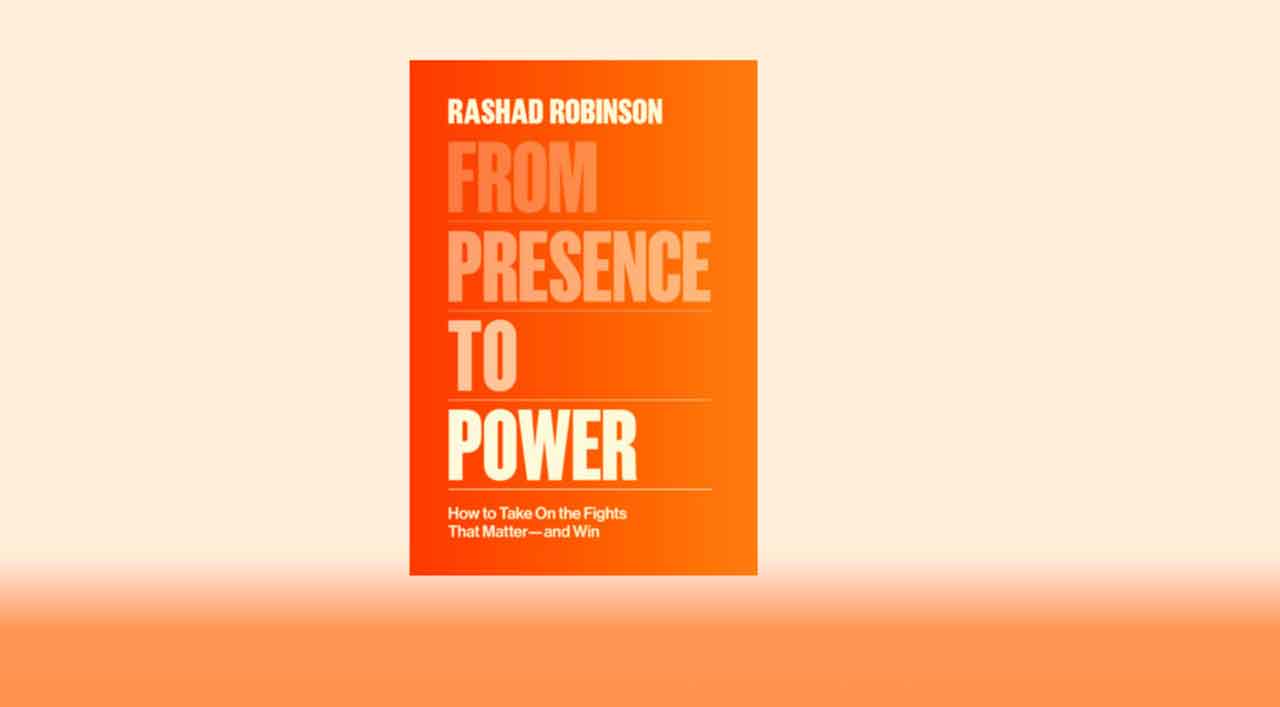
The fight Robinson walked into on that stage maps closely onto the argument at the center of “From Presence to Power,” out July 28 from One World. Its premise: achieving presence, meaning visibility, media coverage and popular sympathy, is a different achievement than gaining the leverage needed to change what legislatures, courts and corporate executives actually decide. Louisiana’s redistricting fight generated plenty of presence. National news coverage. A delayed primary. A Supreme Court opinion dissected by legal scholars within days of its release. It did not generate a second majority-Black congressional district. That district no longer exists.
Robinson, who served as president of Color of Change from 2011 to 2024 and now runs his own advisory practice while collaborating with leaders and organizations on designing high-impact campaigns to advance social change, built the book’s framework out of two decades of campaigns against corporations, Hollywood studios and elected officials. ACLU Executive Director Anthony Romero’s blurb for the book credits him with “an analysis of roles, rules, and results” that he calls a way out of the wilderness progressives currently occupy. Robinson put it more plainly himself, weeks after Louisiana’s map passed: “It’s a book about power, about the magical thinking that stands in the way of social change,” he told Don Lemon, adding that it also takes on “how do we take on profiteers” and “how do we keep the culture of belief alive”. The book’s own description names ten core principles for converting visibility into what it calls structural change.
The Essence Fest panel is not incidental to the book’s release. Robinson’s own event calendar lists the July 3 Global Black Economic Forum panel as the opening date on a circuit that runs through a July 27 launch event in New York with Jane Fonda, a July 28 Washington event with Joy-Ann Reid at Politics and Prose, and stops in San Francisco and Los Angeles the two days after that. The panel came first, ahead of any event built around the book itself, and it happened on a stage organized around the exact kind of loss the book spends 400 pages trying to help readers prevent.
A Live Test of the Framework
Louisiana v. Callais makes an unusually clean test case for that framework because it leaves little ambiguity about what presence without power looks like. Civil rights organizations tracked the underlying case for years. Voters cast tens of thousands of mail ballots for a primary that got postponed anyway. Legal scholars and election experts produced detailed critiques of the ruling within days. None of it stopped the legislature from passing a map that erased Cleo Fields’ seat months before voters would have used it at the ballot box in the rescheduled Nov. 3 primary.
Asked directly about the ruling on The Don Lemon Show weeks after Louisiana’s new map passed, Robinson didn’t point to more visibility as the fix. “We will need over participation to make sure that our voices are heard,” he said. “We’re going to need people to turn out in numbers like we haven’t seen in a lot of places to ensure that we get a fair shot. And what we know is because they can’t convince the people to stand with them, they’re going to have to cheat at every turn.” He was just as direct about where he thinks that turnout has to be organized from: “We’re not going to be able to count on Democratic elected officials to lead us out of this,” he said. “It will be movements and communities”.
Sharing a stage with a sitting senator and a sitting House member gave Robinson a different institutional vantage pointon that fight than any advocacy organization that spent the spring litigating and lobbying against the new map. By his own account, that vantage point isn’t the thing that decides whether Louisiana’s rescheduled Nov. 3 primary looks like power built from presence, or one more instance of the gap his book is about to spend 400 pages describing. Turnout is.