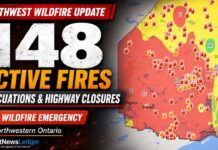
Northwestern Ontario Wildfire Update: Evacuations Continue as Thunder Bay Services Begin to Resume
THUNDER BAY — Ontario Provincial Police continue to support wildfire evacuations and enforce highway closures across Northwestern Ontario, while improving air quality is allowing some City of Thunder Bay services to resume.
The regional emergency remains active. Several communities continue to face evacuation orders or alerts, Thunder Bay is accommodating displaced residents, and smoke is reducing visibility along parts of the provincial highway network.
OPP Supporting Evacuations and Enforcing Road Closures
The OPP North West Region has deployed Aviation Services, the Emergency Response Team, the Provincial Liaison Team and operational support personnel to assist the Ministry of Natural Resources and affected communities.
Officers are helping with evacuations, enforcing road closures and supporting public safety operations in collaboration with Indigenous communities, municipal governments and other emergency-management partners.
Police say residents under mandatory evacuation orders must leave immediately and travel away from active wildfire areas. People in communities under alerts or being monitored should remain prepared to leave on short notice.
Wildfire conditions can change quickly because of wind, temperature, humidity and available forest fuels. The Ministry of Natural Resources says protecting lives, critical infrastructure and firefighting personnel remains the priority.
While there has been precipitation in the Thunder Bay, Atikokan and Fort Frances regions, it is likely not enough to seriously impact the wildfire situation.
Highway 599 and Highway 527 Closures
The following highway closures remained in effect in both directions, except for authorized local evacuation traffic:
Highway 599 between Highway 516 and Mishkeegogamang First Nation; and
Highway 527 at Gull Bay First Nation.
Drivers should confirm conditions through Ontario 511 before travelling. Smoke can sharply reduce visibility, and closures may change as fire behaviour and emergency operations evolve.
The OPP warns that entering an evacuated area without authorization can endanger residents, police officers and other emergency responders.
Police say drivers who disregard road-closure signs could face a $110 fine and three demerit points.
Thunder Bay Air Quality Showing Improvement
The City of Thunder Bay reported Sunday that the Air Quality Health Index remained in the very high-risk range but was forecast to improve later in the day and during the coming days.
City crews are resuming some outdoor work with added precautions, including respiratory protection where appropriate, more frequent breaks and continued monitoring of smoke conditions.
The City had previously closed several outdoor programs and facilities because of extremely poor air quality.
Residents should continue checking current air-quality information before exercising, working or spending extended periods outdoors. Children, older adults, pregnant people and people with heart or breathing conditions may be more affected by wildfire smoke.
City Splash Pads Reopen; Pools and Beaches Remain Closed
The following splash pads reopened Sunday:
County Park;
Franklin Street;
North End Park; and
Northwood Playfield.
Municipal golf courses are monitoring conditions and will reopen when air quality permits.
Golfers with scheduled tee times are expected to be contacted directly, with additional updates posted at the courses and through City social-media channels.
Outdoor pools and beaches remain closed, along with the splash pad at Marina Park and Prince Arthur’s Landing.
The City says it is prepared to adjust operations again if air quality deteriorates.
Garbage Collection Resuming
Collection crews are picking up garbage from businesses and multi-residential buildings Sunday and Monday.
Regular residential garbage collection is expected to resume during the week.
Residents should watch for additional City notices because smoke, road conditions and worker-safety requirements could affect schedules.
Thunder Bay Supporting Regional Evacuees
Thunder Bay continues to serve as an important transportation and accommodation centre during the regional wildfire emergency.
Evacuees are being housed at locations across the city, while others are travelling through Thunder Bay International Airport on their way to host communities in Southern Ontario.
This role places additional pressure on hotels, emergency shelters, transportation providers, health-care services and community organizations. It also demonstrates Thunder Bay’s position as the primary service and transportation hub for much of Northwestern Ontario.
The emergency has had a particularly serious effect on remote First Nations, where road access may be limited and evacuations often depend on aircraft. Evacuations can separate families from their communities, health services, cultural supports and regular sources of food and medication.
Where Donations Are Being Accepted
The City says donations for evacuees continue to be accepted at:
Superior Inn;
the Avila Centre at Lakehead University.
Non-perishable food can be donated to the Regional Food Distribution Association.
Monetary donations are being accepted through the United Way of Thunder Bay.
People planning to donate should confirm what items are currently needed before attending a collection location. Unrequested goods can create storage and distribution challenges during emergency operations.
Restricted Fire Zone Remains in Effect
A Restricted Fire Zone remains in effect across the Northwest Fire Region and part of the Northeast Fire Region.
Open-air burning, including campfires, is prohibited within the restricted zone. Burning permits are suspended until the order is lifted. Portable gas or propane stoves may be used with extreme caution.
Municipal fire bans may impose additional restrictions. Residents and visitors must follow both provincial and municipal rules where both apply.
The restricted zone was imposed because of high-to-extreme fire danger, the number of active fires and the need to prevent additional human-caused fires.
What to Bring During an Evacuation
People preparing to evacuate should take essential items, including:
prescription medication and basic medical supplies;
identification and important documents;
mobile devices, chargers and portable batteries;
clothing and personal-care items;
food, carriers, leashes and medication for pets; and
items required by children, older adults or family members with disabilities.
Residents should follow evacuation routes provided by local authorities and avoid non-essential travel through affected areas.
Do not travel to wildfire scenes to take photographs or video. Vehicles and members of the public can interfere with firefighting equipment, aircraft operations and emergency traffic.
Emergency and Public Information Numbers
Call 911 only when there is an immediate threat to life, safety or property.
People without cellular service may be able to send an emergency satellite alert using a supported smartphone or smartwatch.
For other information:
Call 211 for general information and community resources.
Call the Northwestern Health Unit at 1-800-830-5978 for health questions in the Kenora District.
Call the Thunder Bay District Health Unit at 807-625-5900 for health questions in the Thunder Bay District.
Call Ontario 511 or 1-800-268-4686 for provincial highway information.
Call 310-FIRE — 310-3473 — to report a wildland fire in Northern Ontario.
The OPP says residents must remain outside evacuated communities until local authorities confirm that conditions are safe for return.
The situation remains fluid. Evacuation orders, road closures, municipal services and air-quality conditions may change with little notice.