July 19 news: Ford’s wildfire visit, Trump tariffs, Iran and major attacks on Kyiv
THUNDER BAY — Northwestern Ontario’s wildfire emergency remains the leading story for NetNewsLedger readers on Sunday, July 19, 2026, with 137 active fires, continuing evacuations and widespread smoke affecting communities, transportation and public health.
Ontario Premier Doug Ford was in Thunder Bay Saturday, where he met with fire officials and Indigenous people evacuated from threatened and damaged communities.
Ford used the visit to defend Ontario’s wildfire response, promise continued provincial spending and strongly reject criticism from U.S. President Donald Trump over Canadian wildfire smoke.
Nationally, Prime Minister Mark Carney, Trump and Mexican President Claudia Sheinbaum are attending the FIFA World Cup final amid increasingly difficult continental trade negotiations.
Internationally, escalating fighting between the United States and Iran is threatening global energy supplies, while Russia has launched one of its largest ballistic-missile attacks of the war against Kyiv.
Ford meets fire officials and Indigenous evacuees in Thunder Bay
Ford travelled to Thunder Bay Saturday with Emergency Preparedness and Response Minister Jill Dunlop and Natural Resources Minister Mike Harris. The premier met emergency officials and Indigenous residents who had been forced from their communities by the fires.
The visit brought provincial decision-makers directly into contact with people experiencing the consequences of the emergency. Some evacuees have lost homes, camps, businesses and personal belongings. Others do not know when they will be permitted to return or what condition their communities will be in when they arrive.
At Saturday’s briefing, provincial officials said nearly 190 wildfires were burning across Northern Ontario. More than 150 fire crews and over 80 waterbombers and helicopters were involved in the response. Ten communities had been evacuated or were being evacuated, while four others were preparing for the possibility of leaving.
Ford said approximately 655,000 hectares had burned across Ontario. He told ministers there would be no spending limit when lives and public safety were at risk. Provincial resources were being concentrated around communities, evacuation routes and critical infrastructure rather than attempting to extinguish every remote fire simultaneously.
First Nations leaders have raised concerns about delays and administrative barriers affecting aircraft, accommodations, transportation and emergency funding. The Chiefs of Ontario has called for direct collaboration with First Nation leadership and full evacuation, health and financial support for affected communities.
The scale of the displacement means the response cannot be measured only by the number of aircraft or firefighters deployed. Evacuees also need reliable information, culturally appropriate accommodations, health care, mental-health services, transportation and assistance replacing medications and identification.
Thunder Bay is carrying a significant part of that responsibility as a regional reception, health-care and transportation centre.
Ford tells evacuees not to return to threatened areas
Ford urged people under evacuation orders not to return to their homes, camps or communities until fire officials declare it safe.
The premier said unauthorized returns can interfere with suppression operations because waterbomber pilots cannot drop water where people are visible on the ground. Some residents have returned to threatened areas to build firebreaks or operate sprinkler systems because they fear their homes will not otherwise be protected.
Those concerns are understandable, particularly in communities where homes, cultural sites and essential infrastructure may be at risk. Returning without authorization, however, can endanger residents, pilots and firefighters while diverting emergency resources from other operations.
Ford said reception centres would connect evacuees with shelter, meals and medical services. The province is also transferring some people to other Ontario cities because Thunder Bay’s available hotel capacity is limited.
The need to move Indigenous evacuees hundreds or thousands of kilometres from home can separate families and make it more difficult to maintain community services. Host locations must therefore work with First Nation leadership rather than treating an evacuation as only an accommodation problem.
Ford calls Trump’s wildfire criticism “absolutely unacceptable”
Ford sharply rejected Trump’s claim that Canadian forest management was responsible for smoke affecting the United States.
Trump said Friday that he intended to add what he described as the “incalculable cost” of the smoke to existing tariffs on Canadian goods. Details explaining which goods would be affected, how costs would be calculated or what legal authority would be used had not been released.
Speaking in Thunder Bay, Ford described the criticism as “absolutely unacceptable.” He said Americans making the complaints had a short memory, pointing to Canadian and Ontario assistance during serious California wildfires.
Ford said Canada would provide help without hesitation if the situation were reversed and American communities required support. Cross-border wildfire assistance has traditionally operated on that principle because smoke, drought and fire do not stop at national boundaries.
Trump’s proposal should be treated as a tariff threat rather than a completed policy change. It nevertheless creates additional economic uncertainty at a time when Canada and the United States are already disputing trade, tariffs and the future operation of the Canada-United States-Mexico Agreement.
For Northwestern Ontario, the concern is direct. Forestry, mining, manufacturing, trucking and Great Lakes shipping all depend on reliable access to American markets.
Ford connects forest management to U.S. softwood lumber tariffs
Ford said that if Trump wants Canada to remove more wood from its forests, the United States should eliminate tariffs on Canadian softwood lumber.
The premier argued that improved access to the U.S. market would create greater demand for Canadian lumber and make it more economically practical to harvest and process additional wood. He said tariff-free Canadian lumber exports could help address some of the forest-management concerns raised by Trump.
The argument has particular relevance in Northwestern Ontario, where sawmills, harvesting contractors, trucking companies and forestry communities are affected by American lumber duties.
Removing tariffs could improve market access and strengthen the economics of some harvesting operations. It would not, by itself, solve the immediate wildfire emergency. Many fires are in remote locations where road access is limited, commercial harvesting may not be viable and removing enough material to alter fire behaviour would require years of planning.
Forest management also involves more than commercial logging. Prescribed burns, community firebreaks, vegetation management, Indigenous fire stewardship, road access and protection around critical infrastructure are all part of reducing risk.
Ford’s comments nevertheless shift the debate back toward a longstanding trade issue. Canadian producers have repeatedly challenged U.S. duties on softwood lumber, arguing that they unfairly restrict Canadian access to the American construction market.
Any formal change would require action by the Trump administration and likely involve broader Canada-U.S. negotiations. No tariff reduction was announced Saturday.
Northwest reports 137 active fires, with 67 not under control
There were 137 active wildland fires in the Northwest Fire Region as of the Saturday evening update. Sixty-seven were not under control, seven were being held, four were under control and 59 were being observed.
Eight new fires were confirmed, including two already larger than 1,000 hectares when formally listed. Smoke and limited visibility can prevent aircraft from promptly identifying or mapping fires in remote areas.
Thunder Bay 36, composed of several merged fires in and around Wabakimi Provincial Park, was estimated at 318,812.7 hectares and remained out of control. Poor flying conditions had prevented updated aerial mapping.
Despite its name, Thunder Bay 36 does not mean the fire is close to the City of Thunder Bay. The fire is in a remote area near Wabakimi Provincial Park and is not creating an evacuation threat for city residents. It may, however, affect First Nations, traditional land users, tourism operators, rail services and aviation routes across a large area.
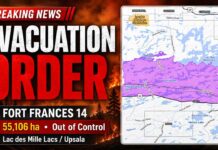
Fort Frances 14 was estimated at 51,806 hectares. Its northern perimeter was approximately five kilometres southwest of the Trans-Canada Highway, while its southern perimeter was about nine kilometres north of Highway 11.
Fort Frances 15 was estimated at 48,261.4 hectares, with its northern edge approximately 1.5 kilometres south of Highway 11. Evacuation orders and alerts remain associated with the fires, but they do not apply to the Town of Fort Frances.
Highway 11 is a major regional transportation corridor. A closure could affect residents, emergency services, commercial trucking and the movement of essential supplies between communities.
Travellers should check Ontario 511 immediately before leaving and should never attempt to bypass a closure or use an unfamiliar forest road as an unofficial detour.
Fort Hope evacuation continues with military assistance
The evacuation of Eabametoong First Nation, also known as Fort Hope, was underway during the weekend.
The federal government authorized Canadian Armed Forces aircraft to assist after Ontario requested help evacuating remote First Nations. Military support is especially important where communities have no permanent road connection or where smoke and fire conditions make civilian aircraft operations difficult.
Remote evacuations require careful sequencing. Elders, people with medical conditions, children and other vulnerable residents are generally moved first, followed by remaining community members.
The challenges continue after an aircraft lands. Evacuees must be registered, transported to accommodations and connected with food, medication and health services. Families may be sent to different cities when one host community does not have enough available rooms.
These recurring evacuations highlight the need for long-term investments in northern emergency transportation, telecommunications, community fire protection and evacuation infrastructure.
Thunder Bay remains a host city, not an evacuation area
Thunder Bay is not under an evacuation order and is not facing an immediate wildfire threat.
The city has activated its Emergency Operations Centre to improve co-ordination among municipal departments, emergency officials and agencies supporting evacuees. Local hotels have reached or approached capacity, requiring some displaced residents to be moved to other Ontario municipalities.
The distinction between heavy smoke and an approaching fire is important. Smoke can travel hundreds or thousands of kilometres and does not necessarily indicate flames are moving toward the city.
Residents should rely on the City of Thunder Bay, Ontario’s Aviation, Forest Fire and Emergency Services, First Nation governments and police for evacuation information. Social-media claims should be verified before being shared.
Thunder Bay’s responsibilities are likely to continue even if cooler weather slows fire growth. Evacuations may last for weeks when power systems, water treatment, communications, airports or homes have been damaged.
Smoke sharply reduces visibility across Thunder Bay
Thunder Bay remained under an orange air-quality warning Sunday as widespread wildfire smoke caused very poor air quality and reduced visibility.
Visibility at Thunder Bay Airport was reported at only 1.6 kilometres at 9 a.m. Sunday. The temperature was forecast to reach 25 C, with the humidex making it feel closer to 30. Smoke was expected to remain a concern into Monday.
Everyone can be affected by heavy wildfire smoke. Children, older adults, pregnant people, outdoor workers and people with heart or lung conditions face an increased risk.
Residents should reduce strenuous outdoor activity, keep windows closed when practical and use filtered indoor air. A properly fitted N95-style respirator can reduce exposure to fine smoke particles when outdoor activity cannot be avoided.
Anyone experiencing chest pain or serious difficulty breathing should seek urgent medical assistance.
The Restricted Fire Zone remains in effect across the Northwest Fire Region and has been expanded farther into Northeastern Ontario. Campfires and other open-air burning are prohibited, and all burning permits are suspended.
Carney, Trump and Sheinbaum attend World Cup final amid trade tensions
Carney, Trump and Sheinbaum are expected to attend Sunday’s FIFA World Cup final between Argentina and Spain in New Jersey.
The appearance of all three North American leaders carries political significance because Canada and Mexico are attempting to secure greater certainty around CUSMA while facing separate tariff pressures from Washington.
No formal Canada-U.S. meeting or wildfire agreement had been announced Sunday morning. The event nevertheless gives Carney and Trump an opportunity for direct contact only two days after the president threatened additional tariffs connected to Canadian smoke.
That potential conversation matters to Northwestern Ontario because the region is exposed to disputes involving softwood lumber, steel, minerals, machinery and cross-border transportation.
Canada cannot prevent all wildfire smoke from crossing the border, just as the United States cannot guarantee that smoke from American fires will remain south of the border. A practical response would involve shared forecasting, firefighting resources, forest research and emergency planning rather than assigning a tariff value to airborne pollution.
Whether the World Cup meeting produces any progress remains uncertain.
U.S.-Iran fighting threatens energy supplies and global inflation
The United States said it completed an eighth consecutive night of attacks against Iran after two American military personnel were killed in Jordan and another was reported missing.
Iran and the United States have intensified their attacks since an interim ceasefire collapsed. Kuwait and Bahrain reported intercepting Iranian missiles or drones, while attacks also affected military and civilian infrastructure in the Gulf region.
The conflict is increasingly focused on control and security around the Strait of Hormuz. About one-fifth of global oil shipments normally pass through the narrow waterway, making any extended disruption a threat to international energy supplies.
For Northwestern Ontario, the most immediate risk is higher fuel prices. Diesel, gasoline and aviation fuel are essential to trucking, mining, forestry, construction and remote-community resupply.
Higher oil prices also increase the cost of moving groceries, building materials and industrial equipment across long northern distances. Those costs can eventually be passed on to households and First Nations already facing high prices.
A sustained energy-price shock could also complicate future Bank of Canada decisions. Higher fuel costs place upward pressure on inflation even when domestic economic growth is weak.
Russia launches major ballistic-missile attack against Kyiv
Russia launched one of the largest ballistic-missile barrages of the war against Kyiv overnight, killing at least one person and injuring 16 in the capital.
Ukraine’s air force said the wider attack involved 41 missiles of several types. Residential buildings, warehouses, a supermarket, a dormitory, a metro station and an underground pedestrian passage were among the structures damaged.
Four other people were killed and 19 injured in a separate strike on a postal depot near Kharkiv, according to regional officials.
The attack renewed attention on Ukraine’s shortage of air-defence systems and interceptor missiles. Canada remains a significant military, financial and political supporter of Ukraine, meaning continued escalation could produce additional requests for equipment and assistance.
The regional economic implications include possible disruption to grain, fertilizer and energy markets. Attacks on transportation and port infrastructure can affect world commodity prices even when the damage occurs thousands of kilometres from Northwestern Ontario.
Mining is another connection. Modern air-defence systems, aircraft and military electronics require nickel, copper, cobalt, graphite and other materials found or being explored for in Northern Ontario.
What NetNewsLedger readers should watch next
Wildfire conditions remain the most urgent and rapidly changing issue. Readers should watch for new evacuation orders, changes involving Fort Hope and other First Nations, the status of Highway 11 and updated fire mapping when visibility permits aircraft to operate.
Provincial commitments following Ford’s visit will also matter. Evacuees and First Nation leaders will be looking for decisions on accommodations, direct funding, emergency transportation, community protection and rebuilding.
The Canada-U.S. relationship should be watched for any formal follow-up to Trump’s tariff threat or Ford’s call to remove softwood lumber duties. Statements made during or after the World Cup final may indicate whether the dispute is escalating or moving toward direct negotiations.
Internationally, shipping through the Strait of Hormuz will be a key indicator of future fuel prices. Further attacks on Kyiv and other Ukrainian cities will also increase pressure on Canada and its allies to provide additional air-defence assistance.
The day’s leading stories share a common regional consequence: disruption to transportation and supply chains.
Wildfires are threatening northern roads and aviation, U.S. tariffs could restrict forest-product exports and overseas conflicts are affecting fuel and commodity markets. For Thunder Bay and Northwestern Ontario, each development can translate into higher costs, delayed shipments and greater pressure on emergency services.