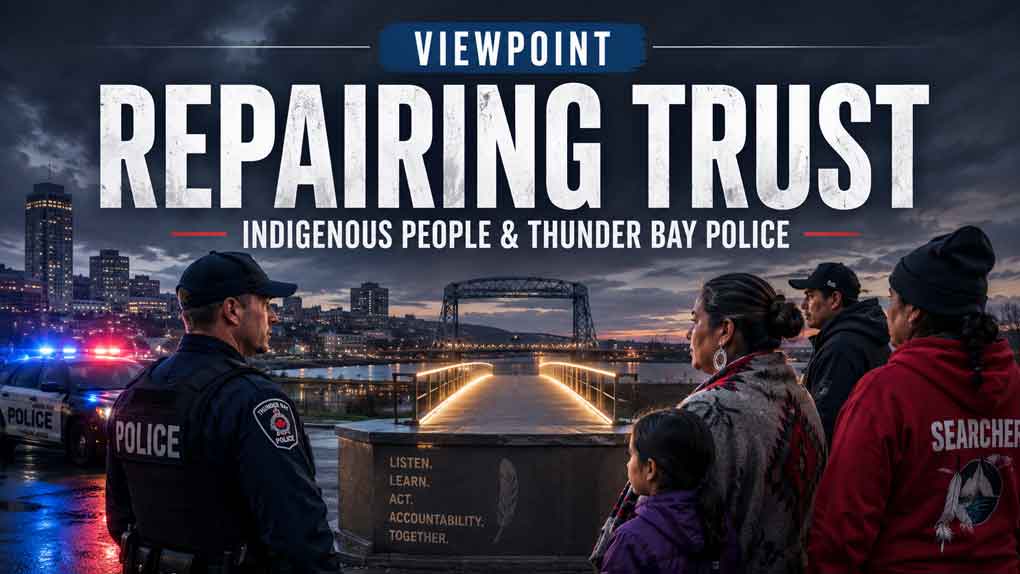
Repairing Trust Between Indigenous People and Thunder Bay Police Will Require More Than Statements
THUNDER BAY — VIEWPOINT – The recent public exchange between Thunder Bay Police Chief Darcy Fleury over a statement issued by Nishnawbe Aski Nation Grand Chief Alvin Fiddler and the comments by Chief Fleury on Kiiwetinoong MPP Sol Mamakwa has reopened one of the most difficult questions facing Northwestern Ontario: How can trust be rebuilt between Indigenous people and the Thunder Bay Police Service?
The answer will not come from one meeting, one apology or one policy change.
The public record points to a deeper requirement: Indigenous-led participation in missing-person searches, transparent communication with families, stronger civilian oversight, measurable anti-racism work, and a willingness by police leadership to treat criticism from First Nations leaders as evidence of unresolved harm rather than as a communications problem.
Recent Missing-Person Cases Re-opened a Long-Standing Wound
The current dispute followed recent missing-person investigations in Thunder Bay.
NAN Grand Chief Alvin Fiddler criticized how Indigenous volunteer searchers were recognized by the Thunder Bay Police, and raised concerns about communication with families and search leaders.
The Grand Chief asserted that the public had been left with the impression that police were primarily responsible for locating several missing people, while Indigenous searchers had played a central role.
Thunder Bay Police Chief Darcey Fleury responded in a May 28 statement, saying Fiddler’s comments did not “accurately reflect” the service’s efforts or commitment.
He said investigators had been in regular contact with families during recent investigations and that families may choose whether to include NAN in those discussions.
Fleury also said Mamakwa’s Queen’s Park statement was “misled,” arguing the broader crisis includes shortages in social supports, housing, addictions and mental-health services.
While that response may reflect the police service’s operational view, it does not resolve the larger issue.
That is not a small issue. Chief Fleury should be looking to build that trust, and should be fully aware of the history of Thunder Bay Police and the Indigenous community.
For many Indigenous families, the question is not whether individual officers worked hard in a specific case.
It is whether the system has changed enough for families to trust that Indigenous lives, knowledge, grief and urgency will be treated with equal weight from the first report.
Nishnawbe Aski Nation Reality
The truth is that Nishnawbe Aski Nation does not have any official jurisdictional power in Thunder Bay. NAN is a political entity that represents NAN communities. There is no budget in NAN for funding searchers.
That does not mean NAN should simply remain silent. The comments made by Grand Chief Fiddler are representative of the communities he represents.
The Record Behind the Distrust
The distrust did not begin this month. It didn’t begin last year, it has festered for many years.
In 2018, the Office of the Independent Police Review Director released Broken Trust, finding significant deficiencies in Thunder Bay police sudden-death investigations involving Indigenous people and finding systemic racism at an institutional level.
The review examined 37 investigations and made 44 recommendations, including external peer review of sudden-death and homicide investigations, formal acknowledgment of racism, a permanent advisory group involving the chief and Indigenous leadership, and priority implementation of a Thunder Bay death investigations framework.
The Law Enforcement Complaints Agency’s March 2024 final update said Thunder Bay police had fully implemented 27 of the 44 Broken Trust recommendations and made significant progress on eight more, with nine recommendations tied to OPP investigations and a review by the Office of the Chief Coroner.
To be fair, all of this happened before Chief Fleury took office.
Now, progress is important, but implementation checklists do not automatically rebuild public confidence if families still experience confusion, exclusion or disrespect during searches.
The governance record also matters.
The Ontario Civilian Police Commission appointed an administrator to the Thunder Bay Police Services Board in 2022 after serious dysfunction.
The administrator’s 2024 final report said Thunder Bay’s role as a hub for Northwestern Ontario and the “fraught history” between Indigenous and non-Indigenous people make fair and effective policing especially challenging.
The report also said policing in Thunder Bay must be trusted by Indigenous people and must fully protect them.
Rather than a battle of statements, there should be face-to-face meetings. There should be bridge building. There should serious efforts to build mutual respect and trust.
As much as a battle of public statements in the media might generate reads and comments on social media, it does not build bridges.
Human Rights Complaints and Oversight Remain Part of the Story
Human rights complaints have also shaped the trust deficit.
The Anishinabek Nation said in 2022 that nine individuals with direct experience had filed human rights complaints against the Thunder Bay Police Service and the board, alleging harassment and discrimination. Allegations in human rights complaints are not the same as findings, but they are a serious indicator of community experience and institutional risk.
One high-profile human rights case involving former police board chair Georjann Morriseau was dismissed by the Human Rights Tribunal of Ontario in 2025 on jurisdictional grounds, not because the underlying trust issues had been resolved. The tribunal ruled her allegations were outside its jurisdiction.
Ontario’s Inspector General of Policing is also reviewing Thunder Bay police and the police board. The inspection, launched in 2024, focuses on death and missing-person investigations, including compliance with the Community Safety and Policing Act and alignment with leading practices.
In 2025, The Inspector General of Policing of Ontario Ryan Teschner provided the following update on his inspection of the Thunder Bay Police Service and Thunder Bay Police Service Board:
“On October 10, 2024, I initiated an inspection of the Thunder Bay Police Service and its governing Board. This inspection focuses on how the Service conducts death and missing person investigations, with particular attention to compliance with the Community Safety and Policing Act (CSPA) and alignment with leading practices.
Since the launch of the inspection, my team has completed a comprehensive review of policies, procedures, and documentation submitted by both the Board and the Service. This work was further informed by interviews with Board and Police Service members, analysis of occurrence reports, engagement with more than 30 external organizations, and dedicated time spent listening to and learning from impacted families.
With the information-gathering phase now complete, the inspection has entered its next stage: the development of the Findings Report. Under the CSPA, if I determine that the report reveals evidence of non-compliance or a risk of non-compliance with legislative requirements, I may issue Directions to the Board, Chief of Police, and/or the Service.
The Findings Report, along with Directions, if I determine it appropriate to make any, is expected to be completed in early 2026.”
The Inspectorate said its information-gathering included affected families and more than 30 external organizations.
“Following an extensive information-gathering phase — which included reviewing documentation and investigative files, conducting interviews with members of the Police Service and the Board, engaging with more than 30 external organizations, and hearing directly from affected family members — the Inspectorate of Policing has now moved into the next stage of its work.
“The Inspectorate of Policing is currently developing the Findings Report, which includes a continued in-depth review of the extensive materials gathered. Given the depth and scope of the work, timelines have shifted from what was previously communicated and the report is expected to be completed in the coming months.
“Once finalized, the report will be provided to the Inspector General, who will determine if there has been non-compliance with the Community Safety and Policing Act. Where this occurs, the Inspector General may issue a Direction to remedy the non-compliance. The Findings Report and any Directions that the Inspector General makes regarding the findingswill be released publicly on the Inspectorate of Policing’s website.”
Why This Matters Across Northern Ontario
Thunder Bay is not simply a city police jurisdiction.
It is the health, education, justice, shopping, travel and service hub for many remote and road-access First Nations across Northern Ontario. When a person from Webequie, Mishkeegogamang, Kingfisher Lake, Kasabonika Lake, Sandy Lake or another northern community goes missing in Thunder Bay, the case reverberates far beyond municipal boundaries.
Statistics Canada data show Indigenous people represented 14.1 per cent of Thunder Bay’s population in the 2021 census, far above the Ontario share of 2.9 per cent.
Those figures do not fully capture the number of Indigenous people who travel to Thunder Bay for school, medical appointments, court, training, family visits, work, shopping and emergency services.
That makes policing in Thunder Bay a regional Indigenous safety issue, not only a municipal governance issue. Perhaps that is where some of the calls for disbanding the Thunder Bay Police Service and replacing policing in the city with the Ontario Provincial Police come from.
Repair Starts With a Shared Missing-Person Protocol
The first practical step should be a formal, publicly posted missing-person and search protocol co-designed by Thunder Bay police, NAN, First Nations police services, family representatives, Elders, Indigenous women’s organizations, youth representatives, victim services, the City of Thunder Bay, fire and emergency services, and volunteer search leaders.
The protocol should set out who contacts the family, how often updates occur, how Indigenous leadership is included when families consent, how volunteer searchers are credentialed and supported, how police receive and document Indigenous knowledge, and how public statements are approved before they are released.
This is consistent with the National Inquiry into Missing and Murdered Indigenous Women and Girls Calls for Justice, which call for standardized police protocols, improved communication with families from the first report, stronger coordination across jurisdictions and Indigenous communities, and standardized response times for missing Indigenous people.
Indigenous Searchers Need a Formal Role
A central issue in the current dispute is recognition of Indigenous searchers.
That cannot be handled informally case by case. Thunder Bay needs a funded Indigenous-led search support model that can be activated quickly when a First Nations person is reported missing.
That model should include training, equipment, safety planning, insurance coverage, mental-health supports, communication links with police command, and respect for cultural knowledge.
It should also include a clear process for documenting searcher observations so they are not dismissed because they do not fit conventional police assumptions.
Police retain legal responsibility for investigations. But families and Indigenous searchers often bring knowledge of the missing person, community networks, land-based understanding and spiritual guidance that police do not possess.
Repair requires making room for that knowledge without tokenizing it.
Public Disputes Should Move to a Standing Crisis Table
When police and First Nations leaders trade public criticism during active grief, trust is further damaged.
That does not mean leaders should stay silent. It means there should be a standing crisis table where urgent issues can be raised immediately before they become public confrontations.
The table should include the police chief, NAN leadership, affected First Nations, family liaisons, Elders, Indigenous service providers and city officials.
It should meet during active missing-person searches and after each case to identify what worked, what failed and what needs to change.
The OIPRD’s Broken Trust recommendations already called for a permanent advisory group involving the police chief and Indigenous leadership.
The current situation shows why that recommendation must be more than a relationship-building exercise.
It must have authority, records, timelines and public reporting.
Police Must Report What Has Changed — and What Has Not
Thunder Bay police and the board should publish plain-language progress reports on all recommendations from Broken Trust, the Sinclair board investigation, the Seven Youth Inquest, the Mamakwa-McKay Inquest and the coming Inspector General report.
The reports should avoid vague terms such as “ongoing” or “in progress” without evidence.
They should say what policy changed, when it changed, who was trained, how compliance is measured, how families experience the change, and what remains unfinished.
The former OCPC administrator specifically recommended periodic reporting on the work done and work still outstanding from major reports and inquests.
Public confidence depends on that kind of transparency.
Training Alone Will Not Fix Institutional Racism
Cultural training is necessary, but it is not enough.
The Broken Trust Report identified systemic racism, not simply a lack of awareness.
That means reform must reach recruitment, promotion, supervision, discipline, case review, data collection, dispatch, communications, officer performance evaluation and leadership accountability.
The National Inquiry’s Calls for Justice urge police services to recruit Indigenous people, ensure Indigenous representation on police services boards and oversight bodies, and train all staff in culturally appropriate and trauma-informed practices.
Thunder Bay police have Indigenous representation in senior governance and leadership, including Chief Fleury, who is Métis, and Indigenous representation on the police board, according to the OCPC administrator’s 2024 report.
Representation is important, but it cannot carry the entire burden of institutional reform.
Legal Context Around Criminal Matters
Separate criminal proceedings involving former Thunder Bay police leadership and members of the service have also affected public confidence. Former police chief Sylvie Hauth faces charges including obstruction of justice, breach of trust and obstructing a public or peace officer; those charges have not been proven in court, and she is presumed innocent unless proven guilty.
While his case is under appeal, Michael Dimini was convicted for charges.
Under the Criminal Code of Canada, breach of trust by a public officer is addressed under section 122 and carries a maximum sentence of five years in prison if prosecuted by indictment. Obstructing justice is addressed under section 139; depending on the subsection and how the Crown proceeds, the maximum sentence can be up to 10 years in prison. Obstructing a public or peace officer is addressed under section 129 and carries a maximum sentence of two years in prison if prosecuted by indictment. Actual sentences depend on the facts, the offender’s circumstances, aggravating and mitigating factors, and whether the Crown proceeds by indictment or summary conviction.
Those criminal matters are distinct from the broader issue of racism-free policing. But they underline why accountability, record-keeping, truthfulness to oversight bodies and public transparency are not administrative details. They are central to public trust.
Social Supports Are Part of the Answer, But Not a Substitute for Police Reform
Fleury is correct that housing, addictions treatment, mental-health care and prevention services are part of the broader safety crisis. Many people who go missing are vulnerable because of poverty, trauma, isolation, colonial displacement, racism, substance use, exploitation or lack of safe housing.
But social crisis cannot be used to deflect from policing obligations. Families still need timely searches, respectful communication, competent investigations and trauma-informed treatment. Both things are true: Thunder Bay needs better social infrastructure, and Thunder Bay police must continue to change how they serve Indigenous people.
A Path to Repair
Repair will require measurable commitments.
Thunder Bay police should jointly create a missing-person response protocol with Indigenous partners, fund and formally recognize Indigenous-led search capacity, and ensure families have one trained liaison from the first report to the conclusion of a case. The police board should publicly report progress on every outstanding recommendation and invite independent Indigenous evaluation of whether reforms are being felt by families.
The City of Thunder Bay and Ontario should fund the civilian and social supports that police alone cannot provide: safe transportation, emergency shelter, sobering and wellness services, mental-health crisis response, youth supports and culturally grounded victim services. The province should ensure the Inspector General’s findings are public, specific and followed by enforceable directions where needed.
Indigenous leaders should not be expected to carry the emotional labour of reform without authority and resources. Their role must be one of shared decision-making, not after-the-fact consultation.
Trust Will Be Measured in the Next Case
The relationship between Indigenous people in Northern Ontario and the Thunder Bay Police Service will not be repaired by declaring that trust is improving. It will be repaired, or further damaged, during the next missing-person report, the next family briefing, the next search, the next media release and the next oversight meeting.
For Indigenous families, the test is simple: when someone goes missing, will police listen early, act urgently, communicate honestly, respect Indigenous knowledge and remain accountable after the search ends?
Until the answer is consistently yes, the work of repair remains unfinished.