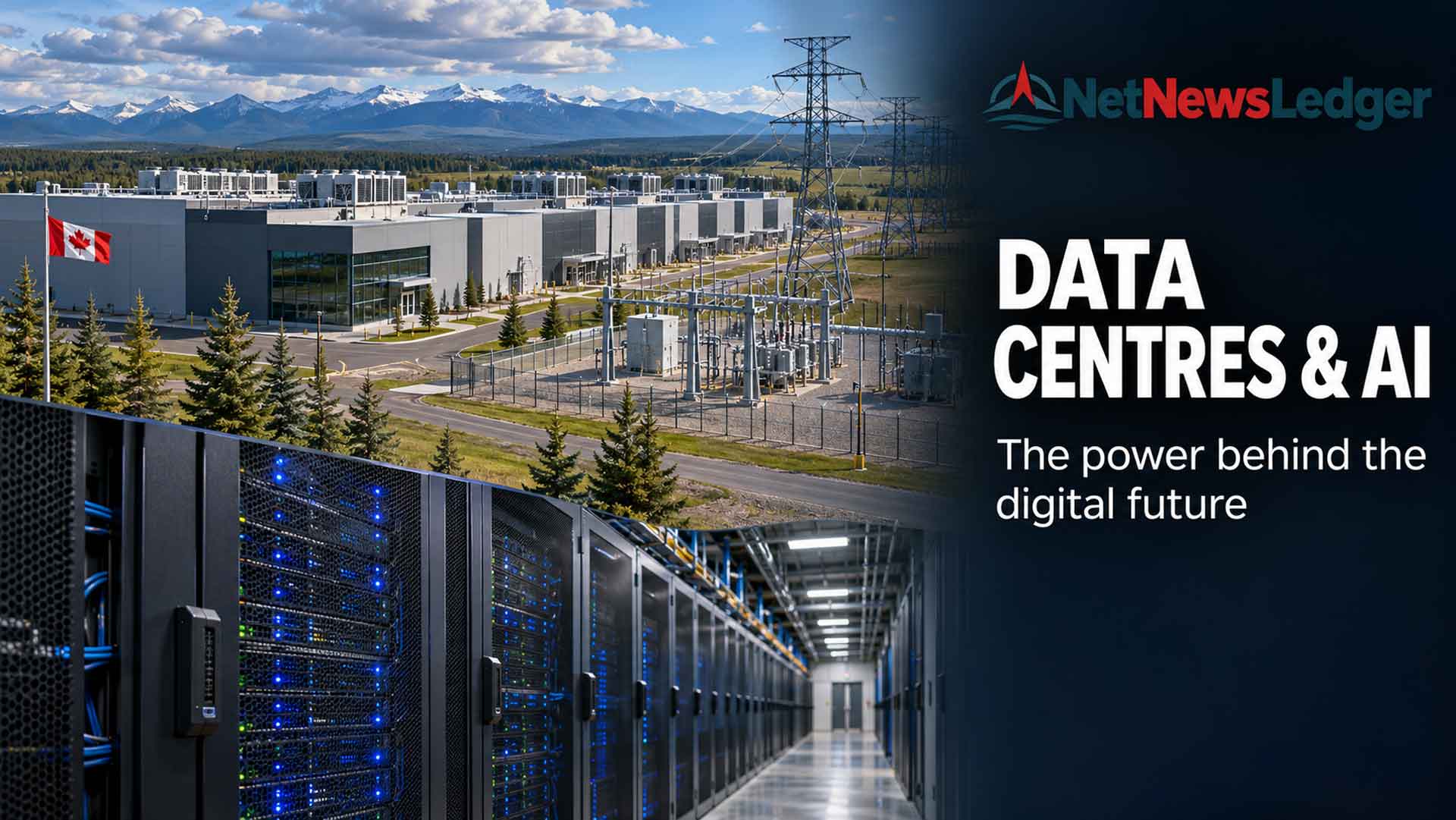
New Alberta legislation would protect farmland, water supplies and electricity customers, while Ontario focuses on economic benefits and Manitoba puts higher costs on major power users
Alberta AI Data Centre Rules: Ontario and Manitoba Compared
THUNDER BAY — TECHNOLOGY – The rapid growth of artificial intelligence is forcing Canadian provinces to make some difficult decisions about electricity, water, farmland and economic development.
Alberta’s government introduced new legislation on Wednesday, November 18, that would place restrictions on where large data centres can operate and how they use natural resources.
The proposed changes would require major data centres to stay at least 600 metres from homes, avoid valuable farmland, sharply reduce cooling-water consumption and pay for their own electricity infrastructure.
But Alberta is not alone in responding to the growing demand for computing power.
Ontario is developing a system to decide which data centres should receive access to the provincial electricity grid, with an emphasis on economic development and job creation.
Manitoba has taken a tougher financial approach, introducing legislation that allows higher electricity charges and special levies on large data centres and cryptocurrency operations.
Together, the three provinces show how Canada is struggling to balance the economic opportunities of artificial intelligence with the need to protect affordable electricity and natural resources.
Alberta: Data centres must meet new environmental rules
Alberta’s Bill 42, the Energy, Environment and Utilities Statutes Amendment Act, 2026, would introduce several requirements for data centres with electricity demands of at least 10 megawatts.
Under the proposed legislation, these facilities would generally be prohibited from operating within 600 metres of the nearest home.
They would also face restrictions on using Alberta’s highest-quality agricultural land.
The province says the measures would protect approximately 14 million acres of Class 1 and Class 2 farmland, along with Class 3 farmland in municipalities that do not have higher-quality agricultural land.
Large data centres would also be prohibited on irrigated land.
Municipalities could establish alternative setbacks in certain circumstances where local planning supports compatible development.
Alberta Technology and Innovation Minister Nate Glubish said the province is responding to concerns raised by residents and municipalities.
“Albertans told us what matters most: their communities, farmland and water. We listened,” Glubish said in the government’s announcement.
The government says the new rules are intended to give developers clear expectations while protecting communities.
The Alberta Utilities Commission would also take a larger regulatory role in overseeing data centres of at least 10 megawatts. Smaller projects would remain primarily under municipal oversight.
Water consumption becomes a major concern
One of Alberta’s most significant proposals involves water.
Data centres produce substantial heat because thousands of computer processors operate continuously. Cooling those processors is essential to keeping the equipment running.
Some cooling systems use evaporating water to remove heat. Other designs use closed-loop liquid cooling, air cooling or combinations of technologies.
Alberta wants to establish a provincewide standard that would bring data-centre cooling-water consumption close to zero.
The government also wants facilities designed so that excess heat can be recovered and made available for other uses, including heating greenhouses, industrial operations and homes.
That could create opportunities for communities to benefit from energy that would otherwise be released into the atmosphere.
However, the precise water-use requirements would still need to be established through regulations. The proposal does not mean every data centre would immediately operate without consuming water.
There is another important distinction: water-use rules aimed at data centres would not necessarily cover a separate natural gas power plant built to supply them.
Alberta wants developers to pay for their electricity infrastructure
Alberta is also proposing a new Data Centre Designation intended to protect residential and business electricity customers.
Under the proposal, data centre developers would be responsible for the costs of their own power infrastructure projects rather than transferring those costs to other ratepayers.
The province says its existing requirements also protect grid reliability by requiring data centres to demonstrate that their operations will not put the electricity system at risk.
During an electricity emergency, data centres would be required to reduce their electricity use before households and essential services are asked to do so.
The issue is particularly important because some proposed AI data centres require hundreds of megawatts of electricity.
For perspective, a facility using 100 megawatts continuously would consume approximately 876 million kilowatt-hours of electricity over one year.
That is enough electricity to make a significant difference to regional power planning.
The Meta project illustrates the scale
One major development already underway is Meta’s planned $13-billion AI data centre campus in Sturgeon County, north of Edmonton.
The project is expected to eventually require approximately one gigawatt of electricity, or 1,000 megawatts.
Plans include a nearby natural gas-fired generating facility intended to provide power for the computing campus.
According to Canadian Press reporting, Alberta’s proposed new location restrictions would not apply to projects that have already secured development permits and are well underway, including the Meta project.
That distinction is important. The province is proposing tougher conditions for future development while allowing certain existing projects to continue.
Ontario: Data centres must demonstrate economic value
Ontario is taking a different approach.
Rather than beginning with a provincewide minimum distance between data centres and homes, the government is concentrating on controlling access to electricity and evaluating the economic value of proposed projects.
Ontario’s Protect Ontario by Securing Affordable Energy for Generations Act, 2025, known as Bill 40, amended the Electricity Act, 1998 to establish authority for additional electricity connection requirements.
These provisions allow the province to create rules governing which data centres can connect to Ontario’s electricity transmission and distribution systems.
The legislation permits criteria that consider economic development, job creation and other provincial priorities.
Ontario’s objective is to avoid allowing large electricity users to secure limited grid capacity without demonstrating sufficient benefits for the province.
Ontario’s three-part economic assessment
In August 2026, Ontario published a proposed Economic and Strategic Assessment Framework for New Data Centres.
The framework is intended to help evaluate the economic and strategic value that proposed data centres could bring to Ontario and its communities.
The government is seeking a way to distinguish projects that contribute to the provincial economy from those that mainly consume electricity.
The framework could help Ontario decide which projects deserve priority when electricity connections are limited.
The province also proposed creating a separate electricity rate class for new large data centres, potentially applying to facilities with demands greater than one megawatt.
This proposed class, referred to as Class C in the consultation, is intended to help prevent the costs of data-centre growth from increasing electricity bills for existing customers.
The consultation closed September 12, 2026. The publicly available proposal reviewed for this article does not establish that all of its proposed regulations have taken effect.
Why Ontario is concerned about electricity
Ontario already faces growing electricity demand from industrial development, electrification, housing and other economic activity.
Artificial intelligence adds another large potential customer.
Unlike many factories, data centres can operate 24 hours a day, seven days a week, creating substantial year-round electricity demand.
A large data centre might also need new transmission lines, substations and other infrastructure before it can begin operating.
These investments can be expensive and may take years to complete.
Ontario’s approach is to give the province greater control over how limited electricity capacity is allocated.
For Northern Ontario, this raises an important question: Should a data centre receive access to electricity ahead of a mine, manufacturing plant or another industrial project that might create more permanent jobs?
Ontario’s proposed assessment framework provides a mechanism for considering that question, although the final results would depend on the rules adopted and how individual projects are evaluated.
Manitoba: A tougher approach to large electricity consumers
Manitoba has moved further than Ontario in establishing special financial rules for large data centres.
The province’s approach reflects concerns about electricity availability, costs to Manitoba Hydro customers and the long-term economic value of large computing facilities.
Legislation receiving royal assent on June 1, 2026, amended The Manitoba Hydro Act and provincial tax legislation to establish separate customer classes for data centres, cryptocurrency operations and certain other large electricity users.
The legislation also established authority for an electricity-use levy.
Where a different rate has not been prescribed, the statutory default levy is calculated using amounts equivalent to 100 per cent of the applicable monthly energy and demand charges.
In practical terms, that could substantially increase the electricity costs of a qualifying facility.
The law also permits higher electricity rates for these customer classes, subject to the applicable regulatory framework.
The precise amount an individual operator pays depends on the regulations, customer classification and electricity charges that apply.
Manitoba wants revenue returned to households
On October 15, 2026, Manitoba introduced further legislation aimed at directing revenue from the electricity levy toward residential Manitoba Hydro customers.
Finance Minister Adrien Sala said large AI data centres and cryptocurrency operations should contribute fairly to the electricity system.
The government argues that these facilities create major demands for electricity and should not leave ordinary customers paying the additional costs.
The proposed measures reflect a different policy choice from Alberta’s.
Alberta wants developers to pay for their own power infrastructure, while Manitoba is using a combination of separate electricity classes and levies to address the costs of major power consumption.
Manitoba’s October legislation was introduced as a proposal, so its additional revenue-distribution provisions should not be treated as enacted without confirmation of their final legislative status.
Manitoba has already opposed a hyperscale project
Manitoba Premier Wab Kinew made the province’s position particularly clear in June 2026 when he said his government would not allow a proposed hyperscale AI data centre southeast of Winnipeg to proceed.
The project, associated with Jet.AI and Consensus Core Technologies, was proposed near Île-des-Chênes.
Its developers planned to use natural gas generation to supply much of the electricity.
Kinew questioned whether the project’s environmental effects and electricity requirements were justified by its potential economic benefits.
The developers disputed that assessment, arguing the project would provide construction employment, permanent jobs and local tax revenue.
The dispute shows that electricity pricing is not Manitoba’s only concern. The province is also questioning whether some very large data centres deliver enough lasting value to justify their environmental footprint.
Manitoba has not rejected all AI data centres. Its government has distinguished smaller projects from massive hyperscale developments.
Three provinces, three different strategies
The policies reveal different priorities for managing the rapid growth of artificial intelligence infrastructure.
| Policy area | Alberta | Ontario | Manitoba |
|---|---|---|---|
| Main approach | Environmental protection and development restrictions | Electricity access and economic value | Electricity pricing and tighter control of large projects |
| Large-project threshold | 10 MW for key proposed restrictions | Thresholds under consideration, including 1 MW for a separate rate class | Defined through legislation and regulations |
| Distance from homes | Proposed 600-metre setback | No equivalent provincewide data-centre setback identified in the reviewed measures | No equivalent provincewide setback identified |
| Farmland | Proposed restrictions on high-quality and irrigated land | Existing planning rules; no comparable data-centre-specific ban identified | Existing planning rules; no comparable data-centre-specific ban identified |
| Water | Proposed near-zero cooling-water standard | Existing environmental and water approvals | Existing environmental and water approvals |
| Electricity costs | Developers would pay their own infrastructure costs | Proposed separate electricity rate class | Separate customer classes and electricity-use levy |
| Economic development | Encourage investment within stronger restrictions | Prioritize projects providing economic and strategic benefits | Greater scrutiny of whether large projects justify their costs |
The comparison is not entirely between equivalent laws. Alberta’s newest measures are proposed, Ontario has enacted enabling legislation but is still developing parts of its framework, and Manitoba has already enacted significant electricity-pricing provisions.
What does this mean for Thunder Bay and Northwestern Ontario?
For Thunder Bay, Kenora, Dryden, Greenstone and other Northwestern Ontario communities, the debate has implications beyond artificial intelligence.
Northern Ontario has several characteristics that could attract data-centre developers, including a cold climate, industrial land and potential opportunities to connect with electricity infrastructure.
Cooler temperatures can reduce the energy required for some types of data-centre cooling.
But cold weather does not eliminate the need for electricity, water management, backup power and expensive computer equipment.
Nor does it guarantee that enough electricity is available at the exact location where a developer wants to build.
Competition for electricity could become a major issue
Northern Ontario’s mining and industrial sectors already require reliable electricity.
New mines, mineral processing operations and manufacturing facilities can create substantial long-term power demands.
If large AI data centres seek connections to the same electricity infrastructure, provincial authorities may face difficult choices about which projects should receive priority.
A data centre can involve a substantial initial construction investment, but its permanent employment may be relatively limited compared with the number of workers needed to build it.
A mine or manufacturing facility may provide different employment opportunities and supply-chain benefits.
These differences do not automatically make one project better than another. They demonstrate why Ontario’s proposed economic assessment matters.
Communities should be able to understand how much electricity a project will require, how many permanent jobs it will create and whether it will generate lasting local economic benefits.
Could excess heat provide an economic opportunity?
One of Alberta’s more innovative proposals involves recovering heat produced by data centres.
This could be particularly relevant in Northern Ontario, where communities face long heating seasons. Remember how in Marathon Ontario the heat created by the paper mill heated the homes in the community back in the day?
A data centre produces heat continuously while its servers operate.
With suitable infrastructure, some of that heat could be transferred to nearby buildings or industrial operations.
Potential uses include greenhouse agriculture, district heating systems and industrial processes requiring low-temperature heat.
However, recovering heat is not as simple as connecting a pipe between a data centre and a greenhouse.
The project would need suitable heat exchangers, distribution equipment, backup systems and customers close enough to make the investment practical.
The temperature of the recovered heat also matters. Some applications require additional equipment, such as heat pumps, to make it useful.
Nevertheless, Alberta’s proposal raises a worthwhile question for Ontario: Should large data centres be encouraged or required to demonstrate how their waste heat could benefit surrounding communities?
Indigenous communities must have a voice
The development of large data centres also raises questions about Indigenous participation, land use and economic opportunities.
In Northern Ontario, major infrastructure projects can involve Crown lands, transmission corridors, water resources and areas subject to Aboriginal and treaty rights.
Governments must meet applicable legal obligations, including the Crown’s duty to consult where proposed Crown conduct may adversely affect Aboriginal or treaty rights.
Meaningful participation should also consider opportunities for Indigenous ownership, employment, procurement and long-term economic benefits.
These opportunities could extend beyond construction into electricity generation, telecommunications infrastructure, environmental monitoring and technical services.
The key question is whether Indigenous communities would be partners in development or simply communities affected by decisions made elsewhere.
The bigger issue: Who benefits from Canada’s AI boom?
Data centres are becoming essential infrastructure for modern technology.
They support cloud computing, banking, communications, medical research, business applications and increasingly powerful artificial intelligence systems.
Governments have good reasons to attract this investment.
But the industry presents challenges that are different from traditional industrial development.
A large data centre can require enormous amounts of electricity while employing relatively few people once construction is complete.
It may also require significant upgrades to transmission infrastructure and place new demands on water supplies.
Those costs and impacts need to be measured against the economic benefits.
Alberta’s proposed legislation attempts to address these concerns through land-use restrictions, environmental standards and requirements for developers to pay for their own infrastructure.
Ontario is moving toward an approval system that considers the economic and strategic value of projects seeking electricity connections.
Manitoba has chosen to make major electricity consumers contribute more financially while showing a willingness to reject projects it considers unsuitable.
All three approaches recognize the same underlying problem: the growth of artificial intelligence could create electricity demands that are difficult and expensive to accommodate.
What comes next?
Alberta’s Bill 42 must proceed through the legislative process before its proposed restrictions become law. Supporting regulations will also be needed to establish important technical details, including water-use requirements.
Ontario must determine how its data-centre connection framework will operate and whether its proposed separate electricity rate class will be adopted.
Manitoba’s enacted legislation provides a foundation for special electricity charges, while its additional October proposals seek to direct levy revenue toward residential customers.
For Northwestern Ontario, the next important decisions may involve how the province balances data-centre investment against electricity demand from mining, manufacturing, housing and other industries.
There is a clear opportunity for technology investment in Northern Ontario. But attracting that investment is only part of the challenge.
Communities will also need to determine whether the jobs, tax revenue, infrastructure and long-term economic benefits justify the electricity and resources these facilities consume.
The central question is no longer simply whether Canada should welcome AI data centres. It is where they should be built, what they should contribute and who should pay for the infrastructure needed to operate them.