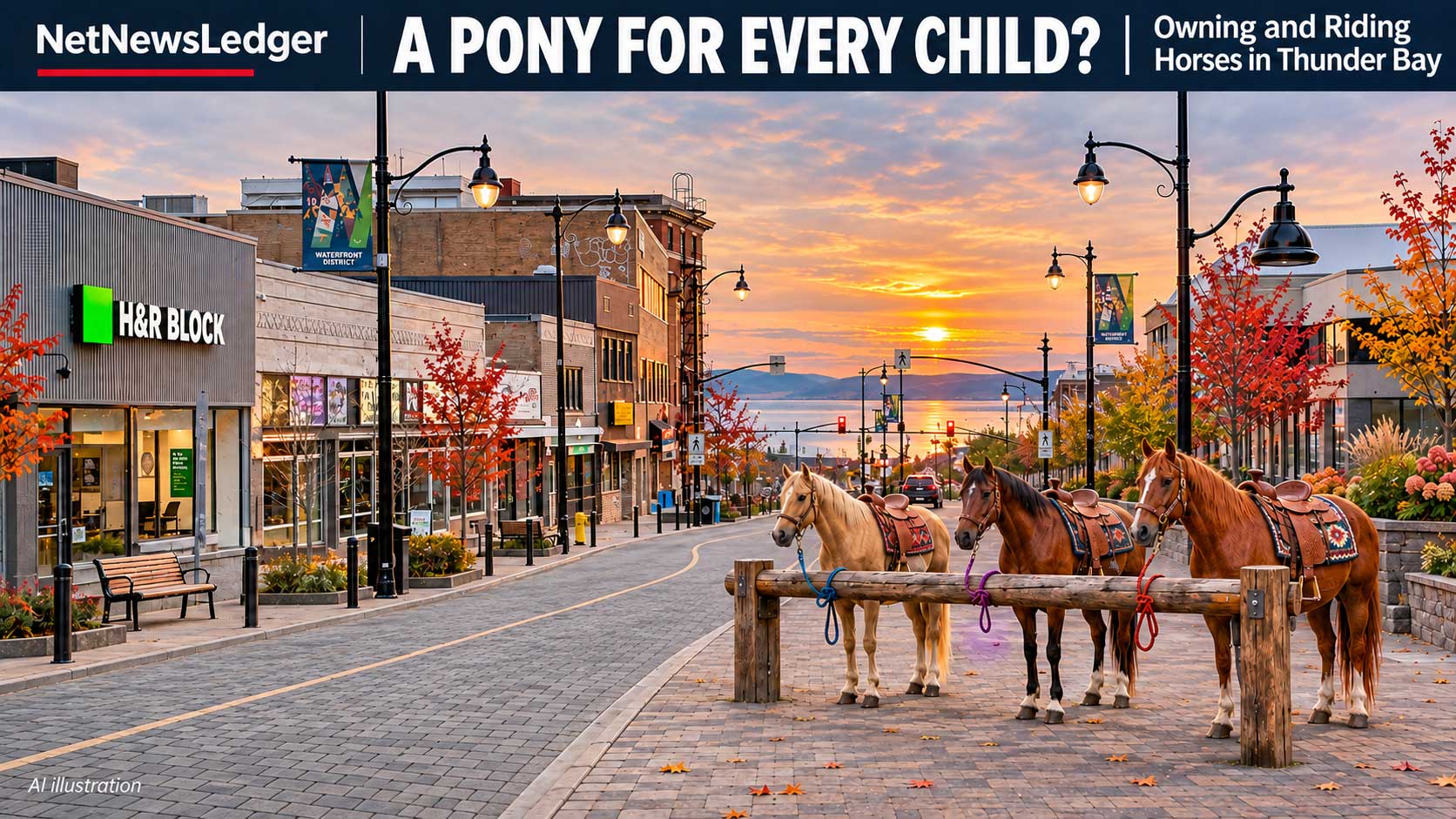
A memory of Mayor Walter Assef’s colourful suggestion raises a practical question: where can families keep a horse, and where can they ride one?
By James Murray — NetNewsLedger
THUNDER BAY — It might sound funny, but one of my first memories of Thunder Bay involves a mayor, a morning radio interview and a proposal that would certainly have changed the school commute.
It was late June 1976, the day I moved to Thunder Bay. On 580 AM CKPR, morning radio icon Rick Smith was interviewing Mayor Walter Assef.
As I remember it, the mayor was suggesting that every child in Thunder Bay should have a pony. They could ride them to school, he said. Learning to care for a horse would also teach young people responsibility.
That recollection has stayed with me for 50 years.
I wrote about the pony proposal in a 2014 NetNewsLedger article, although this remains a personal memory rather than a quotation checked against a recording of the broadcast.
The idea still raises an interesting question: if a family wanted a horse today, what would the rules allow?
The answer is that horseback riding is recognized in Thunder Bay’s traffic rules, while keeping a horse at home depends on the property’s zoning. Moving outside the city does not remove the need to check municipal requirements.
A horse cannot simply move into an ordinary city backyard
Thunder Bay’s Animal Keeping By-law makes an exception for domestic horses and other listed farm animals in areas where agriculture or personal farming is permitted by zoning, or protected by lawful non-conforming status.
That means a family cannot assume a horse is allowed because it is a pet, because the neighbours do not object, or because the backyard looks large enough. The land must qualify for the use.
The city’s posted Zoning By-law 1-2022, consolidated to May 27, 2024, provides a useful starting point:
- In the RU — Rural Zone, lots of two hectares or more, roughly five acres, permit agricultural uses and allow small or large personal farms as secondary uses.
- Rural lots smaller than two hectares allow a small personal farm as a secondary use, subject to the other zoning requirements.
- A horse counts as one large animal unit.
- A small personal farm allows a maximum of one large animal unit.
- A large personal farm can include up to five large animal units, with different combinations available when smaller animals or poultry are also kept.
These are zoning categories, not an automatic approval for any property of that size. Building locations, separation distances, other uses and property-specific amendments still matter. Families should have planning staff check the address and proposed layout before buying an animal or building a shelter. Thunder Bay’s zoning page links to the bylaw and property map.
Can you ride a horse on a Thunder Bay street?
Thunder Bay’s Traffic By-law 40-2016 specifically addresses animals on the highway.
Section 40 requires riders and people in charge of horses to follow the bylaw and Ontario’s Highway Traffic Act. It also prohibits riding at excessive speed or in a manner that endangers or unreasonably inconveniences another person.
The published text therefore supports horseback riding on city streets subject to traffic rules and any applicable restrictions. It does not provide permission to gallop through traffic or take a horse onto every public space. The available online reproduction of this section is an unofficial copy; the City Clerk holds the authoritative bylaw.
Road access and trail access are separate questions. Thunder Bay describes its multi-use trails as routes for people-powered transportation, including walking, cycling and mobility devices. That description should not be treated as permission for horses. Before using a park, recreational trail or conservation area, obtain confirmation from the organization responsible for it.
Riding to school would also require arrangements with the school for access, supervision and somewhere appropriate to keep the animal. A lawful road journey does not settle those practical questions.
Young riders have specific safety requirements
Under section 104.1 of Ontario’s Highway Traffic Act, riders younger than 18 must correctly use the required helmet and footwear when riding or mounted on a horse on a highway. The footwear requirement has an exception for specified safety stirrups. Parents and guardians must not knowingly allow children younger than 16 to ride contrary to those requirements.
The Horse Riding Safety Act specifies an equestrian helmet meeting recognized standards and hard-soled footwear with a heel of at least 1.5 centimetres. It also imposes requirements on covered riding establishments, including properly fitted tack for young riders.
There is a detail worth understanding: that Act defines a horse as an equine over 14.2 hands and excludes ponies, and it contains other exceptions. Its provisions should not be described as a universal helmet law for every rider in every setting. Regardless of those distinctions, a properly fitted equestrian helmet is sensible equipment for riders of any age.
What changes in the surrounding municipalities?
More space can make horse ownership practical, but each municipality has its own rules. Three nearby examples show why checking the actual property matters.
| Municipality | What the published rules say |
|---|---|
| Oliver Paipoonge | Its January 2025 zoning consolidation permits three animal units per hectare in the Agricultural and General Agriculture zones. One horse or pony, including a miniature horse, counts as one unit. The Rural Zone permits agricultural use subject to section 5.3.2 and also lists stables and riding academies. |
| Neebing | Section 2.13 requires a 30-metre side yard for livestock shelters and areas used to pasture or exercise livestock, unless the applicable provincial minimum-distance-separation calculation requires more. Separate well-protection distances also apply. |
| Shuniah | Its fence bylaw requires owners or occupiers of agricultural land keeping horses and other livestock to maintain fencing strong and high enough to prevent escape, unless the animals are otherwise effectively restrained. Zoning permission must also be checked. |
Sources: Oliver Paipoonge zoning consolidation; Neebing zoning bylaw; Shuniah Fence By-law 3329-23.
In Neebing, the well setbacks are generally 15 or 30 metres, depending on the well’s construction. They apply to livestock-accessible yard areas and livestock shelters. A property can look spacious while still having limited room for a compliant paddock.
Shuniah also has a zoning review underway, with a June 2026 draft posted online. A draft is not proof that its proposed rules are in force; owners should ask staff which enacted provisions apply.
The responsibility continues through every season
The mayor’s point about responsibility holds up.
Ontario’s animal-welfare framework includes requirements for appropriate food, water, medical attention, sanitary conditions, exercise space and protection from harmful weather. The legislation also recognizes reasonable and generally accepted agricultural animal-care practices.
For a family, that means planning beyond the purchase price. Before committing, work through:
- Accommodation: Confirm zoning and ask what approvals are needed for a barn, shelter, fencing and manure-storage area.
- Daily care: Arrange feeding, water, cleaning and someone dependable to cover holidays or illness.
- Professional care: Establish access to a veterinarian and hoof-care provider.
- Costs: Obtain local quotes for boarding or hay, bedding, care, equipment and emergency transport.
- Insurance: Ask an insurer about horse ownership, liability and the intended riding activities.
- Experience: Consider lessons and boarding before taking on care at home.
Boarding offers families a way to own a horse without converting their home property into a horse-keeping operation. A written agreement should spell out who handles feeding, turnout, routine care and emergencies.
Mayor Assef’s pony proposal made quite an introduction to Thunder Bay. Half a century later, it remains a memorable idea with a serious lesson behind it.
A child may love the thought of riding a pony to school. The adults first need to know where that pony can legally live—and who will be feeding it before breakfast in January.