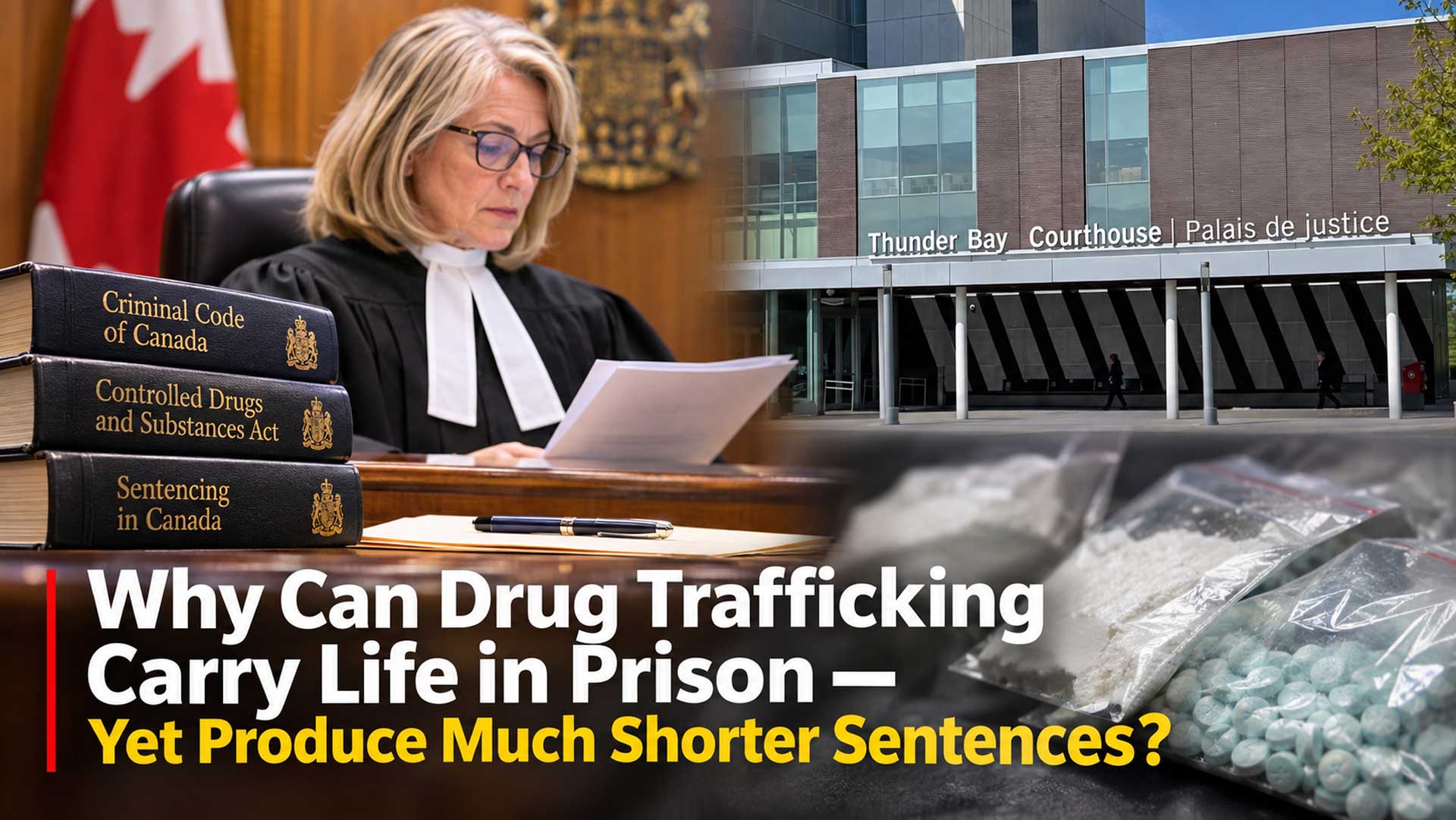
Why drug trafficking can carry life in prison as maximum sentence while Canadian courts often impose far shorter sentences
THUNDER BAY – Legal News Service — When police in Northwestern Ontario announce charges for fentanyl, cocaine or methamphetamine trafficking, the legal explanation can sound startling: conviction for trafficking or possession for the purpose of trafficking in a Schedule I controlled substance can carry a maximum sentence of life imprisonment.
Yet when those cases eventually reach sentencing, the punishment may be measured in years rather than decades. Some accused plead guilty to fewer charges. Others receive credit for time already spent in custody. In some cases, Crown and defence lawyers jointly recommend a sentence considerably below the theoretical maximum.
Incredibly there are even instances where the charges are dropped because due to overcrowding in the courts, the decision is made that the accused is not receiving a trial in a timely manner.
For families and communities living with the consequences of the toxic drug crisis, that can create an understandable question: If Parliament says drug trafficking can result in life imprisonment, why do Canadian courts so rarely impose anything close to it?
The answer lies in the difference between a maximum penalty and a fit sentence, along with the way plea agreements, evidentiary risks, constitutional protections, an offender’s role, rehabilitation and Canadian sentencing law interact.
In Thunder Bay, where 61 people died from opioid toxicity in the district in 2025 and the mortality rate was nearly six times the Ontario average, the debate is far from academic.
Life Imprisonment Is the Ceiling — Not the Starting Point
Section 5 of the federal Controlled Drugs and Substances Act prohibits trafficking and possession for the purpose of trafficking.
Where the substance is included in Schedule I or Schedule II, conviction can result in imprisonment for life. Schedule I includes drugs commonly encountered in Northwestern Ontario trafficking investigations, including fentanyl and cocaine.
But the words “liable to imprisonment for life” do not mean Parliament intended life imprisonment for every person convicted under that section.
The maximum establishes the outer limit of judicial authority.
Canadian sentencing law then requires the judge to determine a sentence proportionate to both the seriousness of the specific offence and the offender’s actual degree of responsibility.
Section 718.1 of the Criminal Code describes proportionality as the fundamental principle of sentencing. Courts must also consider denunciation, deterrence, rehabilitation, protection of society and other sentencing objectives.
That distinction explains much of the apparent gap between the maximum penalty printed in the law and the sentence imposed in an individual courtroom.
Two People Charged With the Same Offence May Have Very Different Cases
“Drug trafficking” covers an enormous range of conduct.
Consider the differences between:
- an addicted person selling small quantities to support their own dependency;
- a first-time offender acting as a courier;
- someone running a local trap house;
- a repeat commercial trafficker;
- a person bringing kilograms of fentanyl into a community;
- an organized-crime leader directing an interprovincial distribution network.
Each can potentially face a trafficking charge under the same federal legislation.
Their moral responsibility, role, profit, sophistication and danger to the public may nevertheless be dramatically different.
Courts therefore look beyond the name of the charge
Judges can examine the amount and type of drug, purity where relevant, frequency of sales, duration of the operation, money involved, level of planning, use of weapons, criminal record, involvement of organized crime, whether children were involved, the offender’s position in the distribution chain and other aggravating or mitigating factors.
The Controlled Drugs and Substances Act specifically directs judges to consider aggravating circumstances including weapons, violence, previous drug convictions, trafficking near places frequented by young people, trafficking to someone under 18 and using a minor in the offence.
This is why describing every person accused of trafficking simply as a “drug dealer” can obscure important distinctions that later matter at sentencing.
Fentanyl Has Driven Sentences Upward
Judicial discretion does not mean courts treat serious trafficking lightly.
The Supreme Court of Canada dealt directly with wholesale fentanyl trafficking in R. v. Parranto.
The cases involved commercial fentanyl trafficking. The Alberta Court of Appeal established a nine-year starting point for wholesale fentanyl trafficking and increased the offenders’ overall sentences to 10 and 14 years. The Supreme Court upheld the appeal court’s result while emphasizing that sentencing ranges and starting points remain guides rather than rigid formulas.
Federal prosecutors say fentanyl trafficking now attracts some of the highest drug-trafficking sentences imposed in Canada.
Recent cases demonstrate that point.
In June 2026, a Manitoba judge imposed a 23-year sentence for conspiracy to traffic fentanyl, cocaine and methamphetamine on the leader of a high-level drug organization, followed by another 18 months for directing criminal-organization offences, producing a total sentence of 24½ years.
In Ontario in 2025, a 25-year-old man who pleaded guilty to possessing 15 kilograms of fentanyl for the purpose of trafficking received a jointly recommended sentence of 16½ years. Prosecutors explicitly said they would have sought a significantly longer sentence without the early guilty plea.
A Fort Frances case reported by NetNewsLedger resulted in an 11-year sentence involving fentanyl and cocaine after the court rejected a defence request for a conditional sentence.
So while life imprisonment remains unusual, lengthy penitentiary terms are very real for high-level trafficking.
Why Plea Bargaining Can Produce a Lower Sentence
One of the most misunderstood parts of the criminal justice system is plea negotiation.
To members of the public, it can appear that the Crown starts with serious charges and then “cuts a deal.”
The legal reasoning is more complicated.
The Public Prosecution Service of Canada — which prosecutes federal drug offences — describes early and meaningful resolution discussions between Crown and defence counsel as an essential part of the justice system.
Those discussions can consider the strength of the prosecution case, potential defences, Charter issues, appropriate charges and the likely sentencing range.
A prosecutor does not simply ask, “What is the most severe punishment available?”
The prosecutor must ask what can actually be proved beyond a reasonable doubt.
That difference is critical.
Police may have reasonable grounds to lay several charges at the beginning of an investigation. Once disclosure is examined, however, prosecutors may discover that proving every count would be difficult.
A negotiated guilty plea can guarantee convictions on serious charges while avoiding the risk of an acquittal or exclusion of key evidence at trial.
Search Warrants and Charter Challenges Create Real Trial Risk
Drug prosecutions frequently depend on search warrants, wiretaps, intercepted communications, vehicle searches, residential searches and evidence connecting an accused person to drugs found in a shared space.
Those investigative steps can be challenged.
The PPSC reported in its 2025-26 annual report that trafficking cases are sometimes stayed or withdrawn because evidence is excluded after a Charter violation, evidence becomes unavailable or less compelling, or the case cannot be completed within constitutionally permitted timelines.
The agency says drug prosecutions frequently involve complex pretrial litigation over search warrants, wiretap authorizations, Charter breaches and whether evidence should be excluded.
That means a plea agreement can sometimes represent risk management.
A Crown faced with an 80 per cent chance of proving one trafficking charge may prefer a guaranteed conviction and significant sentence to pursuing five charges while risking the loss of crucial evidence and potentially ending with no conviction at all.
That does not necessarily mean the prosecution believes the offence is unimportant.
It means criminal convictions must be established according to constitutional rules.
Why Does Pleading Guilty Reduce a Sentence?
Canadian courts have long considered an early guilty plea a mitigating factor.
There are several reasons.
An early guilty plea can demonstrate acceptance of responsibility, eliminate the need for witnesses to testify, reduce court time and expense and allow limited judicial resources to be used on cases that genuinely require trials.
Federal prosecution guidance also notes that the earlier a legitimate guilty plea is entered, the greater its potential mitigating value.
This is sometimes described publicly as a “discount.”
That description is understandable, but incomplete.
An accused person cannot legally be punished for exercising the constitutional right to a trial.
Instead, the person pleading guilty may receive mitigating credit for accepting responsibility and producing the public benefits associated with resolving the case.
There are limits.
Courts have warned against giving a guilty plea excessive weight, particularly in serious fentanyl cases. Ontario appellate decisions have increased sentences where trial judges placed too much emphasis on mitigating circumstances and insufficient weight on the gravity of fentanyl trafficking.
Why Judges Often Accept Joint Sentencing Recommendations
A particularly important form of plea agreement is a joint submission.
That occurs when the Crown and defence agree on the sentence they will recommend to the judge.
The judge technically retains the final decision.
But the Supreme Court of Canada established a demanding standard in R. v. Anthony-Cook: judges should not reject a joint submission unless the proposed sentence would bring the administration of justice into disrepute or otherwise be contrary to the public interest.
Why such a high threshold?
Because plea agreements would become unreliable if an accused agreed to plead guilty in exchange for a joint sentence, only to discover that the judge could routinely impose something substantially harsher.
The Supreme Court has concluded that certainty encourages legitimate resolutions and helps the justice system function.
That can produce the appearance that the judge is merely “rubber-stamping” a negotiated sentence.
Legally, that is not quite what is happening
The judge must still determine whether the joint recommendation crosses the public-interest threshold. Crown counsel must also put the reasons supporting the joint submission before the court, including aggravating and mitigating circumstances.
Federal prosecution policy specifically says agreements cannot hide relevant criminal records, victim harm or provable aggravating facts simply to make a deal more attractive.
Parliament Removed Mandatory Minimum Drug Sentences
Another reason sentencing outcomes may appear different today than they did a decade ago is a major legislative change.
In November 2022, Parliament passed Bill C-5.
Among other reforms, the legislation repealed the mandatory minimum prison sentences that had applied to drug offences under the Controlled Drugs and Substances Act.
The federal government’s stated rationale was that mandatory minimums limited judges’ ability to impose proportionate sentences and contributed to the over-incarceration of Indigenous, Black and marginalized Canadians.
Repealing those minimums did not remove the maximum penalties.
A serious Schedule I trafficking offence can still carry life imprisonment.
What changed was the bottom of the sentencing range: judges regained greater authority to decide what punishment fits the particular offender and offence.
That means courts can impose a very lengthy penitentiary sentence on a major fentanyl trafficker while imposing a substantially different sentence on a marginalized street-level offender convicted under the same section.
Whether Parliament struck the right balance remains a legitimate political debate.
But judges applying the current law are exercising discretion Parliament deliberately restored to them.
Conditional Sentences Can Now Be Available in Some Cases
Bill C-5 also broadened access to conditional sentences.
Under section 742.1 of the Criminal Code, a judge who concludes that a fit sentence is less than two years can in eligible cases allow the sentence to be served in the community under strict conditions, provided community safety would not be endangered and the sentence remains consistent with sentencing principles.
That does not mean someone involved in substantial commercial fentanyl trafficking should expect house arrest.
Before a conditional sentence can even be considered, the judge must first conclude that a sentence below two years is appropriate.
In serious commercial trafficking cases, courts regularly conclude that denunciation and deterrence require years in a penitentiary.
Gladue Principles Can Affect the Sentence — But They Are Not an Automatic Reduction
In Northwestern Ontario, another sentencing principle frequently arises because of the high proportion of Indigenous people appearing before the courts.
Section 718.2(e) of the Criminal Code requires courts to consider all reasonable sanctions other than imprisonment, with particular attention to the circumstances of Indigenous offenders.
The Supreme Court’s decisions in Gladue and Ipeelee require judges to consider the effects of colonialism, residential schools, displacement, systemic discrimination, family disruption and other background factors where they relate to the offender or potential sentencing options.
This is sometimes inaccurately portrayed as an automatic “Gladue discount.”
It is not.
An Indigenous offender can still receive a lengthy penitentiary sentence for serious drug trafficking.
The principle requires the judge to conduct an individualized assessment of moral responsibility and appropriate sanctions rather than treating incarceration as identical in meaning and impact for every offender.
For northern courts serving communities deeply affected by residential schools, child welfare displacement, poverty, addiction and intergenerational trauma, those considerations can be substantial.
They do not erase the harm caused by trafficking.
Time Already Spent in Jail Can Make the Final Sentence Look Smaller
Another source of public confusion is pre-sentence custody.
An accused may spend months — sometimes well over a year — in jail awaiting trial or sentencing.
Under section 719 of the Criminal Code, a judge can generally credit that custody toward the eventual sentence, normally up to one day for each day served and, where justified, up to 1½ days for each day spent in pre-sentence custody.
Consider an offender sentenced to four years who has already accumulated the equivalent of two years of recognized custody credit.
News coverage may focus on the roughly two years remaining to be served.
A reader can understandably conclude the offender “only got two years.”
Legally, however, the court imposed a four-year sentence and then credited incarceration that had already occurred.
Responsible court reporting should distinguish between the gross sentence and the time remaining after credit.

Multiple Charges Do Not Automatically Mean Sentences Are Added Together
The same issue arises when someone is convicted of several trafficking offences.
A court can order sentences to be served concurrently — at the same time — or consecutively.
But the Criminal Code includes a principle of totality: where consecutive sentences are imposed, the combined punishment should not become unduly long or harsh.
As a result, five serious charges do not necessarily mean five complete sentences simply added together.
The judge must produce a global punishment proportionate to the overall criminal conduct.
That can again create a public impression that some offences “didn’t count.”
They did.
They were considered as part of the overall sentence.
Is the System Too Lenient?
That is ultimately a policy question rather than one that can be answered simply by pointing to the maximum sentence.
There are strong arguments on both sides.
Residents living through a toxic drug crisis can reasonably argue that people who knowingly import and distribute fentanyl for profit are contributing to extraordinary community harm and that denunciation and deterrence should be given substantial weight.
The Thunder Bay District’s 61 opioid toxicity deaths in 2025 provide grim context for that argument.
The Supreme Court itself has emphasized the devastating harm caused by fentanyl, and appellate courts have intervened when sentences failed to reflect the seriousness of commercial trafficking.
At the same time, proportional justice requires distinctions.
A vulnerable 19-year-old courier, a person selling small quantities while experiencing addiction and the leader of an organized crime network importing kilograms of fentanyl are not equally responsible simply because the same statutory section appears on their charge sheets.
A system that imposed the maximum penalty without considering those differences would conflict with the fundamental Canadian sentencing principle of proportionality.
The Plea-Bargaining Question Deserves More Transparency
Where criticism of the system has greater force is transparency.
The PPSC itself acknowledges that resolution discussions can generate public suspicion because negotiations occur outside the courtroom before the eventual agreement is presented publicly.
Courts and prosecutors can help by clearly explaining:
Why were charges withdrawn?
What evidentiary weakness affected the case?
Was the guilty plea early or entered only after extensive litigation?
What did the Crown originally seek?
What did the defence seek?
Was the sentence jointly recommended?
What benefit did the prosecution obtain?
Was the offender a courier, street-level seller, mid-level trafficker or organizer?
How much fentanyl or cocaine was involved?
How much pretrial custody credit was given?
What aggravating and mitigating circumstances affected the sentence?
Those details allow the public to evaluate a sentence rather than comparing it only with a theoretical life maximum.
What NetNewsLedger Readers Should Keep in Mind
When NetNewsLedger reports that trafficking fentanyl or cocaine can carry life imprisonment, that is an important explanation of the seriousness Parliament attaches to the offence.
But the statement requires context.
Life imprisonment is the maximum available penalty. It is not a prediction of the sentence that will be imposed.
Canadian judges are required to impose individualized, proportionate sentences.
Plea negotiations can reduce charges or sentencing positions because of evidentiary risk, constitutional issues, an early acceptance of responsibility or legitimate benefits to the prosecution.
Joint sentencing recommendations receive substantial deference because the Supreme Court has concluded they are important to the functioning of the justice system.
Indigenous background factors, rehabilitation, addiction, age, criminal history and the offender’s role can affect moral responsibility.
Pre-sentence custody can substantially reduce the amount of time left to serve.
And despite perceptions of widespread leniency, major commercial fentanyl trafficking cases continue to produce sentences in the range of 10, 15, 20 years or more.
The harder question for Canadians is therefore not simply, “Why didn’t the judge impose life?”
It is:
Did the sentence properly reflect the harm caused, the offender’s real responsibility, the strength of the prosecution case and the need to protect the community?
That is the question sentencing judges are legally required to answer — and, particularly in communities such as Thunder Bay that have experienced extraordinary losses from the toxic drug supply, it is a question courts and prosecutors should explain as clearly as possible.