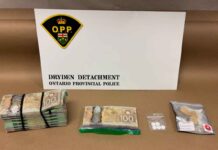
OPP report seizure of suspected cocaine, methamphetamine, hydromorphone and oxycodone; accused remains in custody
DRYDEN — A Dryden resident faces six charges after Ontario Provincial Police executed a search warrant at a Machin Avenue residence on October 20, 2026.
Police say officers searched the home shortly after 2 p.m., seizing suspected methamphetamine, cocaine, hydromorphone and oxycodone, along with Canadian currency and other evidence investigators allege is connected to drug trafficking.
The investigation was led by the Dryden OPP Community Street Crime Unit. Assisting officers came from the Northwest Region Emergency Response Team, street crime units in Red Lake, Sioux Lookout and Kenora, the Kenora Organized Crime Enforcement Bureau, and the Dryden OPP Detachment.
Police have charged Derek Palermo, 38, of Dryden, with:
- Possession of cocaine for the purpose of trafficking.
- Possession of methamphetamine for the purpose of trafficking.
- Possession of hydromorphone for the purpose of trafficking.
- Possession of oxycodone.
- Possession of proceeds of property obtained by crime over $5,000.
- Failure to comply with a release order.
Following a bail hearing on October 21, Palermo was remanded into custody. His next appearance before the Ontario Court of Justice will take place at a future date.
All charges remain allegations. Palermo is presumed innocent unless proven guilty in court. Remand is pretrial detention, not a sentence.
Police did not disclose the quantities or estimated value of the suspected drugs, the amount of currency seized, or the release condition allegedly breached.
What the drug charges mean
The four drug charges fall under the Controlled Drugs and Substances Act (CDSA). The proceeds-of-crime and release-order charges fall under the Criminal Code.
Possession for the purpose of trafficking, prohibited by section 5(2) of the CDSA, alleges that a person possessed a controlled substance with the intention of trafficking it. The Crown must establish the trafficking purpose; possession alone does not establish that element.
For Schedule I substances, such as the cocaine, methamphetamine and hydromorphone alleged in this case, section 5(3)(a) provides a maximum sentence of life imprisonment. That is the statutory maximum, not an automatic sentence or a prediction of the outcome.
The oxycodone charge alleges unauthorized possession, rather than possession for trafficking. Section 4(1) prohibits possession of specified controlled substances except where authorized, such as through lawful prescription arrangements.
For possession of a Schedule I substance, the potential penalties are:
| Prosecution route | Maximum penalty |
|---|---|
| Indictment | Seven years in prison |
| Summary conviction, first offence | Six months in jail, a $1,000 fine, or both |
| Summary conviction, subsequent offence | One year in jail, a $2,000 fine, or both |
These penalties come from section 4(3) of the CDSA. The police release does not disclose any prior convictions, and none should be assumed.
Possession of proceeds of crime over $5,000
This charge generally concerns knowingly possessing property or proceeds obtained through crime. It is addressed by section 354 of the Criminal Code, with penalties set out in section 355.
The “over $5,000” designation refers to the alleged value of the property or proceeds involved. It does not establish the precise amount of cash police seized.
For property valued above $5,000, the offence carries a maximum of 10 years in prison if prosecuted by indictment. It can also proceed by summary conviction.
Failure to comply with a release order
This allegation generally falls under section 145(5) and concerns failing, without lawful excuse, to comply with a condition of a court release order other than the requirement to attend court.
The release does not identify the exact subsection or condition involved. Being subject to a release order does not establish guilt in the matter that led to that order.
The maximum sentence is two years in prison if prosecuted by indictment, with summary conviction also available. For both Criminal Code charges, the general summary-conviction maximum is two years less a day in jail, a $5,000 fine, or both.
Any sentence would depend on the offences proven, the circumstances and the applicable sentencing principles. The maximum penalties should not be added together to suggest a likely total sentence.
Anyone with information about suspected illicit drug trafficking is asked to contact the OPP at 1-888-310-1122.