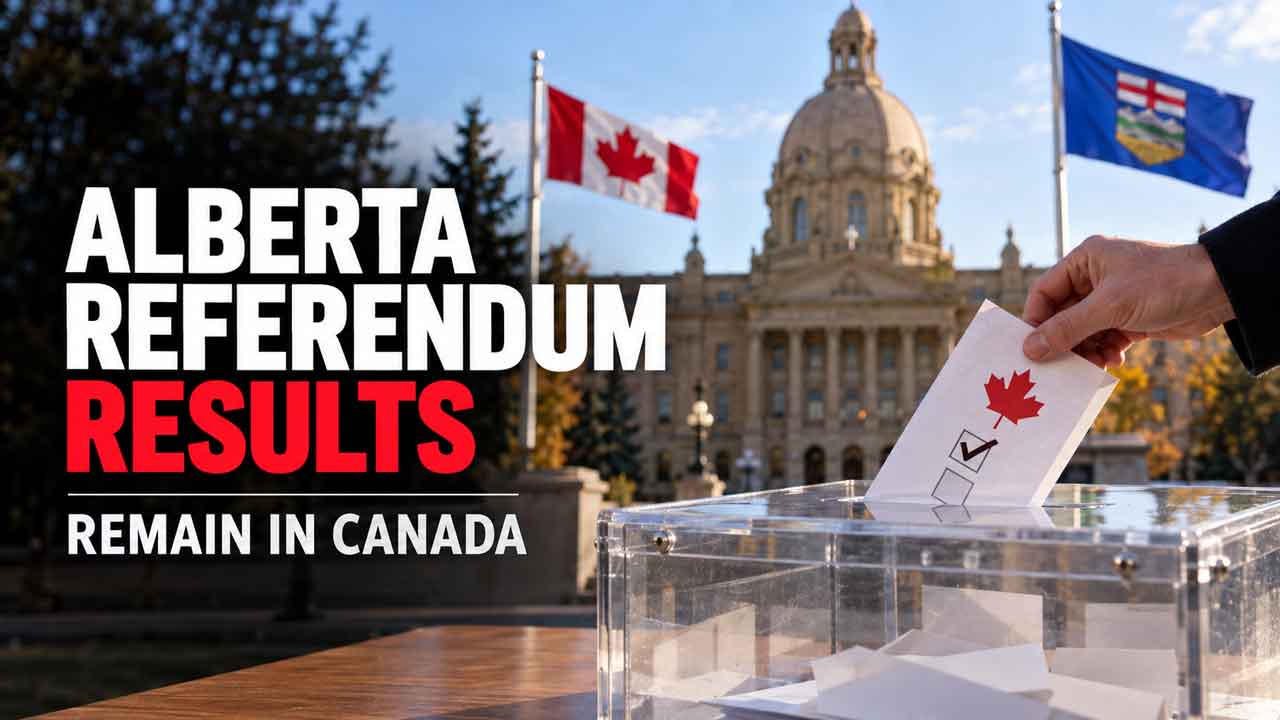
THUNDER BAY – Analysis – Canada and Alberta woke up this week to a result that many in the business community had been watching closely: voters chose to stay in Canada. For business owners across the province, the relief was immediate and real.
Uncertainty is bad for business, and the question of whether Alberta might chart its own course outside the federation had been hanging over boardrooms, storefronts and family farms alike.
I spent twenty years living in Alberta, this news touches very directly, and I write for the people who actually have to live with the outcome, as an outsider watching from a distance.
That matters on a story like this one. When a headline talks about “Alberta businesses,” it is talking about the folks running shops, trucking companies, oilfield services and farms who have spent months unsure what the future held.
That kind of relief is for any business that has been dealing with uncertainty. Over the past two years, between US President Trump pushing his 51st state efforts along with his tariffs, there has been more than enough uncertainty.
Monday’s result is the feeling of being able to start to plan again.
Separation talk in Alberta has ebbed and flowed for years, tied up in frustrations over federal policy, energy regulation and the province’s relationship with Ottawa.
But talk is one thing.
A vote is another. When the question moved from kitchen table arguments to an actual ballot, it forced business owners to think concretely about what independence, or even the serious threat of it, would mean for contracts, currency, cross border trade and the countless agreements that assume Alberta is part of Canada.
That is why the relief matters.
Businesses do not thrive on uncertainty. They thrive on knowing the rules will not change overnight. A vote to remain in Canada means the currency stays the same, the trade agreements stay the same, and the legal and regulatory framework businesses have built their operations around does not need to be torn up and rebuilt. For companies that buy and sell across provincial and national lines, that stability is worth more than almost anything else.
What it means for residents
For everyday Albertans, this result likely means a return to something closer to normal, at least on this particular front.
The uncertainty that comes with talk of leaving the country touches more than just corporate balance sheets. It touches mortgage rates, investment decisions, pension stability and the confidence that keeps local economies moving.
When business owners are unsure whether their province will remain part of Canada, they tend to delay hiring, delay expansion and delay the kind of spending that keeps a local economy humming.
On a more Thunder Bay perspective, our city deals with problems for business related to the homeless crisis, the increased crime rate and the repeated homicide rates making the city Canada’s murder capital.
It is difficult to say in Alberta what the fallout from the referendum will be.
A number of United Conservative Party MLAs, members and supporters were supportive of Alberta leaving confederation. Premier Danielle Smith will have her work cut out for her balancing the divisions.
Alberta has an interesting political history, in the province’s history, no political party that was in power and lost has ever regained power. The Liberals formed Alberta’s first government, then it was the United Farmers of Alberta, followed by the Social Credit party.
Next was the Progressive Conservative dynasty, in power from 1971 until 2015.
Except for the Liberals, none of those parties really exist. They were followed by the Wildrose Party.
Once voted out of office, Albertans have never returned a party to power.
There has always been a separatist fringe in the Albertan political spectrum.
Now, it will be up to a former maverick politician and now Premier Danielle Smith to put things back together.
With the vote settled, residents can expect that pause to ease.
Businesses that held off on investment decisions while the outcome was in doubt may now feel freer to move forward. Workers who worried about job security tied to larger economic uncertainty can breathe a little easier too. And for the many Albertans whose livelihoods depend on trade with the rest of Canada and beyond, whether through energy, agriculture or manufacturing, the result reaffirms the framework they have built their businesses and careers around.
It is also worth remembering that a vote like this does not erase the underlying frustrations that led to it in the first place. The grievances that fueled talk of separation did not vanish overnight simply because voters chose to stay. Residents should expect that conversations about Alberta’s place within Canada, its share of federal resources, and its influence over national policy will continue. The business community’s relief is about avoiding the disruption of a sudden break, not about declaring every underlying issue resolved.
For now, though, the dominant mood among business owners is one of relief and a desire to get back to the business of doing business. Plans that were shelved can come off the shelf. Decisions that were delayed can move forward. And the broader Alberta economy, so tightly woven into the fabric of the country, can continue operating under the same rules it always has.
As more details emerge across Alberta about reaction across the province, this is a story worth continuing to follow, especially for residents whose jobs and livelihoods are tied to the decisions businesses make in the weeks ahead.