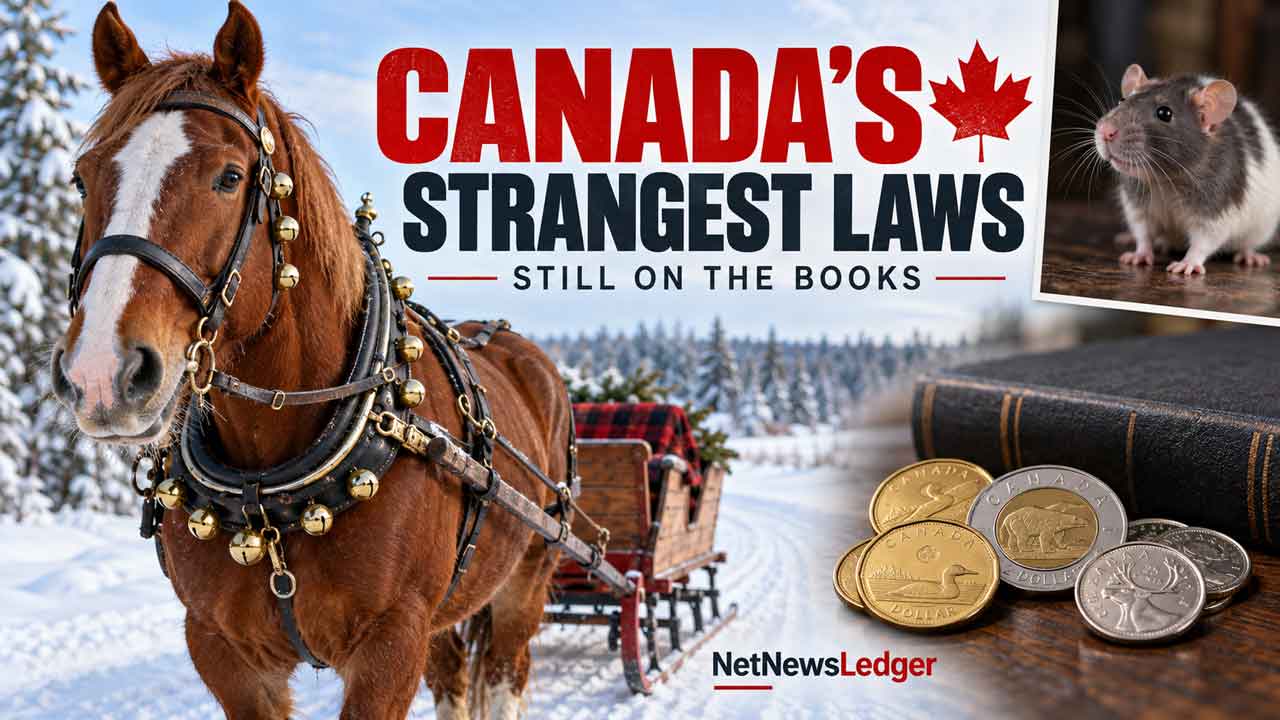
From Ontario’s sleigh bells to Alberta’s pet-rat ban, explore six unusual Canadian laws still on the books
Some surprising rules remain in Canadian law, but several famous examples have been repealed
THUNDER BAY — Today many people complain about how the courts repeatedly release repeat offenders. Respect for the legal system is needed for real justice.
However still on the books are a number of laws that remain on the books. Here is a summary of some of the Canadian laws.
Heading out in a horse-drawn sleigh? Ontario law says it needs bells. Moving to Alberta with a pet rat? The province prohibits keeping that animal as a household pet.
Canada’s statutes and municipal bylaws contain provisions that can sound strange when pulled out of context. Some govern activities that have become uncommon. Others protect public property, control pests or regulate money.
Here are six examples found in government legislation and official guidance. Their reach varies: federal rules apply across Canada, while provincial laws and municipal bylaws apply within their own jurisdictions.
An unusual law should not automatically be described as unenforced. The records checked for this article do not establish how frequently each provision results in enforcement.
1. Ontario requires bells on an animal-drawn sleigh
The jingling is more than a seasonal soundtrack.
Section 77(1) of Ontario’s Highway Traffic Act requires anyone travelling on a highway with a sleigh or sled drawn by a horse or another animal to have at least two bells attached to the harness, sleigh or sled. They must provide ample warning sound.
The Ontario Court of Justice’s set-fine schedule, updated Jan. 22, 2026, still lists “No sleigh bells” as an offence, with a $5 set fine.
The requirement concerns animal-drawn transportation on a highway. It does not require children to attach bells to a backyard toboggan.
2. A wheelbarrow of coins does not give you unlimited payment rights
Planning to settle a large bill with loose change? The federal Currency Act limits how much qualifies as legal tender when paid in coins.
Section 8(2) sets these limits:
| Coin denomination | Legal-tender limit |
|---|---|
| $2 through $10 | $40 |
| $1 | $25 |
| 10 cents through less than $1 | $10 |
| 5 cents | $5 |
| 1 cent | 25 cents |
Offering more coins is not automatically a crime. The provision limits their legal-tender status.
There is another qualification: legal tender does not mean every retailer must accept cash. The Bank of Canada explains that businesses can choose their payment methods, and buyers and sellers can agree on other forms of payment.
3. Owning a coin does not give you unrestricted permission to melt it
Another federal provision reaches beyond spending money.
Section 11(1) of the Currency Act prohibits melting down, breaking up or using otherwise than as currency a coin that is current and legal tender in Canada, except under a ministerial licence.
For someone considering turning circulating Canadian coins into metal for a craft project, that is a significant qualification.
The wording specifically concerns coins that are current and legal tender in Canada. It should not be stretched into a claim covering every old or foreign coin.
4. Alberta prohibits pet rats
A domesticated rat may be a household companion elsewhere, but Alberta prohibits private citizens from keeping rats of the genus Rattus as pets.
The provincial government says its Agricultural Pests Act and Pest and Nuisance Control Regulation support the prohibition. It includes domesticated white and hooded rats.
The province identifies exceptions for institutions such as zoos, universities, colleges and recognized research institutions.
This rule forms part of an active pest-control program. Alberta warns that escaped domestic rats could establish wild populations, and its guidance says suspected infestations are investigated.
5. Oshawa prohibits climbing trees on municipal property
Tree climbing can be a familiar childhood activity. In Oshawa, ownership of the tree matters.
Section 8.3 of the City Trees By-law prohibits interference with trees on municipal property. Its examples specifically include climbing, along with attaching or placing objects on a tree.
The city continues to list the bylaw in its directory. Its posted consolidation incorporates amendments from 2013 and 2022.
The restriction concerns municipal property. Describing it as a blanket ban on climbing every tree in Oshawa would overstate its reach.
6. Prince Edward Island retains a horn requirement when passing — if necessary
Prince Edward Island’s Highway Traffic Act contains an easily oversimplified provision about overtaking another vehicle.
Section 154(1)(a) requires an audible horn signal to alert the other driver if necessary.
Those final words matter. The current government consolidation does not require motorists to honk every time they pass another vehicle.
It is an example of how an unusual-sounding rule becomes less surprising when its full wording is read.
Three famous examples that no longer belong on a current list
Some memorable Canadian legal oddities have been removed from the Criminal Code.
Justice Canada’s current text marks these provisions as repealed in 2018:
- Section 49: the former provision concerning alarming the monarch.
- Section 71: the specific duelling offence.
- Section 365: the former offence of fraudulently pretending to practise witchcraft.
Their repeal should not be read as permission to commit violence or fraud. These particular provisions simply no longer belong on a list of laws still in force.
What applies in Thunder Bay?
For Thunder Bay and Northwestern Ontario readers, the federal currency provisions and Ontario’s sleigh-bell requirement are the directly relevant examples.
Oshawa’s tree bylaw, Alberta’s pet-rat prohibition and Prince Edward Island’s passing rule apply within their respective jurisdictions.
Location, exceptions and exact wording separate an entertaining legal fact from a misleading internet claim.