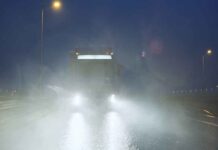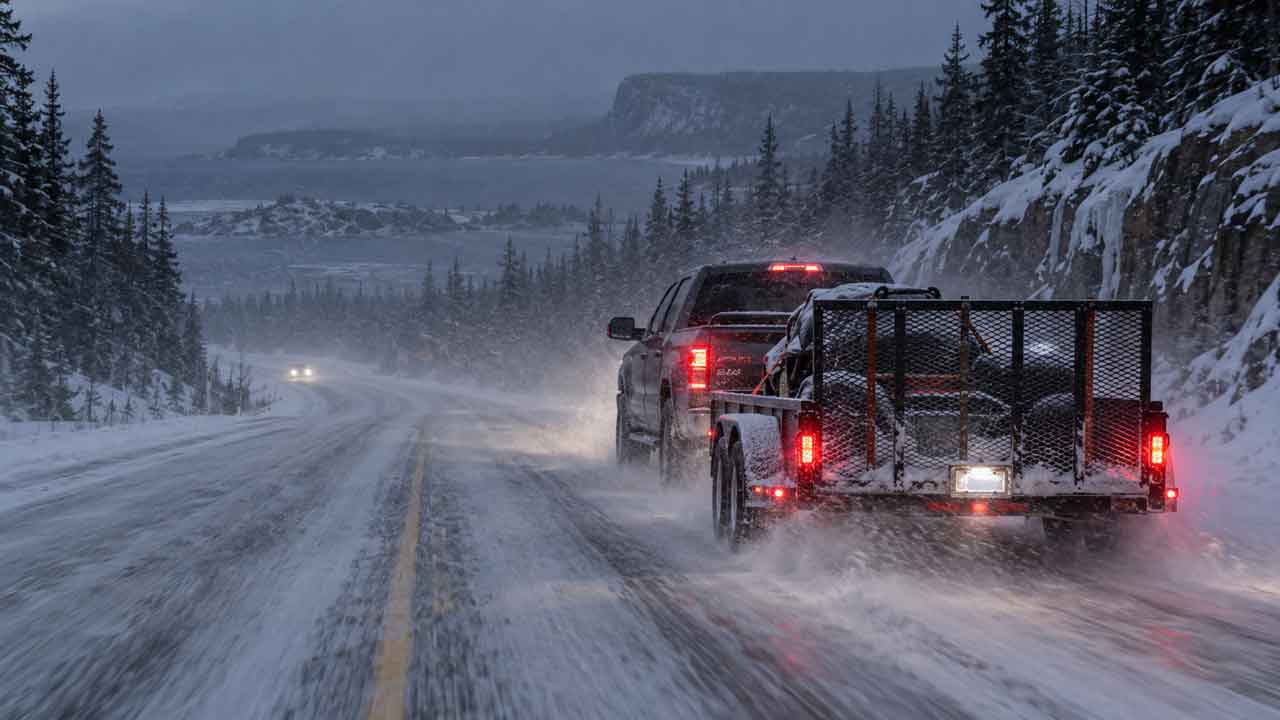
A trailer with dim or snow-covered lights can disappear from a following driver’s view in seconds on a Northwestern Ontario highway, especially when a squall rolls in off Lake Superior. Trailers get hauled all year in the north, to job sites, camps and trailheads, including through the coldest and darkest months, so lights are one part of trailer safety that cannot wait until spring. How can Northwestern Ontario drivers keep trailer lights visible in winter?
Clear snow and salt off every lens before each trip, check the connector and wiring for corrosion, replace dim or damaged lamps with sealed LEDs, and confirm the tail, brake, turn signal, and licence plate lights work.
That is the short version, but winter has a few surprises that catch even experienced haulers. Some popular upgrades can make snow buildup worse, and some of the worst failures start out of sight inside the plug, so it helps to know what actually goes wrong before the first storm.
Why Do Trailer Lights Fail More Often in Winter?
Winter is harder on trailer lighting than any other season. Road salt and slush work their way into connectors and ground points, and corrosion there often causes lights to flicker, dim, or quit altogether. Cold also stiffens wire insulation and plastic, so cables crack where they flex, and seals can let moisture in.
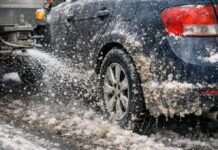
Frozen, rutted roads add vibration that shakes loose connections, and slush thrown up by the tow vehicle and the trailer’s own tires coats lenses and reflectors, cutting the light they put out. Lights that worked fine in a warm garage can fail once the trailer is a few kilometres down a salted highway.
How Bad Can Winter Visibility Get on Northwestern Ontario Highways?
NetNewsLedger’s own reporting shows how quickly conditions change. A staff review of public records published on April 20, 2026 found at least 20 significant collision, closure, or safety events on the Highway 11 and 17 corridor between November 1, 2025 and April 1, 2026, including more than 148 hours of closures from November through January. Snow squalls, blowing snow, and reduced visibility were among the main triggers, and commercial vehicles were involved in several serious incidents.
None of that means trailer lights were to blame in any particular crash. It does show that on long two-lane stretches where a whiteout can arrive without warning, the lights on the vehicle ahead are often the only signal a following driver gets.
What Does Ontario Require for Trailer Lights?
The Ontario driver’s handbook says a trailer must have a white licence plate light, a red tail light and two red reflectors at the rear, mounted as far apart as possible. Trailers wider than 2.05 metres also need two yellow clearance lights at the front and two red clearance lights or reflectors at the rear. The handbook also tells drivers to check the trailer’s lights, along with the hitch, wheels, tires and load, before each trip.
Federally, Transport Canada’s equipment requirements for trailers list tail lamps, stop lamps, rear turn signals, rear reflectors, licence plate lamps and side marker lamps, and say each device must comply with CMVSS 108, the Canadian lighting standard. Rules can change, and details depend on the trailer’s size and weight, so check the current wording with the Ministry of Transportation before assuming a trailer is covered.
Should You Switch to LED Trailer Lights for Winter?
For many drivers, yes. LEDs come on instantly, draw less current than filament bulbs, and generally cope better with moisture and vibration, which suits a trailer that spends its winter on salted, frozen roads. Boat trailers are a good example, since submersible LED models are built for trailers that get dunked at the launch.
There is one catch. LEDs give off very little heat, so snow and ice can stay stuck to the lens instead of melting off. Brush the lenses clear before every trip, and look at heated-lens versions if it is a regular problem. When buying replacements, look for DOT or SAE markings on the lens, match the size and wiring of the originals, and choose sealed units over bulbs in open housings. A catalogue that sorts lights by type, such as the trailer lights range at Ultra Bright Lightz, makes it easier to compare sizes, marker lights and wiring side by side.
What Should a Winter Pre-Trip Light Check Include?
Start by clearing snow, ice, and slush from every lens and reflector, including the side markers and the licence plate light. Then look at the plug and socket. Green or white crust on the pins is corrosion, and cleaning it and adding a little dielectric grease can save a lot of roadside trouble.
Finally, hook up and test everything with a helper standing behind the trailer: tail lights, brake lights, left and right turn signals, and the licence plate light. A small brush, spare fuses, and a couple of spare lamps in the truck make it easy to fix problems on the spot.
Your Next Step Is a Test Before the First Storm
Hook up the trailer this weekend, before the first real snowfall, and have someone stand behind it while you run every light. Replace anything that flickers, dims, or fails, because a cold roadside in a squall is the worst place to find out.