Thunder Bay’s Election: Safer Streets and a Stronger Economy Must Advance Together
NetNewsLedger Analysis | October 6, 2026
THUNDER BAY — Residents asking mayoral candidates to spend more time discussing jobs, investment and new businesses are raising a fair concern. Thunder Bay cannot build its future entirely around managing emergencies.
However, public safety, homelessness and economic development are closely connected.
Unsafe streets can discourage customers. Housing shortages can complicate recruitment. Repeated crises put pressure on resources also needed for infrastructure and growth.
A review of the candidates’ published positions finds that economic development is present in this campaign.
The more useful question is whether candidates offer credible plans to improve safety and attract investment at the same time.
Often in Thunder Bay it seems that the relationship between social issues, crime, and economic development is not fully understood. Prospective businesses from across the country looking at expanding or moving operations look at a city’s overall picture. People moving to a community will look at all of the amenities that the city offers. Then they will look at what problems or local issues that could impact their families will happen.
Thunder Bay’s issues that often seem glossed over; racism, crime, homelessness have had City Hall blaming national media over what is seen as uncomplimentary coverage.
What is not seemingly understood is that journalism is not public relations. Thunder Bay has seen some national media reports over time, especially on missing persons, crime, and social conditions that have pointed to our city’s problems.
Sometimes it is critical for that kind of reporting in order to initiate substantive change.
What the evidence shows
Statistics Canada’s July 22 release places the Thunder Bay census metropolitan area’s 2025 Crime Severity Index at 114.1, up three per cent. Its police-reported crime rate increased 18 per cent, reaching 8,373 incidents per 100,000 people.
Nationally, the Crime Severity Index fell five per cent and the crime rate declined two per cent.
These figures describe the metropolitan area, rather than simply the municipality or one police service. Neither measure represents an individual resident’s probability of becoming a victim. Nevertheless, the direction of the local figures gives candidates a substantial public-safety challenge to address. www150.statcan.gc.ca
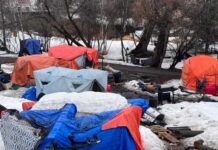
The Lakehead Social Planning Council’s October 5–6, 2024 count identified at least 557 people experiencing homelessness, with 78 per cent of respondents identifying as Indigenous. That is a dated minimum snapshot, not an October 2026 headcount. lspc.ca
These datasets do not establish that homelessness caused the increase in crime. Treating everyone without housing as a criminal would be inaccurate and would undermine efforts to protect people who also need safety and assistance.
How these issues affect Thunder Bay’s national reputation
The potential economic effects operate through several channels.
| Area | Potential consequence |
|---|---|
| Existing businesses | Theft, damage, intimidation and repeated disturbances can increase expenses and discourage customers or staff. |
| Recruitment | Prospective employees weigh neighbourhood safety, housing and family life alongside salary. |
| Tourism and events | Visitors and organizers consider whether transportation, downtowns and public spaces feel welcoming. |
| Investment | Businesses assess whether local government can deliver infrastructure, make predictable decisions and manage difficult issues. |
| Municipal finances | Emergency demands can compete with infrastructure maintenance and other spending priorities. |
These are plausible economic mechanisms, not a measured estimate of Thunder Bay’s losses. The sources reviewed do not establish how many investments, visitors or recruits the city has lost because of its reputation.
There is not a current representative national survey measuring Canadians’ current opinion of Thunder Bay.
That distinction matters.
Serious problems deserve accurate reporting without turning the entire city into a caricature.
Thunder Bay’s public image also includes concerns about racism and institutional trust. The 2018 Broken Trust review documented systemic racism within the police service and deficiencies in investigations involving Indigenous people. Those findings require substantive action, beyond a promotional campaign. newswire.ca
Progress belongs in the account, too. The oversight agency’s April 2024 update reported 27 recommendations fully implemented and significant progress on eight more. That documents reform work; it does not establish that every resident’s trust has been restored. leca.ca
The next mayor’s approach to reputation should therefore include safer daily experiences, respectful Indigenous relationships, reliable services and public evidence of improvement.
Are candidates overlooking business development?
The published platforms do not support a blanket claim that mayoral candidates are ignoring business.
The September 29 Chamber of Commerce forum addressed infrastructure, taxation, development, governance and Indigenous procurement alongside safety and homelessness. Seven candidates participated. An economic-development framework already exists. The CEDC launched its 2026–2030 Thunder Bay Forward planin January, covering investment attraction, business growth, workforce development and tourism. Candidates should explain which parts they would retain, change, fund and measure. CEDC
The evidence does not establish what proportion of the entire campaign has focused on social issues. It does establish that several candidates have published economic proposals.
Comparing the mayoral candidates
This comparison reflects public material reviewed as of October 6. It assesses proposals rather than endorsing candidates.
Where details are missing, that means they were not established in the material reviewed—not necessarily that a candidate has no position.
| Candidate | Published approach | Main question for voters |
|---|---|---|
| Moe Comuzzi | Supports Smart Growth, faster business and housing approvals, Pool 6 development and commercial growth around Innova Park. Her safety response combines police resources, property enforcement, treatment, supportive housing and prevention. | What are the costs, delivery dates and confirmed partners for each priority? |
| Peter Diedrich | Proposes five-year tax breaks for incoming STEM businesses, innovation partnerships, visible patrols, electronic surveillance and work with Infrastructure Ontario to revive LPH for transitional housing and mental-health care. | What is the lawful structure and cost of the incentives, and what approvals and operating funding would the housing and care proposal require? |
| Trevor Giertuga | Emphasizes Smart Growth, commercial and industrial investment, reduced development barriers, infrastructure and cooperation on crime, addictions and mental health. | Which priorities would receive funding first, and what would change from the present council’s approach? |
| Volker Kromm | Combines business growth and affordability with neighbourhood policing, prevention and a proposed treatment-and-recovery facility. | Can staffing proposals work within existing budgets, and who would finance and operate the facility? |
| Aldo Ruberto | Emphasizes stronger enforcement, downtown police locations, action on nuisance properties and coordinated housing, treatment, training and employment support. | Which measures can City Hall deliver, and what evidence, funding and legal authority support the rest? |
| Doug Vincent | Lists stronger police presence, development, spending control, new infrastructure funding approaches and action on homelessness and poverty. | What specific projects, housing outcomes and budget commitments would define his first year? |
| Wolfgang Schoor | Emphasizes construction discipline, infrastructure, safe transportation, public safety and bringing businesses back. | How would these priorities become a costed program with named delivery partners? |
| Peter Panetta | His public record includes youth mentorship through the Underground Gym. A detailed current platform was not established in this review; the City page carries no profile statement. | What is his complete 2026 plan for investment, safety, housing and municipal finances? |
| Donald Baxter | The City’s candidate page lists no profile statement, and this review did not establish a detailed current platform. | What policies, costs and implementation commitments is he asking voters to support? |
The comparison draws on candidate websites, their statements published by NetNewsLedger, the City’s candidate profiles and reported background.
Shane Judge remains on the ballot but has ended his active campaign, according to NetNewsLedger’s October 2 report. His earlier proposals included infrastructure priorities, shared administrative services and a housing task force. Those should be identified as earlier campaign proposals. netnewsledger.com
Where the strongest differences emerge
Comuzzi and Giertuga favour building on the existing growth framework. Comuzzi identifies development locations and approval processes. Giertuga connects investment, tax-base expansion and infrastructure.
These approaches offer continuity. Their test is delivery: which initiatives come first, how much they cost and what results would change? Identifying a development area does not establish a committed investor. moeformayor.ca
Diedrich proposes more explicit changes to economic-development tools. His business tax incentive and innovation proposals give voters concrete measures to examine. They also raise questions about foregone revenue, fairness to existing employers and whether subsidized investment would have happened anyway.
His safety and housing proposals require equally close examination: surveillance needs costs, privacy safeguards and effectiveness measures; the LPH proposal needs property, building, health-service and operating arrangements. These are proposals, not secured projects. Diedrich for Mayor
Kromm offers numerical commitments that can be scrutinized. In his September 12 response, he proposed six staffed neighbourhood policing zones, at least eight additional professional positions and a treatment centre serving at least 150 people, seeking at least $150 million from senior governments.
Those figures are candidate proposals—not approved funding or independently verified project estimates. Voters need an operating model, workforce plan and explanation of what redeploying police would change elsewhere. His broader platform also supports entrepreneurship, investment and skilled trades. Candidate for Mayor on Public Safety
Ruberto makes enforcement a prominent part of his approach, while also proposing coordinated treatment, housing and employment support. His acknowledgement that a mayor cannot direct police operations is important.
His proposals concerning sentencing, compulsory care and enforcement require scrutiny against actual authority and available services. Strong language cannot establish that a measure is lawful, funded or effective. Public Safety
Vincent and Schoor identify relevant municipal priorities, but the material reviewed provides fewer details for assessing costs, delivery and outcomes. Panetta and Baxter require more current public detail for a comparable assessment. City of Thunder Bay
Promises must match the mayor’s authority
Municipal leadership can influence budgets, infrastructure, development processes, public spaces and partnerships. Policing governance must remain distinct from operational command.
Ontario’s policing framework restricts police boards from directing specific operational decisions or day-to-day policing. A candidate’s commitment to support neighbourhood safety should therefore explain the governance and funding route, rather than imply personal command over officers. gsps.ca
Proposals depending on provincial health services, outside property owners or federal funding should identify those dependencies.
Seeking funding is not the same as securing it.
Every major proposal deserves the same questions: Who has authority? Who delivers it? What does it cost? Who pays? When does it start? How will residents know it worked?
Business growth needs more than a ribbon-cutting
For this election, a credible economic platform should explain how the city would:
- Retain and help expand businesses already operating here.
- Make development approvals timely and predictable.
- Prepare infrastructure and sites for investment.
- Connect training and housing with employers’ workforce needs.
- Build meaningful partnerships with Indigenous businesses and governments.
- Measure investment, employment and business survival.
These are proposed standards for judging platforms, rather than findings that any candidate has fulfilled every requirement.
New development also brings servicing and maintenance costs. More assessment can strengthen municipal finances, but voters should ask about the net benefit over time.
Similarly, moving people from one encampment to another would not, by itself, demonstrate reduced homelessness. A successful response needs to track stable housing and whether people remain housed.
The scorecard voters should demand
The next council should report publicly on a manageable set of outcomes:
| Priority | Results worth measuring |
|---|---|
| Safety | Violent and property crime trends, response times, and resident and business confidence. |
| Housing | Stable housing placements, returns to homelessness and access to appropriate supports. |
| Business | New investment, existing business expansions, business survival and occupied commercial space. |
| Delivery | Approval times, infrastructure condition, project completion and spending against budget. |
| Trust | Transparent reporting and meaningful participation by Indigenous partners and affected neighbourhoods. |
Thunder Bay’s next mayor needs to make the city easier to invest in and better to live in. The most credible campaign will show how to deliver both—with costs, partners, deadlines and results residents can check.