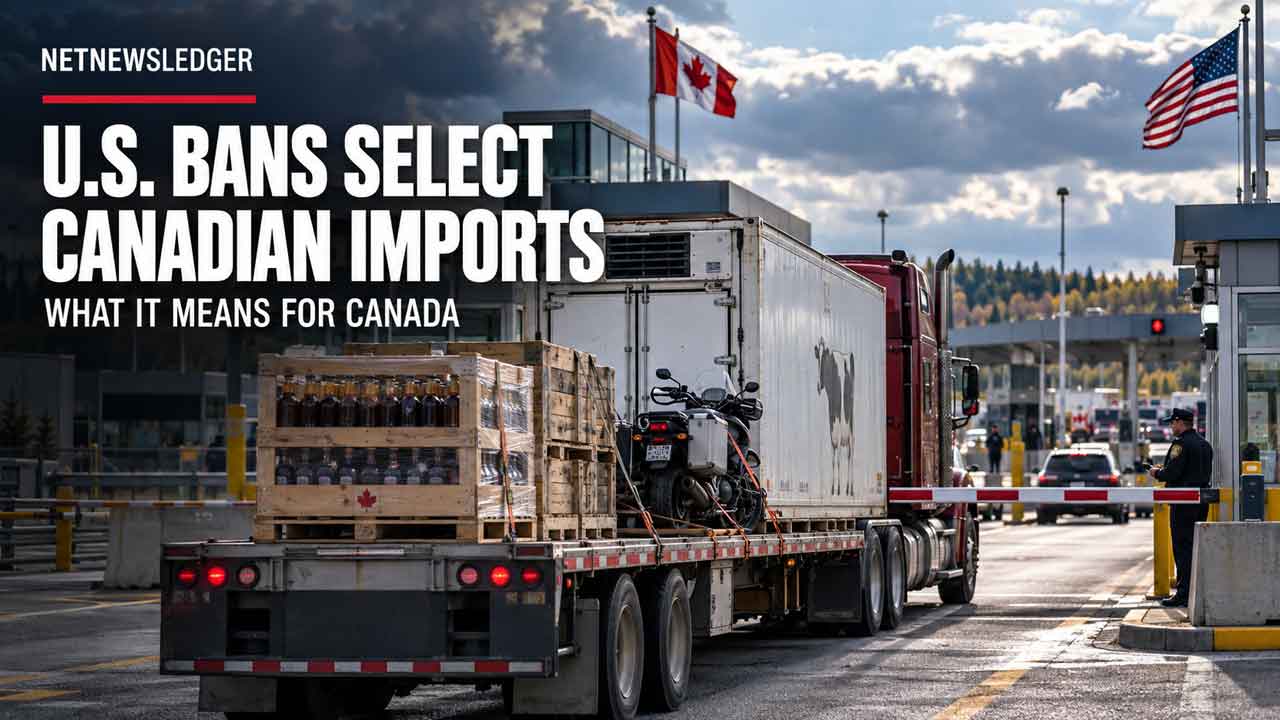
The United States has banned selected Canadian alcohol, dairy and vehicle imports. What does the escalating trade dispute means for consumers and Northwestern Ontario businesses
OTTAWA – BUSINESS AND TRADE – September 30, 2026 – The United States has escalated its trade dispute with Canada by replacing 50% tariffs on certain Canadian products with outright import bans.
The new restrictions took effect at 12:01 a.m. Eastern time on September 29, 2026. They cover selected Canadian alcoholic beverages, dairy products, motorcycles and other motor vehicles identified in US tariff schedules.
The change is more serious than another tariff increase.
A tariff makes an imported product more expensive. An import ban prevents the covered product from entering the US market.
The White House says affected products imported before September 29, but not yet entered for consumption or removed from a bonded warehouse, remain subject to the previous 50% duty.
Approximately US$1 Billion in Canadian Trade Affected
The estimates that the newly banned products represent approximately US$1 billion in annual Canadian exports, based on earlier trade figures.
That is a small share of the roughly US$880 billion in annual trade between Canada and the United States. However, the total figure does not show the damage that may be concentrated in individual companies, communities and industries.
A producer that depends heavily on the US market could lose an important customer base overnight. Smaller manufacturers may have fewer options for redirecting inventory or absorbing the cost of interrupted contracts.
What Products Are Covered?
The US measures apply to selected products within three broad groups:
- Canadian alcoholic beverages;
- Canadian dairy products; and
- Canadian motorcycles and other motor vehicles.
The restrictions do not automatically cover every Canadian product in those categories. The legal treatment depends on the product’s Harmonized Tariff Schedule classification and the specific annex attached to the relevant US presidential proclamation.
Exporters should not rely on a general product description. They should confirm the tariff code, country-of-origin treatment, shipment date and customs status with a qualified customs broker or trade lawyer.
Why Washington Imposed the Bans
US President Donald Trump used Section 338 of the Tariff Act of 1930 to impose the restrictions.
The White House alleges that Canada discriminates against American commerce through its management of dairy tariff-rate quotas, restrictions affecting US alcoholic beverages and measures involving motor vehicles.
Canada rejects the US position. Ottawa says its dairy system complies with the Canada-United States-Mexico Agreement and that Canadian measures affecting American goods were legitimate responses to earlier US tariffs.
These remain opposing government positions. The latest US proclamations enact the bans, but the political claims used to justify them should not be treated as independently proven findings.
Canada’s Counter-Tariffs Remain in Force
Canada’s existing counter-tariffs have not been removed.
Since September 8, 2026, Canada has imposed surtaxes of 15%, 25% or 50% on selected US-origin goods representing approximately C$27.6 billion in imports.
The Canadian measures cover products in sectors that include:
- Steel and aluminum;
- Dairy products;
- Household appliances;
- Agricultural equipment;
- Pulp and paper products;
- Electronics;
- Cosmetics and personal-care products;
- Industrial machinery and tools; and
- Selected recreational and consumer products.
The surtax depends on the customs classification of each product. It applies to covered goods that originate in the United States, not simply to every item sold by an American company.
No official announcement had been identified early Wednesday of a new Canadian tariff rate, a new broad Canadian exemption or a completed Canada-US trade agreement.
What This Could Mean for Canadian Consumers
The US import bans directly target Canadian exporters. They do not place a new tax on Canadian shoppers.
However, Canadian consumers may still feel indirect effects.
Some Canadian Goods Could Be Redirected Home
Canadian producers blocked from the US market may attempt to sell more products in Canada or find customers in Europe, Asia and other markets.
In the short term, additional domestic supply could produce promotions or lower wholesale prices on some goods. That outcome is not guaranteed. Shipping arrangements, provincial alcohol systems, product standards and distribution contracts can make it difficult to redirect goods quickly.
Job and Investment Risks Could Reduce Household Spending
Exporters that lose US sales may reduce production, delay investment or cut working hours. If the dispute continues, some companies could move production closer to their US customers.
Lost jobs or reduced hours would have a larger effect on household finances than modest price changes at the store.
Canada’s Own Tariffs Can Raise Retail Prices
Canadian importers pay the surtax when covered US-origin products cross the border. Businesses may absorb part of that cost, switch suppliers or pass the added expense to customers.
A 25% tariff does not always produce an immediate 25% increase at the cash register. The final change depends on transportation costs, contracts, exchange rates, distributor margins, available inventory and whether a Canadian or overseas substitute exists.
However, sustained tariffs generally create upward price pressure when businesses cannot find a practical alternative.
Cross-Border Shoppers Must Check Country of Origin
The Canada Border Services Agency says returning travellers must pay applicable surtaxes on covered US-origin goods that do not qualify for an exemption.
The surtax does not replace GST, HST or regular customs duties. It is added to the value used to calculate applicable taxes.
A product purchased in the United States is not necessarily US-origin. It may have been manufactured in Canada, Mexico, Europe or Asia. Receipts, product labels and origin documentation can matter at the border.
Northwestern Ontario Businesses Face Supply-Chain Questions
The direct export bans focus on specific alcohol, dairy and vehicle products. The wider tariff conflict could affect a broader range of Northwestern Ontario companies through purchasing costs, shipment delays and weaker customer demand.
The most exposed sectors are likely to include:
- Mining companies purchasing US-made equipment and replacement parts;
- Construction contractors buying steel, aluminum, tools and machinery;
- Forestry companies importing processing equipment or specialized components;
- Transportation companies operating cross-border routes;
- Retailers selling American appliances, electronics or outdoor equipment;
- Food distributors and institutional suppliers; and
- Tourism businesses that depend on American visitors.
These are exposure risks, not confirmed losses. Many US-company products are manufactured outside the United States, while some Canadian products contain American components. Customs treatment depends on origin rules and classification, not the location of a company’s head office.
Mining and Construction Costs Deserve Close Attention
Northwestern Ontario has major proposed mining, road, transmission and community-infrastructure projects. Tariffs on steel, aluminum, machinery or replacement parts could affect project budgets and delivery schedules.
A contractor preparing a bid may need to obtain shorter supplier-price guarantees, identify Canadian alternatives and include clear contract language covering tariff changes.
Mining operators should review inventories of critical parts that may be difficult to replace locally. Stockpiling every component would tie up cash and storage space, but identifying long-lead items can reduce the risk of an unexpected shutdown.
Practical Steps for Businesses
Northwestern Ontario businesses can reduce their exposure by taking several practical steps:
- Confirm the Harmonized System classification and country of origin for important imports and exports;
- Ask suppliers whether quoted prices include tariffs and customs fees;
- Identify Canadian, European or Asian alternatives for critical US-origin products;
- Review contracts for tariff, force majeure and price-adjustment clauses;
- Track federal remission orders that may provide relief for specific uses or industries;
- Avoid describing a product as tariff-free without written customs confirmation; and
- Consult a customs broker before changing shipment routes or invoicing practices.
What Happens Next?
The next developments to watch include:
- Changes to the White House product annexes;
- US Customs and Border Protection implementation guidance;
- Canadian remission orders or targeted exemptions;
- Court challenges to the President’s use of Section 338;
- Additional Canadian countermeasures; and
- A formal restart of Canada-US trade negotiations.
A political statement about possible negotiations is not the same as a settlement. Businesses should plan around measures that are legally in force while remaining ready to adjust if the two governments reach an agreement.
The Bottom Line
The September 29 import bans mark a serious escalation because selected Canadian products are no longer simply taxed at the US border. They are blocked from entering the market.
The immediate Canadian consumer effect may be limited, but the longer-term risks include lost export sales, reduced investment, job losses and higher costs for businesses importing tariffed American goods.
For Northwestern Ontario, the main concern is the cumulative effect on mining, construction, forestry, transportation and retail supply chains. Companies should verify product classifications, review contracts and develop alternative suppliers before tariff uncertainty becomes an operational problem.