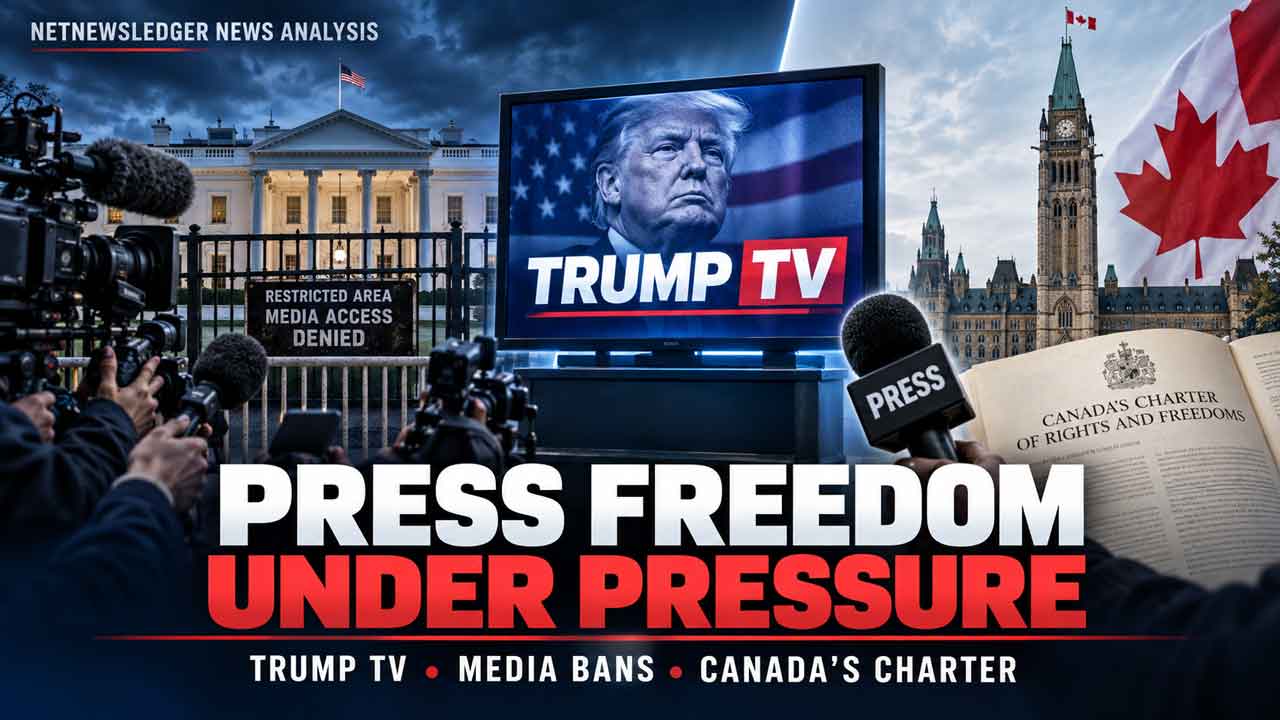
CNN, MS NOW and Politico have gone to court after their journalists were barred from White House grounds. The launch of “Trump TV” adds a second issue: can a government exclude independent reporters while presenting its own official stream as the public’s window into power?
WASHINGTON – NEWS ANALYSIS – September 22, 2026 – President Donald Trump’s decision to bar CNN, MS NOW and Politico from the White House has created one of the clearest press-freedom confrontations of the modern presidency.
This is not simply another argument between a president and reporters. Presidents criticize the press, refuse interviews and choose which questions to answer. The constitutional issue begins when government power is used to deny access because officials dislike a news organization’s reporting or point of view.
Trump announced the ban on September 18, accusing the three outlets of reporting what he called “fake news.” Reporters from the organizations were turned away the next morning, and their White House credentials were deactivated. CNN, MS NOW and Politico filed a federal lawsuit on September 21, alleging violations of the First Amendment and the Fifth Amendment’s guarantee of due process. They asked a judge to restore access while the case proceeds.
As of September 22, the court has not ruled on the merits. A hearing on the request for immediate temporary relief is scheduled for September 23. That distinction matters: the ban is a verified fact, but its constitutionality remains a question for the courts.
What the First Amendment Actually Says
The First Amendment says that Congress shall make no law abridging freedom of speech or of the press. Through later constitutional doctrine, those protections restrain the federal government as a whole, including the executive branch.
The amendment protects publication, editorial judgment, criticism of government and the gathering of news. It is especially important when reporting concerns the conduct of public officials.
However, the Constitution does not give every journalist an automatic right to enter every government building, attend every presidential meeting or receive an interview. The Oval Office is a working and secure space, not a public park. Space, safety and operational limits can justify a small press pool or other restrictions.
The key legal line is viewpoint discrimination. Government may impose reasonable, neutral access rules. It generally may not open facilities to qualified journalists and then exclude particular reporters or outlets because officials object to what they publish.
The Strongest Argument Against the Ban
The president publicly connected the ban to coverage he dislikes. That may make the government’s legal defence more difficult.
If the White House had cited a documented security threat, failure to pass a background check, serious disruption or violation of a clearly written rule, it could argue that the restriction was based on conduct rather than viewpoint. Instead, Trump’s stated justification focused on the content of the outlets’ journalism.
Calling reporting “fake news” does not, by itself, create a constitutional exception. A president may dispute a story, provide evidence, seek a correction or bring a valid defamation claim. The government cannot simply declare unfavourable journalism false and then punish the publisher without the safeguards of law.
The ban also raises a Fifth Amendment issue. The outlets say their credentials were cancelled without advance notice, stated standards or an opportunity to respond. Even where access can lawfully be denied, decades of case law require meaningful rules and fair procedures when an established White House press credential is refused, suspended or revoked.
The White House’s Best Legal Argument
The White House can point to the president’s authority to control secure and limited-capacity spaces. Courts have recognized that journalists do not have an unrestricted right to enter the Oval Office, travel on Air Force One or attend every small presidential event.
A divided federal appeals panel made that distinction in the Associated Press access dispute in 2025. It temporarily allowed the administration to exclude the AP from certain tightly controlled spaces while an appeal continued, although the panel treated broader White House press facilities differently. A final decision in that case remained pending when the new lawsuit was filed.
That precedent gives the administration a stronger argument about a single seat at a small event than about an organization-wide ban from White House grounds. The broader the exclusion, and the more clearly it is tied to editorial viewpoint, the weaker the defence becomes.
Four Cases That Define the Dispute
| Case | What happened | Why it matters now |
|---|---|---|
| Sherrill v. Knight (1977) | A journalist was denied a White House pass on security grounds without adequate standards or a fair process. | The court required meaningful standards, notice of the reasons, an opportunity to respond and a final written decision. It found First and Fifth Amendment violations. |
| CNN v. Trump (2018) | The White House revoked correspondent Jim Acosta’s hard pass after a contentious press conference. | A federal judge ordered the pass restored on due-process grounds. The ruling showed that a credential cannot be removed through an improvised and unexplained process. |
| Karem v. Trump (2020) | The White House suspended reporter Brian Karem’s pass for 30 days under an unwritten standard of professional conduct. | The appeals court upheld an injunction, finding that Karem lacked fair notice that his conduct could trigger that punishment. |
| Associated Press v. Budowich (2025-present) | The AP challenged restrictions imposed after it continued using “Gulf of Mexico” while acknowledging Trump’s preferred “Gulf of America.” | The litigation highlights a distinction between discretionary access to small presidential spaces and broader access to established press facilities. The case was not finally resolved as of September 22, 2026. |
Is the First Amendment Still Applicable in the Digital Age?
Yes. The First Amendment is technology-neutral. Its protection does not end when reporting moves from newsprint and broadcast towers to websites, podcasts, livestreams, newsletters or social media.
The Supreme Court has repeatedly applied free-expression principles to new communications technology. The internet changes the speed, reach and business model of journalism, but it does not give government a new power to punish criticism.
Digital media does complicate the definition of “the press.” A reporter may work for a television network, a local online publication, a non-profit newsroom or an independent channel. That reality supports clear, neutral credential rules based on genuine newsgathering need, security and capacity – not political loyalty or whether an outlet is traditional or digital.
There is also an important distinction between government and private platforms. The First Amendment limits state action. It normally does not force a privately owned social network to carry every speaker. By contrast, the White House is part of the federal government. When public officials distribute access or credentials, constitutional limits apply directly.
The White House may publish its own videos and speak directly to the public. That does not replace independent journalism. Government video shows what officials choose to show; reporters ask questions, compare claims with records, speak to other sources and document events from outside the official frame.
“Trump TV” Is Now Part of the Story
The White House launched a stream branded “Trump TV” on September 21, three days after Trump announced the media ban. An official White House page declared, “Trump TV is Here.” The administration said the stream would carry videos and highlights of what it describes as its achievements.
The launch trailer focused on Trump’s 2024 election victory. The first video carried after the launch was a recording of his July 3 remarks at Mount Rushmore. The YouTube stream had about 8,000 live viewers 15 minutes after it began.
There is nothing automatically unconstitutional about a president operating an official video channel. The White House has long issued speeches, photographs, livestreams and edited videos. Canadian and Ontario governments do the same through their websites, newsrooms and social-media accounts. In Ontario the Doug Ford Government in their first term operated a Youtube channel.
The concern comes from the combination of actions
An official channel is controlled by the government. It decides which events to show, which clips to repeat and which questions – if any – the public hears. Independent reporters decide for themselves what is important, seek contrary evidence and ask questions officials may not want to answer.
The other major U.S. television networks suspended their participation in the White House television pool after CNN was prevented from carrying out its scheduled pool assignment. The result demonstrated the practical difference. The independent pool did not provide its usual shared coverage, while audio on the White House’s own stream of one ceremony was inaudible.
Supporters may see “Trump TV” as direct communication without a media filter. Critics, including the Knight First Amendment Institute’s Jameel Jaffer, have described it as government propaganda. The most accurate description is narrower: it is official government communication, not independent news. Viewers should treat it as a primary source showing what the administration chooses to present, not as a substitute for verified reporting.
Have Other Presidents Excluded News Organizations?
Yes, but the historical examples are not all equivalent.
Richard Nixon’s White House excluded The Washington Post from some social events during the Watergate era. Nixon was recorded demanding that Post reporters not be admitted, although the newspaper’s formal White House credentials were not completely withdrawn.
In 2009, Barack Obama’s White House attempted to exclude Fox News from a pool interview with executive-pay official Kenneth Feinberg. The other television networks objected and Fox was included. That was a serious access dispute, but it did not become a continuing ban on Fox journalists entering the White House.
In 2011, the Obama administration disputed a San Francisco Chronicle reporter’s use of video while serving as a print pool reporter at a fundraiser. The White House denied imposing a formal ban, but the reporter later said the Chronicle was not selected for local pool duty for about a year.
Trump’s first administration tried to revoke or suspend the credentials of individual reporters, including Jim Acosta and Brian Karem. Courts intervened. During Trump’s second administration, the Associated Press was restricted from some presidential events in 2025 over an editorial language decision.
Those episodes show a long history of presidents trying to control access and presentation. They do not make every restriction lawful. The current action is notably broader because three entire news organizations were barred from White House grounds and the president expressly linked the decision to their coverage.
A Note About the “White House Press Gallery”
The phrase is commonly used, but it is not technically precise. Congress has press galleries. The White House has a press area, briefing room, credential system and press pools for events where space is limited.
The distinction matters because different rules can apply to a generally available press area, a briefing-room seat, a rotating pool assignment and a small Oval Office event. A court is likely to examine the exact access denied, not simply decide whether journalists have a general right to be near the president.
Could a Canadian Government Ban a News Outlet?
A Canadian government could attempt it, but a ban imposed because officials dislike an outlet’s reporting would face a serious legal challenge.
Section 2(b) of the Canadian Charter of Rights and Freedoms protects “freedom of thought, belief, opinion and expression, including freedom of the press and other media of communication.” That wording is deliberately broad. It covers newspapers, radio and television, but it can also protect online publications, podcasts, livestreams and other digital journalism.
The Charter applies to federal and provincial governments and generally to municipalities when they exercise governmental power. It does not normally apply to a private venue, a private social-media platform or a political party acting in a private capacity. The facts matter. An event organized and controlled by the Prime Minister’s Office, an Ontario ministry or a municipal government is different from a party fundraiser or a privately run conference.
Canada also does not use the U.S. Fifth Amendment model for press credentials. A Canadian challenge would likely combine section 2(b), administrative law and procedural fairness. A court would ask whether the decision was authorized, whether clear and consistent criteria were used, whether the outlet had a fair chance to respond, and whether the decision reasonably balanced press freedom against legitimate concerns such as security, space or serious disruption.
Canada Has Already Faced Similar Access Disputes
There is no exact Canadian equivalent to the current White House ban, but there are important precedents.
In February 2016, Alberta’s NDP government barred two Rebel Media reporters from government news conferences, saying the organization was not a journalistic source. The government reversed the decision within days, acknowledged that it had made a mistake and ordered a review. The review later recommended that the independent legislature press gallery, rather than the government, control access to news conferences in the legislature’s media room.
In October 2019, the federal Leaders’ Debates Commission denied accreditation to journalists from Rebel News and the True North Centre for Public Policy. The Federal Court issued an urgent order allowing them to attend the official federal leaders’ debate. The court later said the journalists had a strong likelihood of proving that the decision was unreasonable and procedurally unfair. The commission had not published clear criteria, had not adequately explained its “advocacy” rule and had not given the applicants a meaningful opportunity to respond.
The court did not create an unlimited right for anyone claiming to be a journalist to enter every government event. It showed that an official body cannot use vague, inconsistently applied criteria to decide which journalists may ask public officials questions.
Canadian courts have also recognized limits. In Canadian Broadcasting Corp. v. Canada (Attorney General), the Supreme Court of Canada held that news gathering is protected by section 2(b), but that journalists do not have an unrestricted constitutional right to conduct interviews, film or take photographs everywhere inside a courthouse. Neutral rules tied to the function, safety and order of a public institution can survive review.
What About Ontario?
Our review did not identify a recent Ontario government action as broad as banning an entire news organization from Queen’s Park and all provincial government media events because of its editorial coverage. That does not mean Ontario governments have never controlled access, limited questions or favoured particular formats. It means those practices should not be described as the equivalent of the current White House ban without evidence of a formal, outlet-wide exclusion.
Three distinctions are important at Queen’s Park:
- Government news conferences: A ministry or the Premier’s Office using public authority to exclude an outlet because of its viewpoint would likely engage section 2(b) and administrative-law review.
- The Legislative Assembly: The Speaker and the Assembly have constitutional parliamentary privileges over proceedings and access inside the chamber. The Supreme Court’s New Brunswick Broadcasting decision confirms that these privileges can make the analysis different from an executive-branch news conference.
- The Queen’s Park Press Gallery: A decision made independently by a journalists’ association is not automatically government action. Charter application would depend on the degree of government control, delegation or involvement.
Campaign events create another boundary. An Ontario political party may be subject to election law and public scrutiny, but it is not automatically the provincial government for every Charter purpose. A government cannot avoid constitutional review simply by relabelling an official event as partisan, but neither is every private party gathering a public forum.
Thunder Bay: Accreditation and Unequal Notice
Press-access concerns are not limited to Washington, Ottawa or Queen’s Park. Canadian media organizations have raised complaints at different times about being left out of government or police media events.
The Thunder Bay Police Service maintains an accreditation system with specific journalistic standards for deciding which organizations and reporters receive media material. The publicly available TBPS guide on missing-person communications states that a missing-person release is distributed to accredited news organizations and journalists before it is posted on the police website and social-media accounts.
Information provided to NetNewsLedger indicates that APTN, The Globe and Mail and Ricochet Media were recently not informed about a TBPS press conference concerning a missing-person case. The concern was raised with the Police Service and appears to have been resolved.
That incident should not be described as equivalent to Trump’s organization-wide White House ban. There is no indication that the three Canadian outlets were formally stripped of accreditation or permanently barred from TBPS events. An omitted notice could result from an outdated distribution list, an administrative mistake or a disagreement about accreditation. Those possibilities are different from deliberate retaliation for critical coverage.
However, the distinction does not make the issue unimportant. A police press conference about a missing person can produce new evidence, public appeals and direct answers that are not available in a written release. If some qualified journalists receive advance notice while others do not, the excluded organizations lose the opportunity to ask questions and provide timely information to their audiences.
The Indigenous dimension requires particular care. APTN and Ricochet Media have devoted significant reporting to Indigenous people, policing and missing-person cases in Thunder Bay. The Globe and Mail brings national reach. Leaving those organizations out of a missing-person briefing, even unintentionally, can deepen concerns among communities that already have documented reasons to question how police communicate about Indigenous deaths and disappearances.
Clear standards protect both the Police Service and journalists. They help TBPS exclude people who misrepresent themselves or interfere with operations without allowing officials to choose among outlets based on tone, criticism or editorial position.
As a public police service exercising governmental authority, TBPS is subject to the Charter. It may impose reasonable security and operational rules, but selective treatment based on viewpoint would raise serious section 2(b) concerns. Even where the Charter claim is uncertain, inconsistent accreditation or notice could be challenged as unreasonable or procedurally unfair.
How Section 1 of the Charter Changes the Canadian Test
Unlike the absolute wording of the U.S. First Amendment, Canadian Charter rights are expressly subject to section 1. Governments may impose reasonable limits that are prescribed by law and can be demonstrably justified in a free and democratic society.
That does not give officials a free hand. A limit must serve a pressing and substantial objective, be rationally connected to that objective, impair the right no more than reasonably necessary and produce benefits that outweigh the harm. Security screening, room capacity and rules against persistent disruption can be legitimate. Punishing an outlet for unfavourable reporting would be much harder to justify because it strikes at political expression and democratic accountability.
If a Canadian government imposed a viewpoint-based ban, the outlet could seek judicial review and an urgent injunction restoring access. A court could set aside the decision, issue a declaration or grant another appropriate remedy under section 24(1) of the Charter. If the restriction came from legislation, a court could declare the law of no force or effect under section 52 of the Constitution Act, 1982.
Parliament or a provincial legislature could theoretically invoke section 33, the notwithstanding clause, against section 2 rights through express legislation. That would be an extraordinary step. It could not be done by a press secretary’s announcement, it would expire after five years unless renewed, and using it to shield retaliation against the press would carry major democratic and political consequences.
The Canadian Ramifications Go Beyond One Outlet
A government does not need to arrest journalists or censor a printing press to weaken media freedom. It can create a chilling effect by making access depend on favourable coverage, rewarding friendly outlets, withholding routine information or forcing reporters to rely on polished official feeds.
In Canada, the Charter’s reference to “other media of communication” makes section 2(b) well suited to the digital age. The harder question is not whether online journalism is protected. It is how courts should distinguish a working journalist from an activist, influencer or partisan operator without allowing government to choose only supportive voices.
The soundest answer is transparent, published and viewpoint-neutral accreditation. Criteria can consider security, capacity, a record of newsgathering and compliance with reasonable conduct rules. They should not turn on whether the government likes the questions, the headlines or the outlet’s editorial position.
Canada and Ontario can operate official video channels. They cannot use official communication as proof that independent access no longer matters. A government feed is evidence of what the government said and chose to show. A free press tests those claims on behalf of the public.
What Happens Next?
The immediate question is whether the judge will temporarily restore access while the lawsuit continues. To obtain emergency relief, the outlets must generally show a likelihood of success, irreparable harm and that the balance of interests supports an injunction.
The case could then move through appeals, where judges may draw a careful line between broad access to White House press facilities and selective invitations to restricted presidential spaces.
The strongest constitutional conclusion at this early stage is narrow but important: the First Amendment does not guarantee every outlet every seat, but it makes government retaliation for critical reporting highly suspect. Security and capacity are legitimate reasons to regulate access. Dislike of an editorial viewpoint is not.
The digital age does not weaken that principle. It makes the principle more important because governments can now bypass independent reporters, distribute polished material directly and attempt to define criticism as disinformation. The public can hear from a president instantly. It still needs independent journalists who can verify what the president says.
This article is a news analysis, not legal advice. The constitutional claims described here are being litigated and may be affected by new court orders.
Overview
Trump’s media ban and “Trump TV” test press freedom. The analysis examines Canada’s Charter, Ontario access rules and a recent Thunder Bay media complaint.
Sources Checked
- Reuters – Trump announces the ban, September 18, 2026
- Reuters – Reporters turned away and passes confiscated, September 19, 2026
- Reuters – CNN, MS NOW and Politico file suit, September 21, 2026
- The White House – “Trump TV is Here,” September 21, 2026
- Reuters – Legal analysis and case status, September 22, 2026
- Congress.gov – Constitution Annotated, First Amendment
- U.S. Court of Appeals – Sherrill v. Knight (1977)
- U.S. Court of Appeals – Karem v. Trump (2020)
- U.S. District Court – Associated Press v. Budowich preliminary-injunction ruling (2025)
- Reporters Committee for Freedom of the Press – 2009 Fox News pool dispute
- Smithsonian Magazine – Nixon and White House press history
- Department of Justice Canada – Canadian Charter of Rights and Freedoms, sections 1 and 2(b)
- Department of Justice Canada – Charterpedia analysis of section 2(b)
- Department of Justice Canada – Charterpedia analysis of section 1
- Supreme Court of Canada – R. v. Vice Media Canada Inc. (2018)
- Supreme Court of Canada – Canadian Broadcasting Corp. v. Canada (Attorney General) (2011)
- Supreme Court of Canada – New Brunswick Broadcasting Co. v. Nova Scotia (Speaker) (1993)
- Canadian Bar Association – Federal Court order on 2019 leaders’ debate accreditation
- Global News – Alberta government reverses Rebel Media ban, February 17, 2016
- Global News – Alberta access review, March 18, 2016
- Thunder Bay Police Service – Missing Person Media Release Best Practices
- Thunder Bay Police Service – Corporate Communications and Media Relations contact information
- Office of the Independent Police Review Director – Broken Trust report