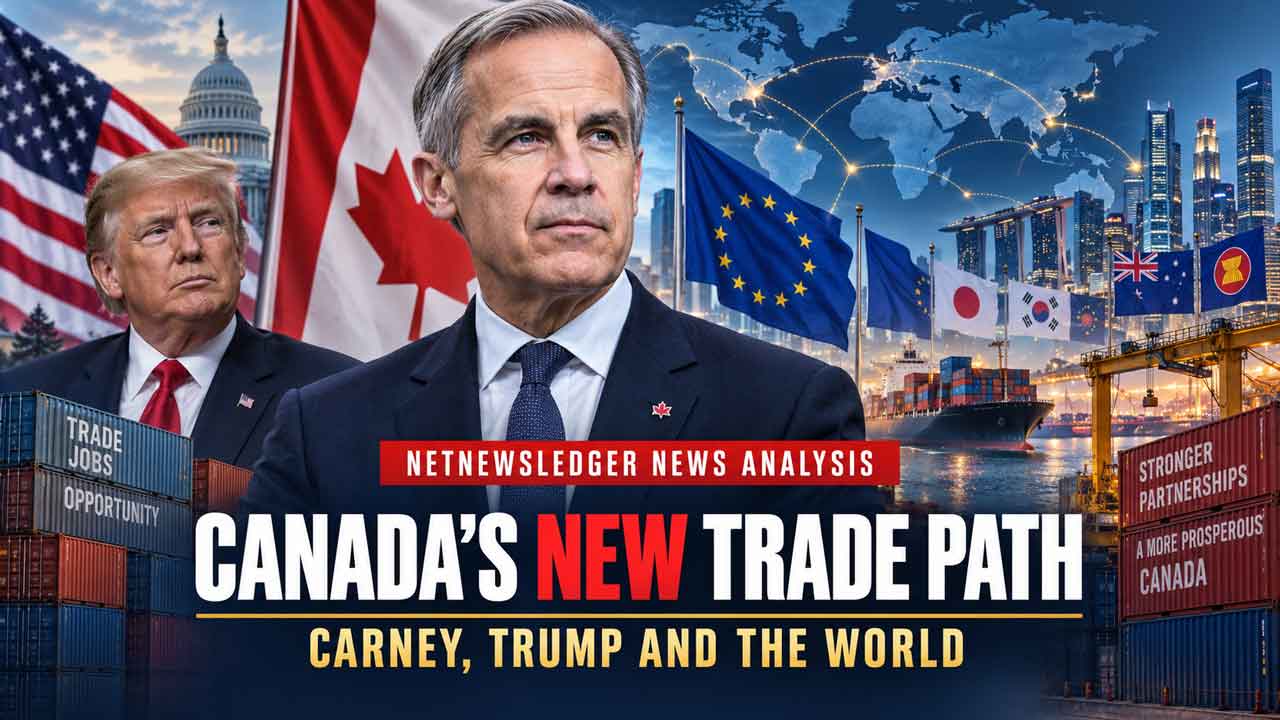
Analysis: Canada is building stronger links with Europe and Asia, but the strategy is not a divorce from the United States. Its success will depend on infrastructure, productivity and whether new agreements produce real trade
OTTAWA – ANALYSIS – September 22, 2026 – Prime Minister Mark Carney has moved Canadian economic and foreign policy quickly since taking office in March 2025. The change has unfolded over about 18 months, rather than less than a year, but it has still been unusually fast by Canadian standards.
Carney’s government has deepened Canada’s security and economic relationship with the European Union, accelerated trade negotiations across the Indo-Pacific, lowered federal barriers to internal trade and promoted large projects intended to reach markets beyond the United States.
At the same time, Carney has tried to manage an increasingly difficult relationship with U.S. President Donald Trump. He has avoided matching every insult, preserved room for negotiation and refused terms that Ottawa says would limit Canada’s freedom to make its own trade agreements.
Supporters describe that approach as calm resistance to economic bullying. Critics say Carney is using the Trump crisis to make sweeping changes that Canadians did not specifically approve.
Both arguments contain part of the truth. Canada is making a real strategic shift. It is also doing so under severe economic pressure, with several of its most ambitious initiatives still incomplete.
First, Canada Is Not Joining the European Union
The phrase “EU associate membership” has created more heat than clarity
European Commission President Ursula von der Leyen floated the idea of Canada becoming the EU’s first associate member in September 2026. Carney welcomed the ambition behind closer cooperation, but he did not say Canada was seeking full EU membership.
The distinction matters. An EU associate-member category does not presently exist in European treaties. Its rights, costs and obligations have not been defined. Any formal arrangement could face difficult negotiations and approval by EU member states.
Carney has instead described a “unique alliance” built around practical cooperation in defence, critical minerals, artificial intelligence, energy, digital trade and youth mobility. He has also said any agreement would be debated and voted on in Parliament.
The most likely result is not membership in the normal sense. It is a set of agreements that allow Canada to join selected European programs and supply chains while retaining Canadian sovereignty.
That process has already started. Canada and the EU announced a new Strategic Partnership of the Future and a Security and Defence Partnership in June 2025. Canada later became the first non-European country to join the EU’s Security Action for Europe, or SAFE, defence initiative.
This is meaningful, but it is not the same as gaining access to the EU Single Market or a seat in EU institutions. Canada already has a major trade agreement with Europe through CETA. Bilateral merchandise trade grew by more than 77 per cent between 2016 and 2025, according to Global Affairs Canada. However, CETA is still only provisionally applied because not every EU member state has ratified it.
That unfinished business is a warning. A large announcement in Brussels does not automatically remove the regulatory, political and transportation barriers that Canadian exporters face.
The Asia-Pacific Push Is Real, but Several Deals Are Not Finished
Canada’s Indo-Pacific strategy is more advanced than the EU headline may suggest, but the record is mixed. Some agreements are signed. Others are negotiating objectives, not completed trade deals.
| Partner | Status on September 22, 2026 | Why It Matters |
|---|---|---|
| Indonesia | A bilateral economic partnership agreement was signed in September 2025. | It was Canada’s first bilateral trade agreement with an ASEAN country and is designed to reduce or eliminate tariffs on more than 95 per cent of current Canadian exports. |
| Philippines | Negotiations are more than 90 per cent complete, according to Canada’s trade minister, with Ottawa seeking a conclusion by November 2026. | The government sees opportunities in agriculture, forest products, energy, infrastructure and digital services. |
| ASEAN | Regional free-trade negotiations are also reported to be more than 90 per cent complete. Talks began in 2021, before Carney became prime minister. | An agreement could give Canadian firms broader access across a fast-growing Southeast Asian market. |
| India | Canada and India resumed comprehensive trade talks and have set an ambitious goal of reaching an agreement in 2026. | The opportunity is large, especially in energy, uranium, agriculture, technology and critical minerals, but the deadline is political rather than guaranteed. |
| Thailand | Free-trade negotiations were launched in late 2025. | The talks add another possible route into Southeast Asian manufacturing and consumer markets. |
Carney deserves credit for giving these files political urgency. He should not receive credit for starting every one of them. The Canada-ASEAN negotiations began in November 2021, and exploratory discussions with the Philippines began before he took office.
The economic test is also more demanding than signing agreements. Canadian businesses must use the tariff preferences. Canada needs ports, rail capacity, electricity, processing facilities and reliable transportation corridors to deliver products across the Pacific. Small and medium-sized firms need help managing foreign regulations and finding customers.
Without that practical work, trade agreements can produce impressive communiques without producing enough new sales.
Carney’s Trump Strategy: Restraint, Resistance and Diversification
Carney’s handling of Trump is sometimes described as either submission or defiance. In practice, it has combined both restraint and resistance.
The government has tried to protect tariff-free trade under the Canada-United States-Mexico Agreement, or CUSMA, while avoiding a public quarrel over every presidential statement. It has also imposed counter-tariffs when negotiations failed and rejected U.S. demands that Ottawa viewed as an unacceptable limit on Canadian decision-making.
This approach recognizes a basic imbalance. The United States has much more economic power and can impose pain on Canada faster than Canada can respond. Escalation for its own sake may satisfy public anger while damaging Canadian workers and exporters.
However, refusing every confrontation would invite further pressure. Carney’s answer has been to keep the door open to a workable U.S. agreement while showing that Canada has other choices.
The danger is that diversification itself can provoke Trump. He has threatened further measures over Canada’s closer relationship with Europe. That means Carney must build alternatives without allowing them to look like an anti-American bloc.
His argument is that a more resilient Canada can also be a better U.S. partner. That is reasonable, but Washington may not accept the logic while Trump remains in office.
Does Carney Have a Mandate?
The mandate debate needs more precision than either side usually provides.
Carney did campaign in the 2025 federal election on standing up to Trump’s tariffs, reducing Canada’s dependence on the United States, removing internal trade barriers and building trade-enabling infrastructure. The election itself was heavily shaped by Trump’s threats and Canada’s sovereignty. Voters therefore had a clear opportunity to judge the broad direction.
The Liberals won 169 of 343 seats in that election, short of a majority. The party later reached 174 seats after defections and April 2026 special elections, giving the government a working majority in the House of Commons.
That gives Carney the constitutional authority and parliamentary numbers to negotiate agreements and advance legislation. It does not provide a blank cheque.
Canadians did not vote on an undefined EU associate-member proposal. They have not seen the final text of the Philippines, ASEAN or India agreements because those texts do not yet exist. If closer European ties involve regulatory alignment, financial contributions, labour mobility, procurement commitments or new security obligations, Parliament and the public need the details before approval.
The strongest democratic answer is therefore not that Carney has no mandate, or that an election settled every future detail. He has a mandate for diversification. He still has a duty to disclose the terms, consult provinces, territories and Indigenous nations, and seek the required parliamentary approval for specific commitments.
The United States Will Remain Canada’s Economic Core
Canada cannot quickly replace the U.S. market. Geography, energy networks, auto production, railways and decades of integrated investment make the relationship unique.
Statistics Canada reports that the U.S. share of Canadian merchandise exports fell from 75.9 per cent in 2024 to 71.7 per cent in 2025. That is a notable move, but it still means roughly seven of every ten export dollars went to the United States.
The sensible goal is therefore de-risking, not decoupling.
Canada can reduce the consequences of a future U.S. shock by increasing the share sold elsewhere, expanding trade within Canada, developing several routes to tidewater and attracting investment that serves multiple markets. It cannot make the American economy unimportant.
This also explains why domestic policy is central to the strategy. The One Canadian Economy agenda, faster project reviews and new investment incentives are intended to make it easier to build and move goods at home. Foreign agreements will have limited value if Canada cannot complete transmission lines, mines, ports, housing and transportation projects.
What Could Survive After Trump?
The most important parts of Carney’s policy are likely to outlast Trump because they respond to changes that are larger than one president.
- U.S. protectionism will not disappear overnight. Buy-American policies, industrial subsidies, national-security reviews and competition with China have support beyond Trump.
- New agreements create institutions. Once businesses invest, officials create working groups and supply chains begin to move, relationships become harder for a future government to reverse.
- Infrastructure changes economic geography. A port, pipeline, railway upgrade, transmission line or processing plant can serve new markets for decades.
- Europe and Asia also want diversification. Canada is not the only middle power seeking protection from pressure by larger states.
- A future U.S. administration may be friendlier but still transactional. Ottawa cannot safely assume the old relationship will return exactly as it was.
A post-Trump government in Washington could reduce tariffs and restore more predictable diplomacy. If that happens, Canada’s new partnerships would not become useless. They would give Ottawa more options and could strengthen its bargaining position inside North America.
The most likely long-term model is a North American economic core with broader European and Indo-Pacific connections around it. Canada would remain closely tied to the U.S. while becoming somewhat less vulnerable to any single American decision.
Three Ways the Policy Could Play Out
| Scenario | What Happens | Result for Canada |
|---|---|---|
| U.S. relations improve after Trump | Tariffs ease and rules become more predictable, but Canada keeps its new European and Asian links. | The best outcome: a repaired U.S. relationship plus more bargaining power and market choice. |
| Protectionism continues | A future U.S. president changes the tone but keeps sectoral barriers, procurement preferences and security-based restrictions. | Diversification remains necessary, although benefits arrive slowly and cannot fully offset U.S. losses. |
| Economic blocs harden | The U.S., EU and China impose conflicting standards, subsidies and rules of origin. | Canada gains options but faces difficult choices over technology, defence, autos, minerals and Chinese trade. |
What This Means for Northwestern Ontario
For Northwestern Ontario, the strategy could create opportunities in critical minerals, mining services, forestry, clean power, transportation and value-added processing.
Europe and Asian economies want secure supplies of nickel, copper, lithium, cobalt and other strategic materials. Northwestern Ontario has mineral potential and technical expertise, but deposits alone do not create prosperity.
Projects will require roads, electricity, skilled workers, processing capacity and agreements with affected First Nations. If Ottawa treats Indigenous consultation as a delay to be managed rather than a nation-to-nation obligation, faster approvals may produce more conflict instead of faster construction.
The region also needs a fair share of processing and supply-chain jobs. Shipping unprocessed resources abroad would expand exports without capturing the full economic benefit in Northern communities.
The Verdict: A Necessary Strategy with an Unproven Delivery Plan
Carney is not taking Canada into the European Union, and he is not replacing the United States with Asia. He is trying to make Canada harder to pressure by building more economic options.
That direction is broadly consistent with the platform on which he was elected. It also reflects a lesson that reaches beyond Trump: extreme dependence on one market creates political risk, even when that market is a close ally.
The critics are right to demand more detail. New alliances can carry costs, regulatory obligations and sovereignty questions. Parliament should not approve a slogan. It should examine the terms.
The supporters are right that waiting for a future U.S. president would be a poor economic strategy. Canada cannot control American politics. It can improve its own resilience.
The final measure of success will not be applause in Strasbourg, the number of foreign visits or the number of agreements announced. It will be whether Canadian investment rises, productivity improves, trade corridors are completed and exporters actually sell more goods and services to more customers.
Post-Trump, the best Canadian outcome is not distance from the United States. It is a more balanced relationship in which Canada remains America’s closest economic partner but is no longer treated as having nowhere else to go.
Overview
Analysis of Mark Carney’s economic pivot toward Europe and Asia, his strategy with Donald Trump, the mandate debate and what Canada’s trade policy could mean after Trump.
Sources Checked
- Prime Minister of Canada – European Parliament address, September 17, 2026
- Reuters – explanation of the proposed EU associate-member concept, September 16, 2026
- Reuters – Canada-EU alliance and U.S. response, September 17, 2026
- Prime Minister of Canada – Canada-EU Strategic Partnership of the Future, June 23, 2025
- Global Affairs Canada – Canada-EU relationship and trade data
- Reuters – Philippines and ASEAN negotiations, September 22, 2026
- Prime Minister of Canada – Indonesia agreement, September 24, 2025
- Prime Minister of Canada – India partnership and trade talks, March 2, 2026
- Statistics Canada – 2025 merchandise trade, February 19, 2026
- Elections Canada – official results of the 45th general election
- House of Commons – current party standings
- Liberal Party of Canada – 2025 Canada Strong election platform