An end-of-term analysis finds a council that became better at planning and delivering major projects, but did not improve several of the daily conditions residents feel most sharply
THUNDER BAY – CIVIC POLITICS – Thunder Bay’s 2022 – 2026 City Council took office on November 15, 2022, facing an unusually difficult list of problems: high inflation, a police governance crisis, a shortage of housing, visible homelessness, an opioid emergency, aging infrastructure, and two downtowns under pressure.
Now, after almost four years, and the Civic Election underway, it is a good time to look objectively at how this Council did.
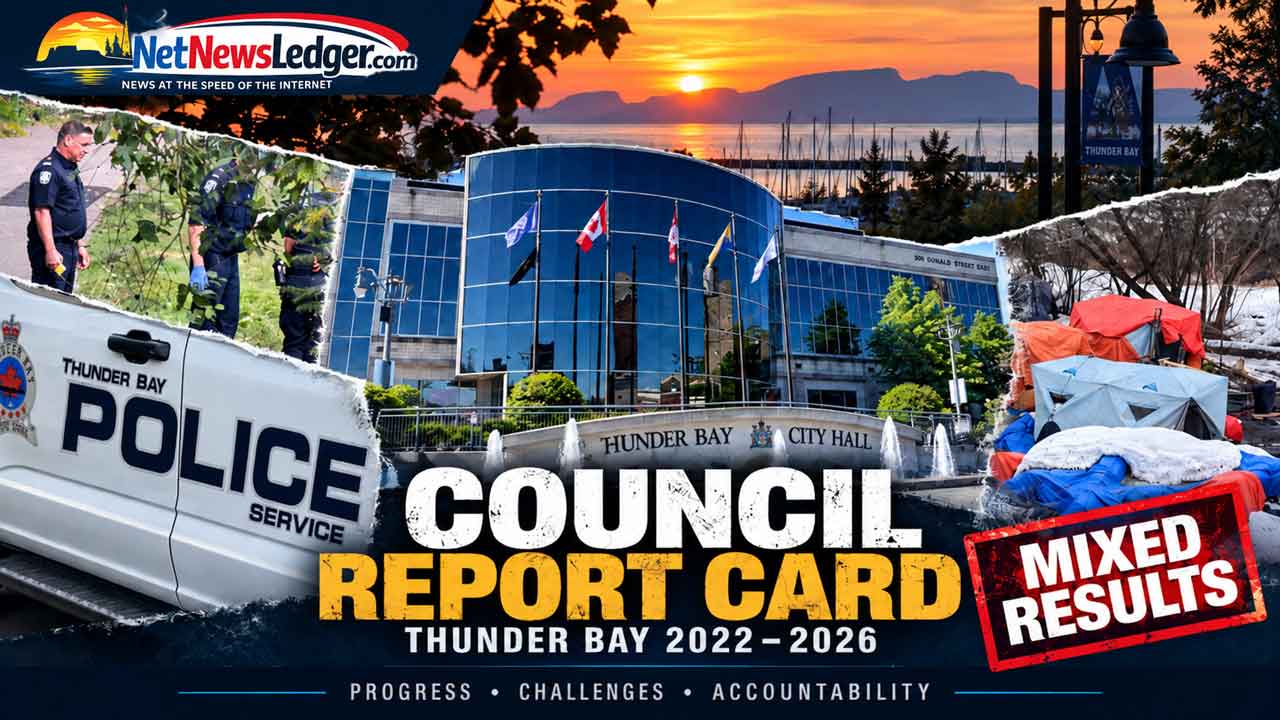
Four years later, the fairest verdict is mixed.
Council approved a clearer strategic plan, secured major housing funding, moved long-delayed recreation and downtown projects into construction, and strengthened the city’s economic-development position. Those are real gains.
However, property-tax pressure continued, homelessness became more visible, the temporary shelter village arrived late, overall crime severity rose, and residents still lack a simple public scorecard showing whether council’s promises produced measurable results.
The central weakness of this term was not a shortage of plans. It was the gap between plans and street-level outcomes.
The End-of-Term Scorecard
| Area | End-of-Term Assessment | Why |
|---|---|---|
| Strategic direction | Improved | Council adopted a clearer 2023-2027 plan built around reconciliation, safety, prosperity and sustainability. |
| Housing-development tools | Improved, but not yet proven | The city secured up to $20.7 million from the federal Housing Accelerator Fund. Targets and permits are not the same as completed, affordable homes. |
| Homelessness and encampments | Worsened | The need grew faster than the response. The 80-unit temporary shelter village was still being prepared near the end of September. |
| Public safety | Worsened overall, with a recent positive signal | Thunder Bay’s overall Crime Severity Index increased from 103.5 in 2022 to 114.1 in 2025. The violent index fell in 2025, but the overall crime rate rose 18 per cent that year. |
| Tax affordability | Worsened | Repeated levy increases placed more pressure on households and businesses already dealing with inflation. |
| Major capital projects | Improved | The Tbaytel Multiplex entered construction, the North Core streetscape reached its final stages and Victoriaville deconstruction moved ahead. |
| Downtown conditions | Mixed | Physical renewal advanced, but vacancy, disorder, business disruption and public confidence remain as serious problems. |
| Economic positioning | Improved | Thunder Bay strengthened its role in mining, transportation, manufacturing, immigration and regional services, although many investments depend on other governments and private employers. |
| Public accountability | Mixed | Budget documents became easier to read, but residents still do not receive a concise quarterly report matching promises, spending, deadlines and results. |
What Council Inherited
It would be unfair to judge this council as if every problem began in November 2022.
The city entered the term with decades-old infrastructure, limited municipal revenue tools, a national housing shortage, an overloaded health and social-service system, and deep concerns about policing and Indigenous trust. Inflation also increased the cost of fuel, construction, insurance, wages and contracted services.
Municipal government does not control hospitals, addiction treatment, income assistance, the courts or the supply of provincial supportive housing. City Council funds the Thunder Bay Police Service, but it does not direct police investigations or daily operations. The Thunder Bay Police Services Board is the civilian governing body for policing.
That does not remove council’s responsibility. Council controls land-use rules, many capital priorities, municipal enforcement, parks, transit, roads, fire services, public-space policy and a large share of local advocacy. It also appoints members to boards and decides how much local tax capacity will be used.
What Improved: A Clearer Plan and Better Project Discipline
One of council’s strongest decisions was adopting the Maamawe, Growing Together 2023-2027 Strategic Plan. Its four broad directions, truth and reconciliation, safety and well-being, prosperity and sustainability gave administration a common framework for budget requests and project decisions.
The title Maamawe, meaning “all together” also placed reconciliation inside the city’s core plan rather than treating it as a ceremonial side issue.
Council also hired John Collin as city manager in 2024. The later budgets used clearer summaries and separated capital and operating discussions, making it easier for residents to understand what the city was buying and what it cost to operate.
The improvement is real, but incomplete. There remains a lot more words than deeds on many of the issues.
Any strategic plan has value only when the public can see a regular, plain-language report on targets, costs, deadlines and outcomes.
That public accountability layer remains too weak
What Improved: Housing Rules and Funding
Thunder Bay secured up to $20.7 million from the federal Housing Accelerator Fund in February 2024. The agreement was designed to support more than 600 additional homes over three years and help the city reach 1,691 permitted homes by February 2027.
The city then offered grants for affordable rental construction and new units in the North Core, South Core and Westfort. It also promoted its Build Thunder Bay one-stop development service and moved toward denser use of already serviced land.
This was one of the term’s most important accomplishments because Thunder Bay needed to improve approvals and make development easier before the shortage became even worse. It also likely is another of the divides between Council and Administration vs the citizens and taxpayers.
However, council and candidates should not count the federal target as 1,691 completed homes. It is a permitting target. The proper test is how many units were actually approved, started, completed and rented at prices local households can afford.
What Improved: Major Projects Finally Moved
The strongest visible evidence of progress is construction.
The long-debated indoor turf facility became the Tbaytel Multiplex, a roughly $39-million multi-use project expected to open in October 2026. By late summer, walls and roof installation was underway. After years of argument and delay, this council helped turn a recurring promise into a facility under construction.
The North Core streetscape project reconstructed sections of Red River Road and Court Street and reached its final traffic-signal and pedestrian-crossing stage in 2026. The work caused real disruption for businesses, but the rebuilt public realm is a long-term investment.
In the South Core, deconstruction of Victoriaville Centre began in August 2025 as part of the plan to restore Victoria Avenue and create a new public plaza. That decision was made before this term, but the current council and administration carried the project into construction.
These projects show better execution. They do not, by themselves, guarantee successful downtowns. New pavement and public spaces must be followed by housing, private investment, safety, maintenance and active storefronts.
What Improved: Thunder Bay’s Economic Position
Thunder Bay ended the term with a stronger economic story than it began with.
The Community Economic Development Commission continued immigration programming, business support and investment promotion. The city strengthened its position as a regional centre for mining services, critical-mineral development, health care, education, transportation and manufacturing.
The 2026 VIA Rail investment connected to Alstom Thunder Bay plant was also an important confidence signal. That however in reality is a federal initiative not a civic one.
Council can reasonably claim credit for advocacy, local readiness and support through the CEDC. It cannot claim sole credit for private investment, federal rail procurement, commodity markets or provincial policy.
What Got Worse: Homelessness Outran the Response
The clearest failure of the term was the growing gap between the number of people living outside and the speed of the municipal response.
Council eventually adopted an Enhanced Encampment Response Plan and committed to a temporary shelter village. The current plan calls for 80 private, climate-controlled units at 879 Alloy Place, with food, hygiene, laundry and round-the-clock staff support.
That is a more practical response than unmanaged encampments.
Yet the project moved through repeated site debates, changed direction and was still being prepared in September 2026. Council allocated money, but did not deliver the new spaces early enough to materially change most of the term.
The city is not the housing service manager. That role belongs to the District of Thunder Bay Social Services Administration Board.
The province is also responsible for major parts of supportive housing, mental health and addiction care. Still, council controls municipal land, emergency encampment policy and local coordination.
Council could, and perhaps should have treated the issue as a term-opening emergency rather than a late-term capital project.
What Got Worse: Overall Crime and Public Confidence
Statistics Canada reported Thunder Bay’s overall Crime Severity Index at 103.5 in 2022 and 114.1 in 2025. The 2025 figure was three per cent higher than in 2024, while the police-reported crime rate increased 18 per cent.
There was one important improvement: the violent Crime Severity Index fell about 7.4 per cent in 2025. That suggests the picture is more complicated than saying every form of crime became worse.
Even so, property crime, drug trafficking, public disorder and repeated calls for service continued to shape how residents and businesses experienced the city. Thunder Bay’s overall index remained well above the national figure of 75.0 in 2025.
Council cannot order arrests, investigations or patrols. It does approve the municipal contribution to policing and can demand better public reporting from the Police Services Board.
It can also fund prevention, lighting, outreach, bylaw enforcement, transit safety and clean public spaces. The term produced new police leadership and visible-patrol initiatives, but not a broad improvement in public confidence.
What Got Worse: The Cost of Municipal Government
Taxpayers absorbed several years of increases.
- The 2023 budget ended with an approximately five per cent tax increase.
- The 2024 municipal levy increased 5.91 per cent before assessment growth, or 5.47 per cent after growth.
- The 2025 operating plan was built on a 3.7 per cent levy increase.
- The 2026 budget carried a four per cent levy increase, including pressure from agencies, boards and commissions outside council’s direct operating control.
Some of this was unavoidable. Inflation, labour agreements, police costs, emergency services and outside-board levies all moved upward.
Council also needed to invest in capital rather than allow roads, pipes and buildings to deteriorate further.
But residents judge affordability by the bill, not by which organization caused each line.
Council improved budget presentation, yet it did not produce a convincing multi-year plan to keep local costs close to household income growth while protecting core services.
What Remained Mixed: The Two Downtowns
Both downtown cores received important physical investment. The Waterfront District streetscape is nearing completion, while the Victoriaville work is reopening a blocked section of the Fort William BIA street grid.
At the same time, merchants and residents continued to report vacancy, disorder, theft, open drug use and concern about personal safety.
Construction also created short-term access and revenue problems for businesses.
The city’s approach remained divided among capital construction, policing, tourism, business-improvement areas, homelessness programs and event funding.
Thunder Bay missed the chance to present one public downtown recovery plan with common targets for housing, storefront occupancy, cleanliness, safety, foot traffic and private investment.
What Was Missed: Faster Decisions on the Hardest Files
1. A crisis-speed housing and homelessness response. The city improved its tools, but the temporary village and permanent supportive-housing partnerships have taken too long to reach delivery.
2. A simple public performance dashboard. Council should have reported quarterly on each strategic promise: the target, deadline, amount spent, current status and measurable community result.
3. One integrated downtown recovery plan. Construction, safety, housing and business support were handled as related ideas, but not with one set of public measures and one accountable lead.
4. A stronger intergovernmental campaign. Council advocated for help, but Thunder Bay needed a more sustained public campaign for supportive housing, addiction treatment, mental-health care and justice resources, backed by exact local capacity gaps and deadlines.
5. A decisive outcome from the council-composition review. A review committee recommended an 11-member hybrid council with four wards, two councillors per ward, two at-large councillors and the mayor. Council rejected the proposed reforms in April 2025. Keeping the current model may be defensible, but the review consumed public time without producing a change or a compelling new defence of the status quo.
6. Better measurement of reconciliation. Naming truth and reconciliation as a strategic priority was important. The next step should have been a public set of measures covering Indigenous procurement, employment, safety, partnerships, service access and implementation of relevant calls to action. The council in many ways ignores Nishnawbe Ashi Nation (NAN) often over the fact that NAN leadership is critical of the lack of action on issues that matter.
The Bottom Line
This was not a do-nothing council.
It approved a strategic framework, hired new senior leadership, improved budget presentation, secured major housing funding, began an indoor turf facility and advanced two major downtown reconstruction projects. Thunder Bay is also better positioned to benefit from mining, rail manufacturing, immigration and regional growth.
But the term’s most urgent human outcomes did not improve enough. Homelessness became more visible. Overall crime severity was higher in 2025 than at the start of the term. Tax bills kept rising. Downtown confidence remained fragile. The shelter village response arrived near the end of the mandate.
The fairest summary is this: Thunder Bay City Council improved the city’s plans, tools and project pipeline, but it did not close the gap between municipal activity and resident’s lived experience.
The next council should spend less time announcing intentions and more time publishing measurable results.
Questions Voters Should Ask in 2026
- How many Housing Accelerator Fund units are permitted, under construction and completed – and how many are genuinely affordable?
- When will all 80 temporary shelter village units open, what will annual operations cost, and where will residents move next?
- What is the plan to reduce the overall Crime Severity Index without asking police to solve health and housing problems alone?
- Which services or assets should change if tax increases continue to outpace household income?
- What measurable outcomes will show that the North Core and South Core investments are working?
- How will council report progress on reconciliation beyond ceremonies and statements?
- Who is accountable when a major project misses its cost, schedule or outcome target?
This article is an evidence-based civic analysis, not an endorsement of any candidate. Statistical trends do not prove that a single council decision caused an outcome.
Summary
A detailed review of Thunder Bay City Council’s 2022-2026 term examines housing, homelessness, crime, taxes, downtown renewal, major projects and missed opportunities.
Fact Checking
- City of Thunder Bay – Maamawe, Growing Together Strategic Plan
- City of Thunder Bay – City manager appointment, May 15, 2024
- City of Thunder Bay – Housing Accelerator Fund programs and targets
- City of Thunder Bay – Temporary Shelter Village and council decision record
- Statistics Canada – Crime Severity Index and weighted clearance rates, Table 35-10-0026-01
- Statistics Canada – Police-reported Crime Severity Index and crime rate by census metropolitan area, 2025
- City of Thunder Bay – 2025 operating budget proposal and budget presentation changes
- City of Thunder Bay – 2026 operating budget and agency, board and commission pressures
- City of Thunder Bay – 2024 approved budget executive summary
- City of Thunder Bay – Tbaytel Multiplex project
- City of Thunder Bay – Reimagine Victoriaville project
- Thunder Bay CEDC – economic development, investment and immigration updates
- Thunder Bay Police Service – explanation of 2024 police-reported crime data