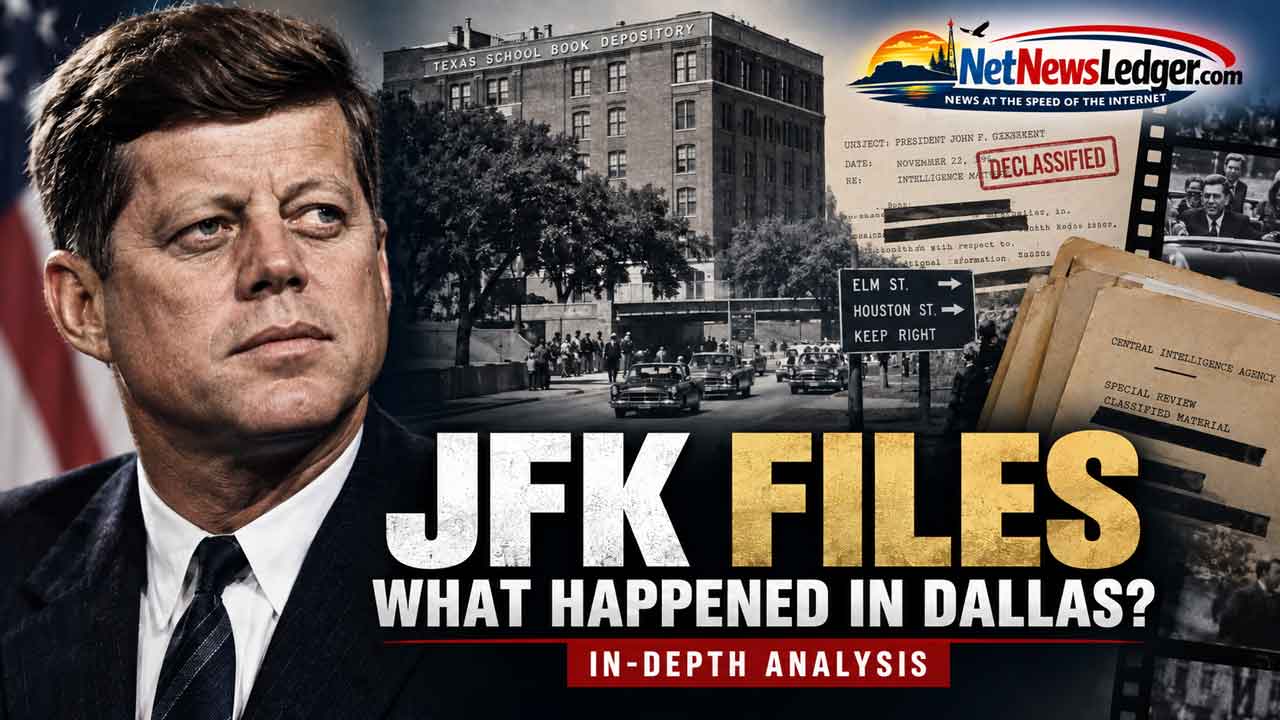
More than six million pages, two major investigations and several generations of film analysis have exposed serious government failures and secrecy. They have not produced reliable and unrefutable evidence of a second gunman.
THUNDER BAY – ANALYSIS – The assassination of United States President John Fitzgerald Kennedy remains one of the most examined crimes in history.
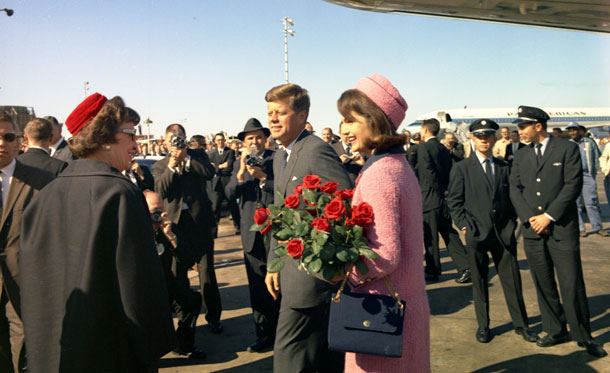
President Kennedy was shot in Dealey Plaza in Dallas, Texas, at about 12:30 p.m. Central Time on November 22, 1963. He was pronounced dead at Parkland Memorial Hospital at 1:00 p.m. Lee Harvey Oswald was arrested later that afternoon.
Two days later, nightclub operator Jack Ruby shot and killed Oswald in the basement of Dallas police headquarters, before Oswald could be tried.
Those facts created the conditions for lasting suspicion: a president murdered in public, an accused assassin killed on live television, an imperfect autopsy, contradictory early reports and intelligence agencies that concealed information.
Yet suspicion is not the same as proof. After comparing the physical evidence, witness accounts, official inquiries, surviving films, later scientific reviews and the latest National Archives releases, the most supportable conclusion remains that Oswald fired the shots that killed Kennedy and wounded Texas Governor John Connally.
The public record does not establish a second shooter or an organization directing Oswald.
The Short Answer: What Most Likely Happened?
Oswald most likely fired three shots from the southeast corner window on the sixth floor of the Texas School Book Depository as President Kennedy’s open limousine moved along Elm Street.
One shot missed. One bullet entered Kennedy’s upper back, exited through the lower front of his neck and continued into Connally, causing several wounds. A final bullet struck Kennedy in the head and killed him.
The precise timing of the first two shots has been debated, but the central finding rests on several independent lines of evidence:
- Three cartridge cases at the sixth-floor window were fired in Oswald’s rifle.
- The recovered Mannlicher-Carcano rifle, serial number C2766, had been purchased under an alias linked to Oswald.
- Oswald’s palmprint was found on the rifle, and his prints were found on materials in the sniper’s position.
- A nearly whole bullet recovered at Parkland Hospital and bullet fragments from the limousine were linked by firearm markings to that rifle, to the exclusion of other tested weapons.
- Medical evidence and authenticated autopsy photographs and X-rays show two shots striking Kennedy from behind.
- Trajectory analysis placed the Depository’s southeast window within the area from which the shots could have come.
- Oswald worked in the building, was present that morning, left after the shooting and was the only employee initially found missing.
No single item answers every question.
Together, however, these facts form a much stronger case than any theory proposing a gunman on the grassy knoll, a changed motorcade route, altered autopsy images or a secret firing team.
A Timeline of the Crime
- 12:30 p.m., November 22, 1963: Shots are fired as President Kennedy’s limousine travels through Dealey Plaza.
- Shortly after the shooting: Witnesses and police look toward both the Depository and the grassy knoll. Officers begin searching the building.
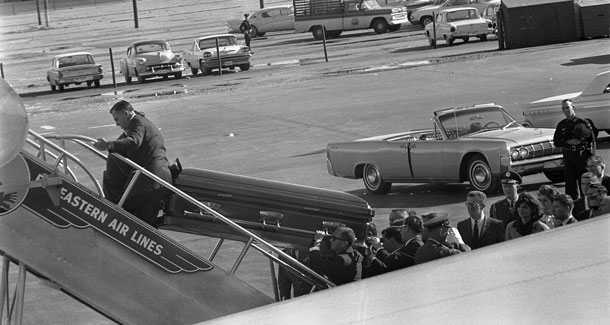
- About 1:00 p.m.: Kennedy is pronounced dead at Parkland Memorial Hospital.
- About 1:15 p.m.: Dallas police officer J.D. Tippit is shot and killed in the Oak Cliff neighbourhood.
- About 1:50 p.m.: Police arrest Oswald inside the Texas Theatre after he resists officers.
- November 24, 1963: Ruby shoots Oswald during a police transfer. Oswald dies before there can be a trial.
The evidence that Oswald killed Tippit is also substantial.
Eyewitnesses identified him, cartridge cases were linked to his revolver, and he was carrying that revolver when arrested. Tippit’s murder is relevant because it is powerful evidence of flight and consciousness of guilt, although it does not by itself prove who shot Kennedy.
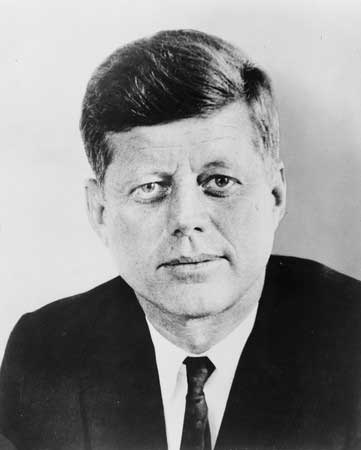
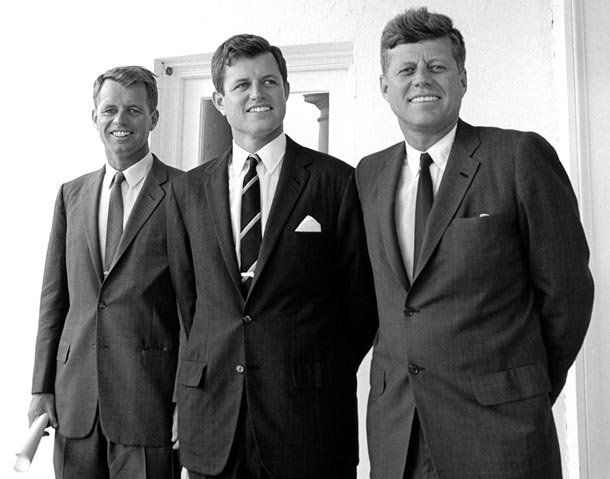
What the Warren Commission Found
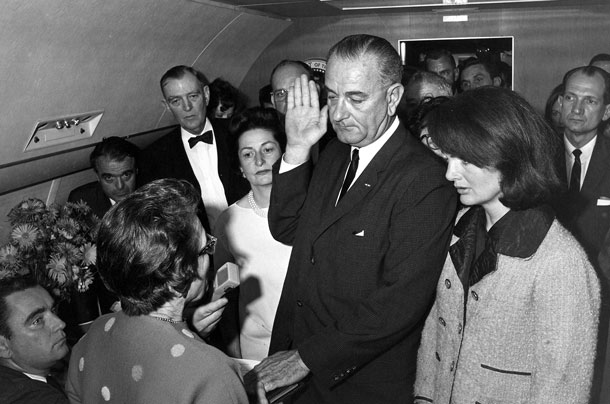
President Lyndon Johnson created the Warren Commission seven days after the assassination.
Chief Justice Earl Warren chaired the inquiry. The Commission took testimony from 550 witnesses, submitted its report on September 24, 1964, and later published 26 volumes of hearings and exhibits.
Its main conclusions were that Oswald fired three shots from the Depository, that one bullet probably wounded both Kennedy and Connally, and that Oswald acted alone. It found no evidence that Ruby was part of a plot to silence him.
The report’s physical case against Oswald remains strong. Its handling of conspiracy, intelligence and security questions was less complete.
The Commission depended heavily on the FBI and CIA – the same agencies whose conduct it needed to evaluate. It did not receive all relevant information about CIA plots to kill Cuban leader Fidel Castro, surveillance of Soviet and Cuban diplomatic sites in Mexico City, or some FBI contacts with Oswald. The Commission’s medical review also suffered because its doctors did not personally examine the original autopsy photographs and X-rays.
The Warren Commission itself sharply criticized Dallas authorities for giving reporters uncontrolled access to Oswald and for releasing erroneous or misleading statements. That media spectacle harmed Oswald’s right to a fair trial and planted doubts before the evidence had been tested.
These were genuine failures.
They weaken confidence in the process, but they do not reverse the ballistics, fingerprint, medical and location evidence identifying Oswald as the gunman.
What the House Assassinations Committee Changed
The U.S. House Select Committee on Assassinations, or HSCA, reinvestigated the case in the late 1970s. It agreed that Oswald fired three shots, that two struck Kennedy, and that the last shot killed him.
The committee’s forensic pathology panel examined the autopsy photographs and X-rays. Eight of its nine medical experts concluded that two bullets struck Kennedy from behind. The panel found no medical evidence of a bullet entering from the front.
However, the HSCA also concluded that Kennedy was “probably assassinated as a result of a conspiracy”. This statement is often quoted without explaining its basis.
The probable-conspiracy finding depended on an acoustic analysis of a Dallas police Dictabelt recording. Experts told the committee that impulses on the recording were consistent with four shots, including one from the grassy knoll.
That conclusion did not survive later scientific review.
The Acoustic Evidence No Longer Supports a Second Gunman
In 1982, a National Research Council panel convened by the National Academy of Sciences re-examined the Dictabelt evidence. It concluded that there was no acoustic basis for the claim of a grassy-knoll shot. The alleged gunshot impulses occurred roughly one minute after the assassination, at a time when police transmissions indicated the motorcade was already being sent to the hospital.
A later published reanalysis in 2005 again found that the sounds were recorded after the shooting and identified serious problems in renewed claims supporting the HSCA acoustics.
This matters because the HSCA said its photographic evidence did not establish a second shooter, its medical evidence showed shots from behind, and its physical evidence tied the fatal shots to Oswald’s rifle. Acoustics supplied the only scientific basis for the committee’s second-gunman finding.
Once that foundation failed, the HSCA’s “probable conspiracy” conclusion was left without reliable scientific support.
What the Zapruder Film Shows and What It Does Not
Abraham Zapruder’s silent 8-mm film is the best-known visual record of the assassination. It captures the limousine before, during and after the bullets strike Kennedy.
The film is valuable for timing. Kennedy first shows a reaction to a wound while partly hidden by a road sign. Connally reacts within a short interval. Their positions and the minimum time required to operate Oswald’s bolt-action rifle support the possibility that the same bullet passed through Kennedy and then struck Connally.
At frame 313, the fatal impact is visible. Kennedy’s head and upper body then move backward and to the left. That motion is frequently presented as proof of a shot from the front.
It is not. A person’s movement after a high-energy head wound is affected by tissue disruption, muscle reactions, posture and the movement of the vehicle. Body motion alone is not a dependable way to calculate bullet direction. The autopsy photographs, X-rays, wound beveling and trajectory work are more reliable, and they show the fatal bullet entering from the rear.
The Zapruder film does not show a gunman, muzzle flash or bullet in flight. It can help establish when Kennedy was struck, but it cannot by itself identify who fired.
Other films and photographs, including the Nix film, provide additional angles. The HSCA examined a supposed human figure in a “firing position” near the knoll and concluded that the image was not a person. Its photographic panel found no verified puff of smoke, muzzle flash or gunman. It also said the images could not absolutely rule out a person in every concealed location.
That is a useful distinction: the films do not prove that every inch of Dealey Plaza was empty, but no film has produced a verified second shooter.
Why Witnesses Disagreed About the Direction of the Shots
Dealey Plaza is surrounded by hard surfaces, an overpass, buildings and open spaces. Sharp sounds echoed. Witnesses were startled, moving and looking in different directions.
The HSCA reviewed accounts from 178 witnesses. Forty-nine identified the Depository area as the source, 21 identified the grassy knoll, 30 pointed elsewhere and 78 could not identify a direction.
These accounts explain why officers and spectators immediately searched the knoll. They do not, on their own, establish that a shot came from there. Human sound-location evidence in an echoing urban space is less reliable than recovered cartridge cases, firearm markings, wounds and trajectories.
The “Single-Bullet” Finding Is Not a Magical Claim
The bullet labelled Commission Exhibit 399 is often called the “magic bullet”. The nickname suggests that investigators invented an impossible route to preserve a lone-gunman theory.
The actual question is simpler: were Kennedy and Connally positioned so that one bullet could pass through both men?
Connally was seated lower than Kennedy, in a jump seat located inward from the side of the limousine. When their positions are reconstructed, the wounds form a generally straight path back toward the Depository. The Zapruder film places their visible reactions close enough together that a single bullet is more plausible than two separately fired bullets from Oswald’s rifle within that interval.
The bullet was damaged and had lost material. It was not untouched. Its condition remains a fair subject for technical debate, but its path does not require the sharp mid-air turns often shown in misleading diagrams.
Older neutron-activation tests were also used to argue that recovered fragments came from only two bullets. That claim should not be overstated.
The FBI stopped comparative bullet-lead examinations in 2005 because composition matches could not reliably establish how many bullets were represented. The stronger evidence is the firearm marking that ties Exhibit 399 and limousine fragments to Oswald’s rifle, not a claim that lead chemistry can count every bullet with certainty.
What the Latest File Releases Actually Added
The National Archives’ JFK collection contains more than six million pages, along with photographs, films, sound recordings and physical evidence.
Following a presidential directive, the Archives began a major release on March 18, 2025 of records previously withheld for classification. Further batches followed in March and April 2025 and on January 30, 2026. The Archives posted totals for those batches amount to 94,643 pages in 2,709 PDF files.
The releases are historically important. They disclose more names, intelligence relationships, surveillance practices and Cold War operations involving Cuba, the Soviet Union and Mexico. They also make it easier to examine what the CIA and FBI knew, what they did not share, and why officials protected sources and methods long after those reasons had lost force.
Media reviews by The Associated Press and Reuters found that the early 2025 material illuminated CIA operations far more than it changed the evidence of the murder. The documents added context, but did not reveal a verified assassination order, payment, operational plan, second rifle or identified second gunman.
It is also inaccurate to say that every possible page is now online without qualification. The classification-based withholding was lifted, but some items remain controlled by court seal, grand-jury secrecy, tax law or private donor restrictions. The Archives also continues digitizing material.
Mexico City: Suspicious History, but No Proven Imposter
Weeks before the assassination, Oswald visited the Soviet and Cuban diplomatic compounds in Mexico City while seeking travel documents.
CIA surveillance produced a confused record. A photograph of an unrelated man was at one point associated with the inquiry, encouraging claims that someone had impersonated Oswald. The HSCA later concluded that the weight of the evidence showed the real Oswald visited the compounds. Visa documents, handwriting and witness evidence supported his presence; the mismatched photograph reflected poor handling rather than proof of an imposter.
The episode still matters. CIA headquarters did not initially receive or share every relevant field detail, and the agency was slow to explain sensitive surveillance programs. That behaviour was secretive and, at times, misleading. It is evidence of institutional failure not proof that the agency sent a false Oswald to Mexico or organized the shooting.
What Was Hidden – and Why That Still Matters
Several official failures are now established:
- The FBI and CIA did not provide the Warren Commission with every relevant record.
- The CIA did not disclose its assassination plots against Castro, information that was directly relevant when investigators were testing possible Cuban motives and retaliation.
- The FBI concealed or mishandled information about its contacts with Oswald, including a threatening note he left at an FBI office before the assassination.
- Dallas police exposed Oswald to the press and transferred him through a public basement despite known threats.
- The Kennedy autopsy was conducted under extraordinary pressure, and notes were destroyed. This was poor practice and intensified suspicion.
- Federal agencies were often more concerned with protecting operations, sources and institutional reputations than with full public disclosure.
These facts deserve criticism. They also explain why so many people conclude that “if officials hid one thing, they may have hidden the murder”.
That is understandable, but it is not a sound evidentiary bridge. An agency can conceal embarrassing operations, illegal plots against a foreign leader or investigative mistakes without having killed the president. The question is whether a document, weapon, communication, financial trail or credible witness links an institution to the Dallas shooting. The released record has not supplied that link.
Did the Mafia, Cuba, the Soviet Union or the CIA Order the Killing?
The HSCA examined the leading institutional theories. It found insufficient evidence that the Soviet government, Cuban government, organized crime as a national group, anti-Castro Cuban organizations, the CIA, FBI or Secret Service took part.
The committee could not rule out contact by individual organized-crime figures or anti-Castro militants. That is different from finding that any such person helped plan the assassination.
Ruby knew people involved in gambling, clubs and criminal activity. The HSCA found that he had underworld contacts, but not evidence that those contacts formed an assassination plot. Ruby’s killing of Oswald prevented a trial and understandably looks like silencing. The documentary and financial evidence, however, has not shown that Ruby received an order to kill Oswald.
The CIA’s anti-Castro operations and its use of organized-crime figures to target Castro are real. They show that American officials were capable of covert and unlawful conduct. They establish motive for secrecy. They do not establish that those same networks murdered Kennedy.
Why Conspiracy Theories Survive Every Release
The case contains several features that no archive release can erase:
- Oswald was never tried or cross-examined.
- Ruby killed him while television cameras were rolling.
- Investigators made early mistakes and agencies withheld information.
- Kennedy had powerful enemies and was involved in dangerous Cold War operations.
- Some evidence, including the President’s brain and original autopsy notes, was lost or destroyed.
- The public saw shocking films before forensic science could be explained clearly.
- Each new release has been promoted as a possible final answer, creating expectations no routine intelligence file can meet.
There is also a basic difference between a loose end and contrary evidence. A record that leaves a question unanswered is not automatically evidence for a competing theory. To replace the Oswald case, another explanation must account for the rifle, cartridge cases, prints, bullets, wounds, trajectories, Oswald’s presence, flight and later conduct and must do so with better evidence.
No proposed conspiracy has yet met that standard.
Comparing the Major Reviews
| Review | Main Finding | Important Limitation or Later Development |
|---|---|---|
| Warren Commission, 1964 | Oswald fired the shots and acted alone; no proven Ruby conspiracy. | Received incomplete intelligence information; conspiracy review was too dependent on federal agencies. |
| House Select Committee, 1979 | Oswald fired three shots and the fatal shot; Kennedy was probably killed through a conspiracy. | The conspiracy conclusion rested on disputed police-radio acoustics. |
| National Research Council, 1982 | The acoustic recording did not support a grassy-knoll shot. | The supposed gunshot impulses occurred about one minute after the assassination. |
| Published acoustic reanalysis, 2005 | Reaffirmed that the alleged shot sounds were recorded after the assassination. | Did not reconstruct every sound in Dealey Plaza; it tested the Dictabelt claim. |
| National Archives releases, 2025–2026 | Added extensive intelligence and Cold War context. | No verified second shooter, sponsor or operational assassination plan emerged. |
The Most Responsible Conclusion
No historical murder can be proven with mathematical certainty, especially when the accused died before trial and agencies damaged their own credibility.
But the task is not to decide whether every mystery has disappeared. It is to identify the explanation best supported by admissible and testable evidence.
That explanation is that Lee Harvey Oswald fired three shots from the Texas School Book Depository, killing President Kennedy and wounding Governor Connally. One bullet missed, one passed through both men and one caused the fatal head wound. Oswald then fled, killed Officer Tippit and was arrested carrying the revolver used in that crime.
His exact motive remains uncertain. The Warren Commission did not claim to solve it, and the later files have not produced a definitive answer.
It is possible to believe two things at once: the government did not tell the public everything, and the physical evidence still points to Oswald acting alone. The first proposition is documented. It does not prove the second is false.
The latest files strengthen the history of secrecy more than the theory of conspiracy. After six decades of investigation, the record contains many reasons to distrust how authorities handled the case, but no reliable evidence that replaces Oswald as the gunman or identifies a partner who helped him kill John F. Kennedy.
This article is an evidence-based news analysis. It distinguishes documented findings from unresolved questions and does not claim that every historical uncertainty has been eliminated.
Sources Checked
- U.S. National Archives – John F. Kennedy Assassination Records Collection
- U.S. National Archives – 2025 and 2026 JFK records releases
- U.S. Government Publishing Office – Warren Commission report and hearings
- Warren Commission Report – Summary and Conclusions
- House Select Committee on Assassinations’ Report and Findings
- HSCA – Medical, ballistics, firearms, fingerprint and photographic evidence
- HSCA – Photographic evidence and witness analysis
- HSCA – Organized crime, foreign governments and anti-Castro groups
- HSCA – Performance of federal agencies and Mexico City evidence
- National Research Council – Report on the JFK assassination acoustic evidence
- Science & Justice – 2005 reanalysis of the JFK acoustic evidence
- FBI Laboratory – Discontinuation of comparative bullet-lead examinations
- Associated Press – Review of the March 2025 JFK file release
- Reuters – Initial March 18, 2025 records release