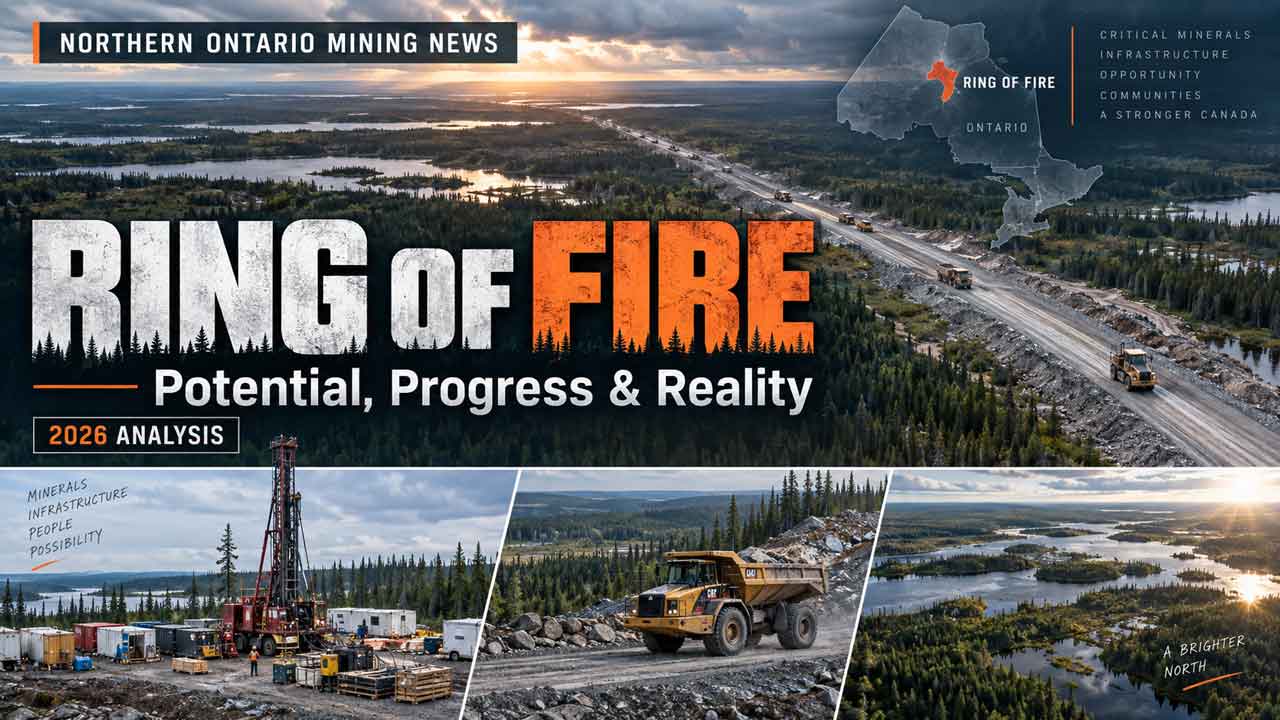
After years of announcements, Northern Ontario’s Ring of Fire has moved beyond maps and political speeches. Two First Nation-led road projects now have major assessment decisions, and a nickel-copper mine is being studied again. Yet the district still has no operating mine, no complete all-season route to the deposits and no approved chromite development
THUNDER BAY – MINING NEWS – For more than a decade, the Ring of Fire has been described as a once-in-a-generation economic opportunity. It has also become a symbol of delay.
Both descriptions contain some truth. Many announcements have been made over the past decade. That does not mean instant action and results.
The Ring of Fire is a part of a long-term process.
The geology is real.
The district contains large chromite resources, along with nickel, copper, cobalt and platinum-group metals.
The need for roads, power, community infrastructure and First Nations participation is also real.
So are the engineering, environmental, financial and legal challenges.
The most accurate conclusion in 2026 is neither :nothing is happening” nor “mining is just around the corner”. The Ring of Fire has entered a more serious infrastructure and assessment phase, but it has not yet reached mine construction. Chromite remains a major long-term option rather than a financed project ready to build.
The Bottom Line
- Potential: The Ring of Fire contains one of North America’s largest known concentrations of chromite, the mineral used to make ferrochrome for stainless steel. It also contains a high-grade nickel-copper-platinum-group-element deposit at Eagle’s Nest.
- Progress: The Webequie Supply Road and Marten Falls Community Access Road received major federal and provincial assessment decisions in 2026. First Nations are leading both proposals. Early work has begun on the Marten Falls route, according to the province.
- Reality: The Northern Road Link -”the middle connection needed to form a route between the provincial highway system and the mineral district” remains in assessment. The completed road network does not yet exist.
- Mine status: Wyloo is conducting a feasibility study for Eagle’s Nest. There is no final investment decision, construction approval or operating mine.
- Chromite status: Large historical mineral resources exist, but no current chromite mine, ferrochrome plant, full financing package or publicly committed construction schedule has been announced.
What Is the Ring of Fire?
The Ring of Fire is a mineral-rich area in the James Bay Lowlands, roughly 500 kilometres northeast of Thunder Bay. Ontario describes an active mining-claim area of about 8,000 square kilometres. The term is also used more loosely for the wider region and its proposed transportation corridor.
Exploration accelerated after important discoveries in the mid-2000s. Noront Resources discovered the Eagle’s Nest nickel-copper deposit in 2007 and the Blackbird chromite deposit in 2008. Cliffs Natural Resources later advanced the much larger Black Thor chromite concept, but suspended its project in 2013. Noront acquired Cliffs’ Ring of Fire chromite properties in 2015. Wyloo acquired Noront in 2022 and now owns Eagle’s Nest and the principal chromite assets.
That history matters. The minerals did not disappear when companies changed or projects stopped. However, ownership changes, cancelled plans and revised assessments mean that an old news release is not a current construction plan.
Why Chromite Matters
Chromite is the ore used to produce ferrochrome. Ferrochrome is added to steel to make stainless steel and other alloys that resist heat, wear and corrosion. It is used in kitchens and hospitals, transportation, construction, industrial equipment and energy systems.
Canada does not currently have a domestic chromite mine. A successful Ring of Fire development could create a Canadian supply chain stretching from a Northern Ontario mine to concentration, transportation, ferrochrome production and steelmaking.
That is the strategic case. The commercial case is more demanding.
Chromite is a bulk commodity, not a compact high-value product like gold. Large volumes must be mined and moved. Ferrochrome smelting requires substantial, reliable and competitively priced electricity. The product must meet customer specifications, including grade, chromium-to-iron ratio and limits on impurities. A developer also needs customers willing to sign contracts, along with a viable plant location and transportation system.
There is no single transparent daily – chromite price – equivalent to the gold or copper quotation. Prices vary by product type, grade, contract terms and delivery location. That makes simple claims based on tonnes multiplied by a headline commodity price especially unreliable.
How Large Are the Deposits?
The scale is significant, but the figures need careful wording.
A historical technical estimate for Black Thor reported approximately 137.7 million tonnes in the measured and indicated categories at an average grade of 31.5 per cent chromium oxide, plus about 26.8 million inferred tonnes at 29.3 per cent. Ontario’s mineral inventory records a 2012 Blackbird estimate of 20.5 million measured and indicated tonnes grading 35.76 per cent chromium oxide, plus 23.5 million inferred tonnes grading 33.14 per cent.
These numbers establish geological scale. They do not establish that all of the material can be mined at a profit.
A mineral resource is an estimate of mineralized material with reasonable prospects for eventual economic extraction. A mineral reserve is the economically mineable portion supported by detailed engineering and economic studies. Inferred resources carry more geological uncertainty and cannot be treated as reserves.
The chromite estimates are also largely based on work completed years ago. Before financing construction, a developer would normally need current resource models, metallurgy, engineering, capital and operating costs, environmental plans, infrastructure agreements and a market strategy.
The – $60-Billion Deposit – Problem
Ring of Fire announcements have often used very large “in-ground value” estimates. Such numbers can be useful for showing geological scale, but they are not the value of a company, a mine or a public revenue stream.
An in-ground calculation usually multiplies estimated metal content by a commodity price. It does not fully deduct mining losses, dilution, processing recovery, construction costs, operating costs, financing, transportation, smelting, taxes, royalties, rehabilitation or the time needed to receive future revenue.
The same caution applies to Ontario’s projection that Ring of Fire development could support more than 70,000 jobs across the province and add more than $22 billion to provincial gross domestic product over 30 years. Those are government economic projections for a broad development scenario. They are not committed jobs, a payroll forecast or a guarantee that every proposed mine will proceed.
What Has Actually Advanced?
The strongest evidence of progress is in transportation planning and assessment. The proposed network has three central sections, and they are at different stages.
| Project | Purpose | Status on September 19, 2026 | What It Does Not Mean |
|---|---|---|---|
| Marten Falls Community Access Road | Connect Marten Falls First Nation toward the existing provincial road network; support safer, lower-cost year-round access | Federal and provincial assessment decisions were issued in August 2026. Ontario says early construction work is underway. Further permits, conditions, detailed work and years of construction remain. | It is not, by itself, a completed road to the mineral deposits. |
| Webequie Supply Road | Build a 107-kilometre all-season road between Webequie Airport and the McFaulds Lake mineral area | Provincial approval was issued June 18, 2026, followed by a federal decision statement on June 25. The project is in the post-decision stage and still requires permits and compliance with legally binding conditions. | An assessment decision is not the same as completed construction. |
| Northern Road Link | Connect the Marten Falls and Webequie road systems, creating the middle section of a possible route to the Ring of Fire | The federal project remains in the impact-statement phase. Ontario approved its terms of reference in 2023, but a final environmental decision has not been issued. | The full all-season corridor to the deposits is not yet approved or built. |
This is meaningful progress. Two community-led road projects have moved through years of assessment. It is also incomplete progress because the central link and much of the construction still lie ahead.
The Marten Falls project has indicated that construction could take five to 10 years because of the terrain, bridges, muskeg, logistics and seasonal limitations. That range is not a promise that every part of the connected network will be finished on the same timetable.
Community Roads and Mining Roads Are Related – but Not Identical
It is a mistake to describe every road only as a mining road.
Marten Falls First Nation and Webequie First Nation have emphasized community goals, including lower transportation costs, improved access to health care and education, reliable delivery of goods, broadband and power opportunities, and local employment. Those benefits can exist even before a mine opens.
At the same time, the proposed network is central to mine economics. Wyloo says the timing of Eagle’s Nest construction and production is linked to the First Nation-led regional road and infrastructure corridor.
Both facts can be true. A road can serve a community and enable industrial development. That is why its design, ownership, access rules, maintenance costs and long-term effects deserve separate scrutiny.
Why Nickel Is More Likely to Lead
The most advanced current mine concept is not a chromite mine. It is Wyloo’s Eagle’s Nest nickel-copper-platinum-group-element project.
Wyloo says it is conducting a feasibility study based on an underground mine processing about 3,000 tonnes per day. Its current concept forecasts an initial 15-year life and annual output of approximately 15,000 tonnes of nickel, 6,000 tonnes of copper, 70,000 ounces of palladium, 22,000 ounces of platinum and 340 tonnes of cobalt. The company proposes placing processed tailings underground as paste backfill.
Those are company plans and forecasts, not operating results. They depend on the feasibility study, updated economics, permitting, consultation, agreements, infrastructure, financing and a final investment decision.
Ontario’s project record also shows that the earlier Eagle’s Nest provincial terms-of-reference approval was revoked and a voluntary agreement ended on June 5, 2025. That did not approve the mine. It means the current project must proceed under the applicable assessment and permitting path rather than relying on the old process.
Eagle’s Nest may lead because nickel-copper concentrate contains more value per tonne than bulk chromite ore, reducing the transportation burden. It is also the project receiving Wyloo’s most visible current feasibility attention. The company’s public project material does not present a chromite mine as being at the same development stage.
Why Chromite Is Likely a Later-Stage Development
Earlier Noront plans contemplated staged development: begin with Eagle’s Nest, then advance chromite as infrastructure and markets allowed. The present facts still point in that direction.
A Ring of Fire chromite project would need decisions on at least six linked components:
- A current mine plan and reserve supported by modern engineering;
- A completed transportation corridor capable of handling bulk freight;
- Reliable electricity for the mine and, if built in Ontario, a ferrochrome plant;
- A processing and smelting location with environmental approvals;
- Customer or offtake agreements strong enough to support financing; and
- Durable agreements with affected First Nations, including benefits, participation, environmental oversight and potentially equity.
None of this makes chromite impossible. It means the mineral resource is only the first part of the investment case.
The Global Market Is Both an Opportunity and a Test
A Canadian supply could reduce reliance on overseas production and offer customers a product made under Canadian labour, environmental and governance rules. That may carry strategic value at a time when governments are seeking secure critical-mineral supply chains.
However, a new Ontario project would compete with established producers in South Africa, Kazakhstan, Turkey, India and other jurisdictions. Many have existing mines, railways, ports, smelters and customer relationships. Ontario’s advantages – ”political stability, skilled workers, access to North American industry and comparatively low-carbon electricity” – must outweigh its disadvantages: remote construction, wetlands, long haul distances and high initial capital.
Critical does not automatically mean profitable. Government policy can reduce risk through roads, power, tax measures or loan support, but it cannot permanently replace competitive operating economics.
First Nations Are Proponents, Rights Holders and Decision-Makers
One of the largest changes since the earliest Ring of Fire proposals is the role of First Nations in infrastructure planning. Webequie First Nation is the proponent of the Webequie Supply Road. Marten Falls First Nation is leading its community access road. The two communities are co-proponents of the Northern Road Link.
That leadership is material. It can help align infrastructure with community priorities and create opportunities for ownership, contracting, training and long-term revenue.
It does not mean all First Nations hold the same position, or that support for a community road equals consent to every mine. Communities whose homelands, waters and harvesting areas may be affected have raised different concerns about consultation, cumulative effects, consent and the province’s fast-track legislation.
In 2025, nine First Nations filed a constitutional challenge to federal and Ontario laws intended to accelerate major projects. The claim alleges the laws threaten self-determination and the duty to consult. Those are allegations in ongoing litigation, not court findings.
The practical lesson is that Indigenous participation cannot be treated as one box to check. Different rights holders require direct engagement. Project certainty will depend on credible agreements, adequate community capacity, transparent environmental information and continuing consent-based relationships.
The Environmental Reality of the James Bay Lowlands
The Ring of Fire lies in a vast wetland and peatland system. The landscape stores carbon, controls water movement and supports fish, migratory birds, caribou, moose and Indigenous harvesting.
Wildlife Conservation Society Canada researchers have estimated that the broader Ring of Fire area stores carbon equal to roughly 1.6 billion tonnes of carbon dioxide. That estimate is not a prediction that all of the carbon will be released. It shows why road drainage, peat disturbance, fire risk and hydrology require close study.
The main challenge is cumulative change. One road, bridge or mine can be assessed on its own, but several connected roads, transmission lines, mines and settlements may alter water flow, wildlife movement and access over a much larger area.
A regional assessment is now being co-led by the Impact Assessment Agency of Canada and 15 First Nations. An interim report was submitted in February 2026, and the assessment remains in progress. Its purpose is to assemble information and examine the combined effects and benefits of past, present and possible future development.
The regional assessment is important, but it does not replace project-specific permits or Indigenous consultation. It should improve the baseline against which individual proposals are judged.
What Is Still Missing?
Before readers can reasonably describe the Ring of Fire as a mining district under construction, several visible milestones are needed:
- A final assessment decision for the Northern Road Link;
- Permits, financing and sustained construction on the connected road network;
- A completed and publicly disclosed Eagle’s Nest feasibility study;
- Updated mineral resources or reserves where older estimates no longer reflect the current plan;
- Mine assessment decisions, operating permits and closure-security arrangements;
- A final investment decision by the project owner;
- Detailed power and communications plans;
- Binding agreements with affected First Nations;
- For chromite, a mine plan, processing route, ferrochrome strategy, customers and project financing.
Until those pieces are in place, construction schedules and production dates should be treated as objectives rather than established facts.
Promises and Reality
| Common Claim | Evidence-Based Reading |
|---|---|
| “The Ring of Fire is worth tens of billions of dollars”. | The minerals have major gross in-ground value, but that is not profit, project value or government revenue. |
| “Road approvals mean the mines are about to open”. | Two road assessments have advanced, but permits and years of construction remain, and the Northern Road Link is not approved. |
| “Chromite is critical, so a mine must be economic”. | Strategic demand helps, but the project must still compete on delivered cost, quality, power and financing. |
| “First Nations support the Ring of Fire”. | Some First Nations lead road projects and seek development benefits; others have raised strong concerns. Positions are community-specific and project-specific. |
| “Nothing has happened”. | Ownership has consolidated, studies have continued, two road projects received 2026 decisions and a regional assessment is underway. No mine or complete road corridor exists yet. |
A Realistic Development Sequence
If the district advances, the most credible sequence is likely to be:
- Build community-serving road sections while completing the Northern Road Link assessment;
- Finish Eagle’s Nest feasibility, consultation, agreements and permitting;
- Reach a financing and final investment decision on the higher-value nickel-copper project;
- Use operating experience and shared infrastructure to reassess large-scale chromite development; and
- Advance chromite only when mine, transport, power, processing and customer agreements form one bankable system.
This is an analysis of the present evidence, not a company or government schedule. A major change in nickel, ferrochrome, power or construction costs could alter the order.
What NetNewsLedger RockHawks Should Watch
- The final route, impact statement and assessment decision for the Northern Road Link;
- Whether early works become sustained, fully funded road construction;
- Wyloo’s Eagle’s Nest feasibility results and any updated resource or reserve;
- A clear provincial and federal mine-permitting route after the old Eagle’s Nest process ended;
- First Nations equity, procurement, revenue and environmental-monitoring agreements;
- Completion of the regional assessment and how it influences later project reviews;
- A current chromite technical study, smelter plan or binding customer agreement; and
- Any final investment decision backed by disclosed financing rather than a political target date.
Conclusion: A District in Transition, Not Yet a Mining Boom
The Ring of Fire has survived more than a decade of political cycles because its mineral endowment is substantial. Chromite offers Canada a possible domestic stainless-steel supply chain. Eagle’s Nest offers a potentially valuable source of nickel, copper and platinum-group metals. First Nation-led roads could improve daily life in remote communities while enabling future industry.
But geology is only potential. A mine requires infrastructure, engineering, permits, capital, customers and durable relationships with the people whose lands and rights are affected.
The important progress of 2026 is that key road proposals have crossed major assessment thresholds. The equally important reality is that the connected corridor, mine approvals and chromite business case are unfinished.
The Ring of Fire should therefore be judged milestone by milestone – not by the size of its headlines.
This article is for news and public information. It is not investment advice. Mineral-resource estimates, project designs and production forecasts are subject to technical, regulatory, market and financing risks.
Overview
A detailed 2026 Ring of Fire analysis examines Northern Ontario’s chromite potential, First Nation-led roads, Eagle’s Nest, environmental risks and the major gaps still blocking mine construction.
This article is for news and general information. It is not investment, tax or legal advice. Commodity prices can change rapidly. Exploration results, construction schedules, costs and production targets are company-reported unless otherwise stated.