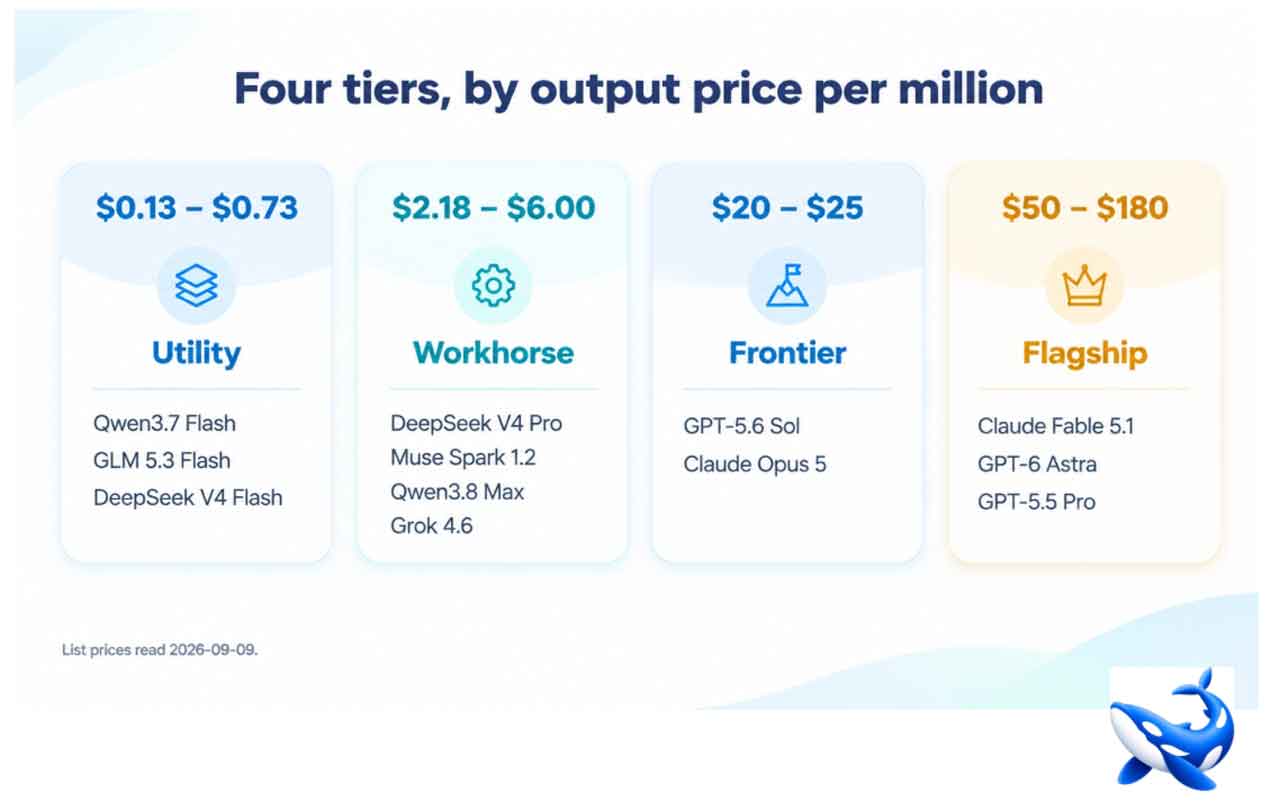
Model prices do not spread evenly — they cluster, and the clusters are far enough apart that moving between them is a different kind of decision from moving within one. OrcaRouter lists every model at list price, which makes the gaps visible: reading llm api pricing as four tiers rather than a flat table is the single change that makes the ladder navigable.
Prices read 2026-09-09, covering the models whose figures were verifiable on their own pages that day.
Tier 1 — Utility, $0.13 to $0.73 per million out
| Model | Input | Output | p50 first token |
| Qwen3.7 Flash | $0.03 | $0.13 | 9.79 s |
| GLM 5.3 Flash | $0.07 | $0.25 | 6.97 s |
| DeepSeek V4 Flash | $0.24 | $0.73 | 435 ms |
What this tier is for: work where the answer is mostly determined by the input. Classification, extraction, routing decisions, first-pass filtering, anything where you are asking the model to recognise rather than compose.
The thing to notice is DeepSeek V4 Flash’s 435 ms — the fastest first-token figure in the entire data set, from the cheapest tier. “Cheap and slow” is not what this tier is.
Tier 2 — Workhorse, $2.18 to $6.00
| Model | Input | Output | p50 first token |
| DeepSeek V4 Pro | $0.73 | $2.18 | 831 ms |
| Muse Spark 1.2 | $1.25 | $4.25 | 2.88 s |
| Qwen3.8 Max | $2.00 | $6.00 | 4.09 s |
| Grok 4.6 | $2.00 | $6.00 | 10.00 s* |
| Gemini 3.5 Flash | $1.50 | $9.00 | 4.06 s |
\* A reporting ceiling rather than a measured value — read as “not measured”.
This is where most production traffic should probably live. You are paying 3 to 8 times tier 1 and getting a genuine capability step, and you are paying a quarter to an eighth of tier 3.
Note Gemini 3.5 Flash sitting oddly here: $1.50 input is tier-1-ish, $9.00 output is above the rest of tier 2. Its 6.0x output-to-input ratio is the highest in this group, which makes it a read-heavy specialist priced into a general-purpose tier.
Tier 3 — Frontier, $20 to $25
| Model | Input | Output | p50 first token |
| GPT-5.6 Sol | $4.00 | $20.00 | 9.37 s |
| Claude Opus 5 | $5.00 | $25.00 | 2.52 s |
| Claude Opus 4.8 | $5.00 | $25.00 | 4.38 s |
Roughly 30x tier 1 on output. What you are buying is the top of the capability curve for tasks where a wrong answer is expensive — hard reasoning, long-horizon agent work, anything where a human has to check the output and their time costs more than the tokens.
The intra-tier spread on latency is the interesting part: 2.52 s to 9.37 s at essentially the same price.
Tier 4 — Flagship, $50 to $180
| Model | Input | Output | p50 first token |
| Claude Fable 5.1 | $10.00 | $50.00 | 4.14 s |
| Claude Fable 5 | $10.00 | $50.00 | 6.70 s |
| GPT-6 Astra | $10.00 | $50.00 | 5.79 s |
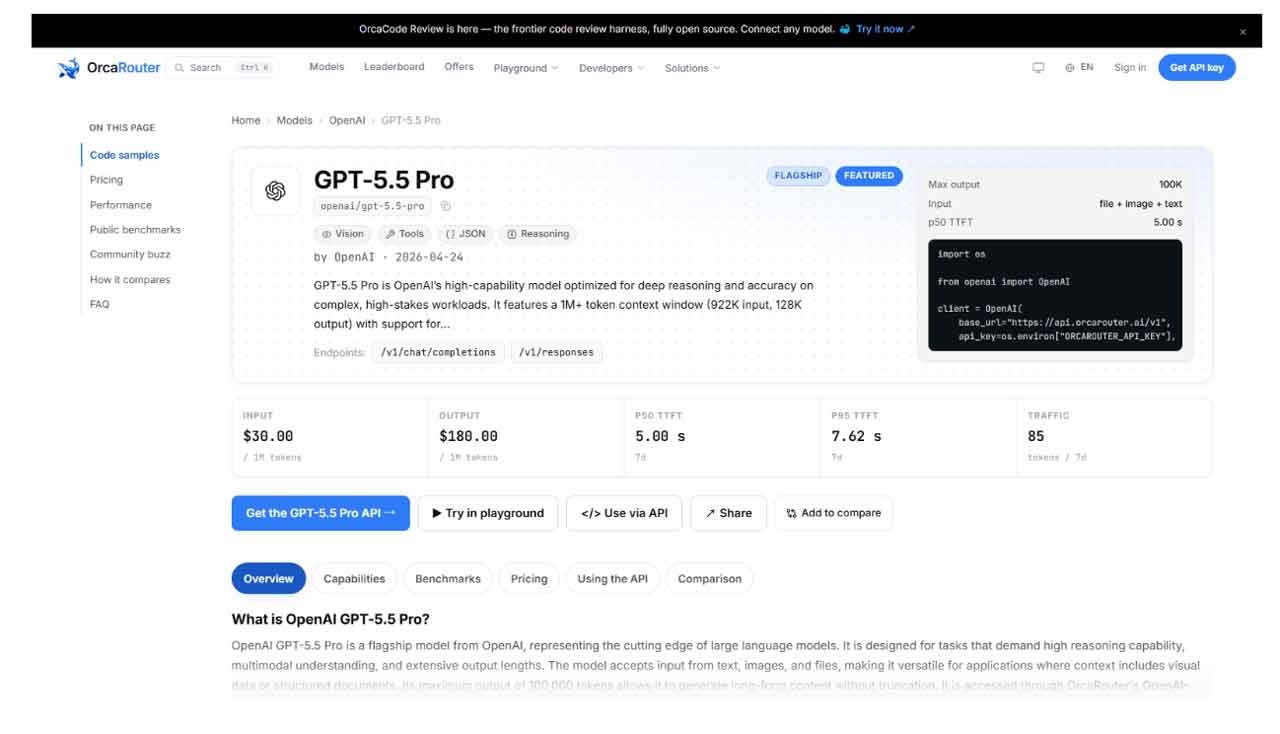
| GPT-5.5 Pro | $30.00 | $180.00 | 5.00 s |
GPT-5.5 Pro is its own category — 3.6x the rest of the tier and 1,385x tier 1’s cheapest. At this level the token cost is deliberately not the constraint; you are buying a specific capability ceiling and the price is a signal about who the model is for.
What crossing a tier boundary actually costs
The gaps are what matter, not the absolute numbers. Per million output tokens:
- Tier 1 → 2: roughly 3x to 8x
- Tier 2 → 3: roughly 4x
- Tier 3 → 4: roughly 2x, then 3.6x again for GPT-5.5 Pro
Multiply by volume and the boundaries become decision points. At 10 million output tokens a month: tier 1 is $1.30–$7.30, tier 2 is $21.80–$60, tier 3 is $200–$250, tier 4 is $500–$1,800. Each boundary is a budget conversation; movement inside a tier is not.
Which suggests the useful discipline: decide the tier from the task, then pick within the tier on latency and quality. Most model-selection arguments are actually tier arguments in disguise, and they get resolved by asking what happens when the model is wrong — if a human catches it cheaply, you are in tier 1 or 2.
The caveats
Rates are half the price. Models emit different amounts for the same brief — by more than two to one — so per-million rates can order per-piece cost wrongly. Within a tier that effect can outweigh the rate difference entirely.
Latency figures are 7-day rolling windows from OrcaRouter production traffic and drift daily; Claude Opus 5’s median moved 3.09 s → 2.82 s → 2.52 s across three consecutive reads. Two figures in this article (Grok 4.6, and Gemini 3.6 Flash which is not tabled here) sit at a 10.00 s reporting ceiling and are not measurements.
This is nineteen models, not the whole catalogue. Anything whose price was not verifiable on its own page that day has been left out rather than estimated.
Choosing a tier from failure cost, not from ambition
The tier question has a better framing than “how good does this need to be”, and it is one you can actually answer: what happens when the model gets it wrong, and who pays for it?
A human catches it immediately and cheaply — a draft they were going to edit anyway, a suggestion they can ignore, a classification with a visible confidence score. Tier 1 or 2. The error is absorbed by a workflow that was already going to inspect the output, so paying 30x for a lower error rate buys very little.
A human catches it later, expensively — a summary that fed a decision, an extraction that populated a record, anything that propagates before anyone looks. Tier 2 or 3. Here the frontier premium buys a lower rate of errors that are costly to unwind, which is a real purchase.
Nobody catches it — autonomous agent steps, anything customer-facing without review, anything that writes to a system of record. Tier 3 or 4, and the token cost is almost certainly not your largest risk.
This reframing tends to move traffic *down* the ladder rather than up, because most production LLM work turns out to be the first case: a person was going to look at the output anyway. Which is the practical argument for a split — route by failure cost, and only the fraction that genuinely nobody checks needs the expensive tier.
One caveat on the tier labels themselves. They are a descriptive convenience for reading the ladder, not a vendor classification, and the boundaries are where the price gaps happen to fall today. A price cut can move a model between tiers without anything about the model changing, which is another reason to date any comparison built on them — including this one.
The takeaway
Prices cluster into four tiers separated by 2x to 8x jumps, and the jumps are where the money is. Pick the tier from what happens when the model gets it wrong; pick within the tier on latency and per-piece cost, which vary a lot at identical rates — Claude Opus 5 and Claude Opus 4.8 are the same $25.00 and 1.86 seconds apart. And do not assume the cheap tier is the slow tier: the fastest first token in the whole data set costs seventy-three cents a million.
Sourcing note: Input and output rates and median time-to-first-token figures are the list prices and production telemetry OrcaRouter passes through, read 2026-09-09; only the nineteen models verifiable on their own pages that day are included. Latency figures are 7-day rolling windows that move daily and reflect its traffic mix and regions. Values shown as 10.00 s sit at a reporting ceiling and are not measured latencies. Tier boundaries are a descriptive convenience, not a vendor classification. Note on the DeepSeek rows: on 2026-09-10 DeepSeek published DeepSeek-V4.1-Flash under the identifier `deepseek-flash`, turned `deepseek-v4-flash` and `deepseek-v4-flash-vision-exp` into legacy aliases routed to it, and stated that requests to `deepseek-v4-pro` will all be routed to V4.1 Flash from 2026-09-14. The DeepSeek figures here are therefore a 2026-09-09 snapshot of a line the vendor is in the middle of consolidating.