THUNDER BAY — ANALYSIS — As Thunder Bay moves closer to the municipal election, much of the early discussion has understandably focused on roads, infrastructure, taxes, housing and public safety. Those issues matter because they affect residents every day.
But an election should also be about the city Thunder Bay intends to become.
Over the next 10 to 20 years, artificial intelligence, automation, digital health, autonomous transportation, advanced mining technology and changing patterns of work could reshape the local economy as significantly as globalization and industrial restructuring changed Thunder Bay over the past four decades.
The question for candidates should therefore extend beyond which streets need rebuilding.
What does Thunder Bay need to do now to remain economically relevant, socially resilient and competitive in 2036 and 2046?
Technology Will Change Thunder Bay Whether the City Plans for It or Not
Thunder Bay has experienced major economic changes before.
The city and surrounding region were once heavily shaped by grain transportation, forestry, railways, manufacturing and the Lakehead’s position as a transfer point between western and eastern Canada.
Those industries have not disappeared, but technology, consolidation, globalization and changing markets transformed the number and types of jobs they support.
The same process is happening again.
Artificial intelligence and automation are moving rapidly into offices, hospitals, mines, transportation networks, warehouses, universities, retail businesses and government services.
The challenge is not stopping that transformation.
It is ensuring Thunder Bay benefits from it.
Artificial Intelligence Will Change White-Collar Work
Much of the early debate about automation focused on factories.
Artificial intelligence changes the equation because it can increasingly perform tasks traditionally associated with office employment.
Routine bookkeeping, document preparation, scheduling, customer support, research, data entry and some administrative analysis are becoming increasingly automated.
That does not necessarily mean these occupations disappear.
More likely, many jobs will change.
A municipal employee who once spent hours manually organizing information could increasingly use AI tools to process records, identify trends or prepare initial drafts.
An accountant could spend less time entering data and more time interpreting it.
A small business might automate parts of customer service that previously required another employee.
That creates both opportunity and disruption.
Thunder Bay will need workers who understand how to use technology rather than simply compete against it.
Health Care Could Become One of Thunder Bay’s Most Important Technology Sectors
The transformation is already beginning locally.
Thunder Bay Regional Health Sciences Centre has identified digital health as part of its future strategy and is developing a regional electronic health record system involving hospitals across Northwestern Ontario. The hospital has also explored artificial-intelligence applications including clinical documentation tools, patient monitoring and ambient transcription.
Technology is particularly important in Northwestern Ontario because geography creates challenges that southern urban health systems do not face.
A patient in a remote community may be hundreds of kilometres from specialist care.
Digital health can narrow that distance.
The hospital’s Northwestern Ontario Navigate Stroke application, for example, combines geographic information, patient information, imaging availability and machine learning to help health-care providers determine where stroke patients should be transported for treatment.
Thunder Bay Regional also already uses telemedicine to connect patients with health professionals while reducing some travel requirements.
This points toward a larger economic opportunity.
Thunder Bay could position itself not simply as a city that uses northern health technology, but as a city where remote-health systems are developed, tested and exported.
Few places understand the challenges of delivering sophisticated health care across enormous distances as well as Northwestern Ontario.
That experience has economic value.
Mining Will Become More Automated — But Thunder Bay Could Gain Jobs
Northern Ontario’s mining expansion is often discussed primarily in terms of extracting minerals.
Technology could make the larger opportunity considerably broader.
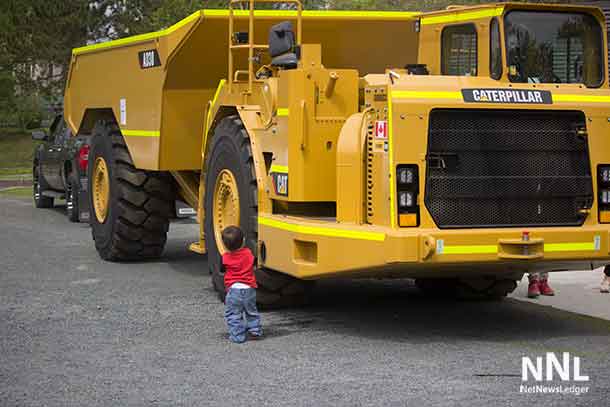
Modern mining increasingly involves autonomous equipment, drones, remote sensing, digital mapping, robotics, machine learning, advanced geological modelling and remote operations centres.
Many of those jobs do not have to be located underground or directly beside a mine.
Thunder Bay already has a substantial mining service and supply sector. The Thunder Bay Community Economic Development Commission has estimated that mining supports more than 1,000 direct mine jobs held by Thunder Bay residents, alongside more than 1,000 exploration and mine-service jobs connected with roughly 400 businesses.
That suggests a strategic question:
Why shouldn’t more mines across Northwestern Ontario be partly operated, monitored and supported technologically from Thunder Bay?
Imagine a future operations centre where technicians in Thunder Bay monitor equipment hundreds of kilometres north of the city.
Engineers could analyze machinery performance remotely.
Geologists could process drone imagery and exploration data.
Artificial intelligence could help identify maintenance problems before equipment fails.
The city could become the technological service hub for Northern Ontario mining rather than simply the place companies use for flights, hotels and supplies.
That would require investment in connectivity, training and power.
Indigenous Partnerships Must Be Part of the Technology Economy
The future of Northwestern Ontario cannot be planned without First Nations.
Mining, transmission lines, broadband, forestry, transportation infrastructure and northern development increasingly involve Indigenous lands, Treaty rights, Indigenous businesses and Indigenous governments.
Technology offers substantial opportunities, but it can also widen existing inequalities if communities do not have equal access to infrastructure, training and ownership.
High-speed broadband is therefore not simply a convenience.
For remote communities it can support telemedicine, education, economic development, banking, government services and locally operated businesses.
Thunder Bay could strengthen its role as a regional technology centre by developing more partnerships with First Nations colleges, businesses, health organizations and governments.
That means moving beyond consultation toward participation and ownership.
Transportation Could Change More Than Most People Expect
Thunder Bay’s transportation system is likely to become considerably more automated during the next two decades.
Trucks will probably incorporate increasing levels of automation.
Ports will use more automated cargo handling and logistics systems.
Railways will rely increasingly on sensors, predictive maintenance and automated monitoring.
Municipal transit could eventually incorporate autonomous or semi-autonomous vehicles.
None of these changes will happen overnight.
Northern Ontario’s weather, distances and road conditions create substantial technological challenges.
But even partial automation could change employment patterns.
Thunder Bay’s location will remain valuable.
The city sits at the intersection of the Trans-Canada Highway, two national railways, the Great Lakes-St. Lawrence Seaway system and air routes serving the North.
Technology could make that transportation advantage more valuable if the city develops expertise in logistics and supply-chain management.
A future Thunder Bay transportation strategy should therefore consider more than asphalt.
It should ask how freight will move through the city in 2040.
The Port Could Become More Important in a Changing Economy
The Port of Thunder Bay has historically been closely associated with grain.
Its future could be broader.
Climate pressures, supply-chain disruptions and growing demand for critical minerals could increase the strategic importance of reliable inland transportation corridors.
Technology will increasingly determine how efficiently ports operate.
Automated scheduling, digital cargo tracking, predictive maintenance and integrated rail-port logistics could help Thunder Bay compete as a Great Lakes transportation hub.
If critical-mineral development expands across Northwestern Ontario, there will also be questions about where materials are processed and how they reach domestic and international markets.
Thunder Bay should be planning for that possibility now.
Energy May Become the Limiting Factor
One technology issue deserves far more attention in municipal economic discussions: electricity.
Artificial intelligence, advanced manufacturing, electrified transportation, mineral processing and data centres all require substantial electricity.
Ontario’s electricity system operator is already planning around significant long-term demand growth as electrification and new industrial loads increase.
That means communities with access to reliable and expandable power supplies may have a significant competitive advantage.
For Thunder Bay, economic development strategy should increasingly include electrical capacity.
Before attempting to attract major technology employers or mineral-processing facilities, the city needs to understand:
How much power is available?
Where could new industrial loads connect?
What transmission upgrades might be required?
Could local renewable generation or storage contribute?
Energy infrastructure could become as important to economic development as roads and industrial land.
Data Centres Could Be an Opportunity — With Important Caveats
One frequently discussed technology opportunity for northern communities is data centres.
Thunder Bay offers several potential advantages, including a cooler climate, comparatively abundant land and geographic separation from major southern Ontario centres.
But data centres also consume enormous amounts of electricity.
Some require substantial water for cooling.
They do not always create large numbers of permanent jobs relative to their physical size and power consumption.
Thunder Bay should therefore avoid treating a data centre as automatically desirable.
Any proposal should be evaluated against several questions:
How many permanent jobs would it create?
How much electricity would it consume?
Would local businesses benefit?
Would municipal infrastructure require upgrades?
Could that electricity support higher-employment industries instead?
The goal should be attracting technology investment that creates lasting regional value rather than simply attracting technology for its own sake.
Education Will Determine Whether Local Workers Benefit
Thunder Bay already has two significant advantages that many comparable cities lack: Lakehead University and Confederation College.
Those institutions could become central to the city’s technology strategy.
The workforce of 2040 will require skills that are difficult to predict precisely, but several areas are already apparent:
artificial intelligence, cybersecurity, robotics, health technology, software development, advanced manufacturing, electrical trades, automation, geographic information systems, aviation technology and mining technology.
Training will also need to extend beyond young students.
Workers in their 30s, 40s and 50s may need repeated opportunities to acquire new skills throughout their careers.
The traditional model of completing education at 22 and working with roughly the same skill set until retirement is becoming less realistic.
A forward-looking municipal government should therefore treat workforce retraining as economic infrastructure.
Thunder Bay Could Become a Northern Cybersecurity Centre
As more infrastructure becomes digital, cybersecurity becomes more important.
Hospitals, municipal systems, utilities, businesses and schools increasingly depend on interconnected networks.
A cyberattack can now disrupt operations almost as effectively as physical infrastructure damage.
Thunder Bay Regional Health Sciences Centre has already been designated within Ontario’s regional health-sector cybersecurity structure, serving organizations across Northwestern Ontario.
That creates another potential cluster.
Lakehead University, Confederation College, health organizations, government agencies and private technology companies could build a specialized cybersecurity ecosystem focused on northern and remote infrastructure.
That could include protecting hospitals, mines, municipalities, Indigenous organizations and transportation systems.
Cybersecurity jobs can also be performed from almost anywhere, making them particularly valuable for a mid-sized northern city trying to retain younger professionals.
Remote Work Changes Thunder Bay’s Population Equation
Technology also creates an opportunity unrelated to major industrial projects.
Many professional jobs can now be performed remotely.
Thunder Bay offers characteristics that could attract some remote workers: comparatively shorter commutes, access to outdoor recreation, a regional airport, educational institutions and housing that has historically been less expensive than Canada’s largest metropolitan areas.
Thunder Bay CEDC’s current strategy identifies population growth, business attraction and retaining newcomers as important economic objectives.
Remote workers could be part of that strategy.
But attracting them requires more than advertisements showing Sleeping Giant Provincial Park.
People deciding where to live consider broadband reliability, schools, health care, air connections, housing, arts and culture, neighbourhood quality and public safety.
Technology makes geography less restrictive for employment.
That means cities increasingly compete on quality of life.
Technology Could Help the City Manage Its Own Infrastructure
There is an important connection between today’s election debate about roads and tomorrow’s technology.
Technology does not replace infrastructure.
It can help municipalities manage it better.
Sensors can monitor water systems for leaks.
Artificial intelligence can help identify pavement deterioration.
Traffic data can improve signal timing.
Digital models can help municipalities predict which infrastructure will require replacement years before failure.
Snow-clearing routes can be optimized using real-time conditions.
Fleet maintenance can become predictive rather than reactive.
That raises an important election question.
Instead of asking candidates only how much they will spend on roads, voters could also ask how they will use data to determine which roads should be rebuilt first.
Those are very different approaches to municipal management.
City Hall Will Have to Become More Digital
Municipal government itself will change.
Residents will increasingly expect permits, applications, payments, property information and service requests to be available digitally.
Artificial intelligence could eventually assist staff in processing routine applications, responding to basic inquiries and reviewing large municipal datasets.
Used properly, that could improve service and reduce administrative workload.
Used poorly, it could frustrate residents, create privacy risks or make government less transparent.
Thunder Bay will therefore need rules governing municipal AI.
Residents should know when automated systems are being used in decisions affecting them.
Human review should remain available for important decisions.
Personal information must be protected.
Technology should make City Hall easier to access rather than creating another barrier.
The Biggest Risk Is a Digital Divide
There is another side to technological change.
Not everyone will benefit equally.
Seniors, low-income residents and people without reliable internet access can be disadvantaged when services move online.
Some jobs will disappear.
Others will require qualifications that displaced workers do not immediately possess.
Businesses capable of investing in automation may become more productive while smaller competitors struggle.
Municipal governments cannot prevent every consequence of technological change.
They can help reduce the disruption.
Public libraries, community organizations and educational institutions can provide digital-skills programs.
Municipal services can maintain non-digital access for residents who need it.
Economic-development programs can help small businesses adopt useful technologies.
The objective should be technological progress without abandoning people who need more time or assistance adapting.
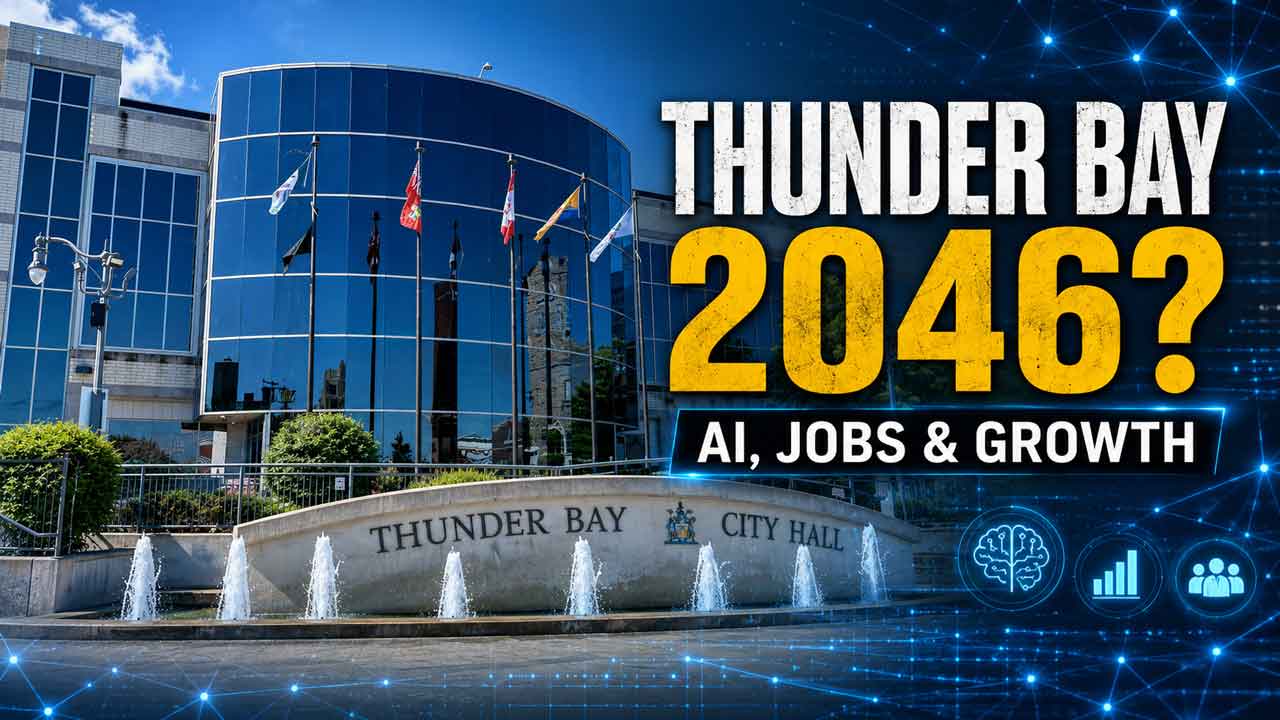
Thunder Bay Needs a 2046 Strategy, Not Just a Four-Year Plan
Municipal governments operate on four-year election cycles.
Infrastructure and economic development do not.
A road can last decades.
A subdivision can shape transportation patterns for generations.
Industrial land decisions can determine where businesses locate long after today’s council has left office.
Technology infrastructure is no different.
Thunder Bay should consider developing a 20-year technology and economic resilience strategy involving the city, Fort William First Nation, other regional First Nations partners, Lakehead University, Confederation College, Thunder Bay Regional Health Sciences Centre, the CEDC, utilities, businesses and labour organizations.
It should identify:
- future electricity requirements;
- broadband and telecommunications capacity;
- cybersecurity needs;
- workforce and retraining requirements;
- opportunities in mining technology;
- remote-health innovation;
- transportation automation;
- advanced manufacturing;
- municipal data infrastructure;
- AI governance;
- Indigenous technology partnerships; and
- strategies for attracting and retaining skilled workers.
The city’s current economic-development strategy already emphasizes diversification, population growth and strengthening Thunder Bay as a place to work, live and invest.
The next step is extending that thinking beyond 2030.
The Election Question Candidates Should Be Asked
Roads matter.
So do water mains, bridges, policing, housing and taxes.
A responsible municipal government has to maintain the city residents live in today.
But leadership also involves preparing for the city residents will inherit tomorrow.
In 2046, Thunder Bay will still be located on Lake Superior. It will still sit at the centre of Northwestern Ontario’s transportation and service network. Mining, forestry, health care, education and transportation will probably remain important.
How those industries operate, however, may be radically different.
The communities that prosper will likely be those that combine physical infrastructure with digital infrastructure, affordable energy, skilled workers, strong institutions and the capacity to adapt.
Thunder Bay has several pieces of that puzzle already.
It has a university and college.
It has a regional hospital and research institute.
It has transportation infrastructure.
It has an established mining-services sector.
It is the service centre for a vast region undergoing potentially significant resource development.
And it has longstanding relationships — sometimes successful, sometimes difficult — with Indigenous communities whose role in the northern economy will continue to grow.
The opportunity is considerable.
But opportunity is not a strategy.
As voters listen to municipal candidates debate potholes, taxes and infrastructure this campaign, perhaps one additional question should be asked repeatedly:
What are you going to do during the next four years to make sure Thunder Bay succeeds during the next 20?
That answer may ultimately matter more than any single road project.
James Murray