RockHawks Mining Update: Copper Supply Race Intensifies as Gold Prices Climb and Critical Minerals Projects Advance
Northwestern Ontario Mining News | Friday, October 16, 2026
THUNDER BAY, ONTARIO — Global competition for copper, gold, lithium, cobalt and other critical minerals is accelerating, with new government-backed stockpiles, major mining investments and exploration programs reshaping the outlook for the industry.
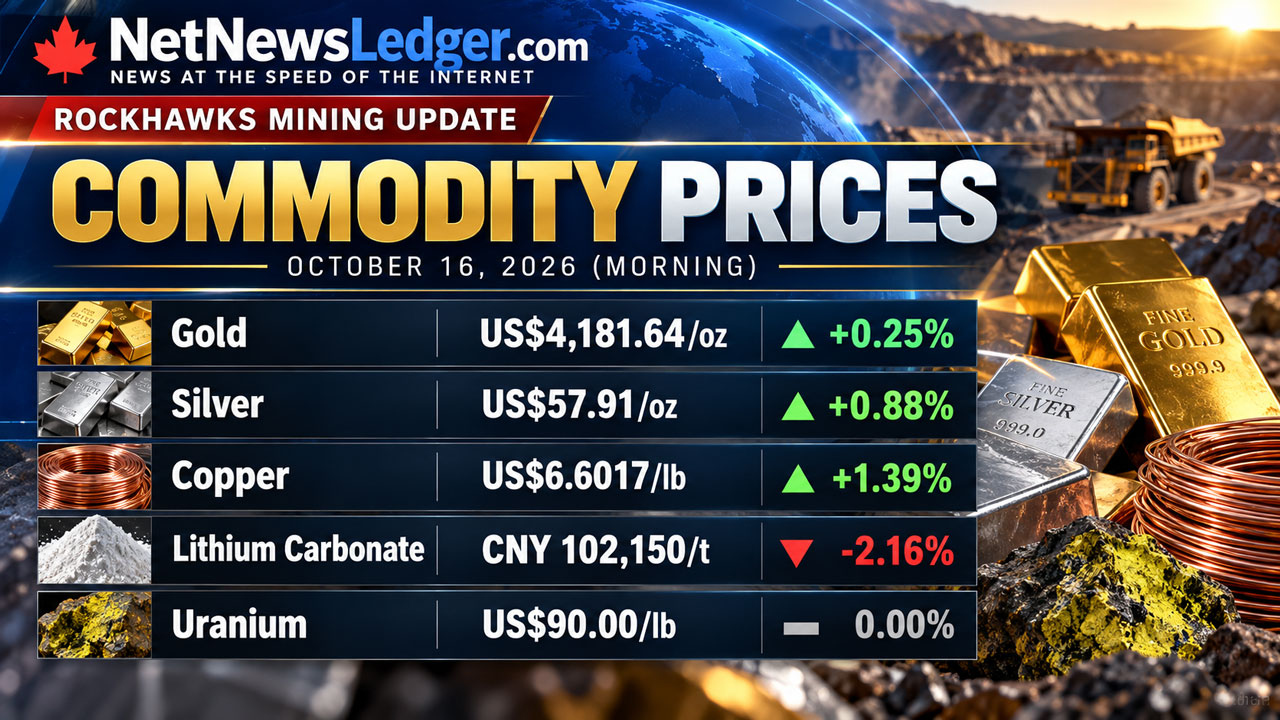
Gold traded above US$4,180 per ounce in Friday morning market readings, while silver approached US$58 and copper remained above US$6.60 per pound.
The latest developments include the first copper delivery into the United States’ Project Vault strategic reserve, a World Bank plan to expand critical-minerals financing, a major lithium expansion decision in Australia and new mining activity across Canada.
For Northwestern Ontario, the most immediate developments include exploration near Pickle Lake, continued drilling at Rainy River and progress on Ontario’s cobalt-processing capacity.
Together, these developments underline the growing importance of mining districts that can combine promising geology, reliable infrastructure, investment and meaningful relationships with Indigenous communities.
However, high commodity prices and ambitious project announcements do not guarantee successful mines. Financing, environmental approvals, construction costs and technical results remain essential considerations.
Commodity Prices: Gold, Silver and Copper Remain in Focus
Precious metals entered Friday’s session at elevated prices, while copper continued to attract attention amid concerns about future supply and growing demand from electrical infrastructure, manufacturing and technology.
The following indicative October 16 morning prices were included in the market information compiled for this report.
October 16, 2026: Morning Commodity Market Snapshot
| Commodity | Indicative Price | Reported Change |
|---|---|---|
| Gold | US$4,181.64/oz | +0.25% |
| Silver | US$57.91/oz | +0.88% |
| Copper | US$6.6017/lb | +1.39% |
| Nickel | US$15,329/tonne | +0.52% |
| Cobalt | US$39,345/tonne | Unchanged |
| Lithium carbonate | CNY 102,150/tonne | -2.16% |
| Iron ore | US$90.57/tonne | -0.19% |
| Uranium | US$90.00/lb | Unchanged |
| Platinum | US$1,648.90/oz | +1.69% |
| Palladium | US$1,133/oz | +0.40% |
Source: Indicative Trading Economics market quotations supplied in the original October 16 report. Cobalt reflects an October 15 update. Lithium carbonate is quoted in Chinese yuan. Prices reflect different market benchmarks and observation times.
Kitco’s live morning quotations were close to the broader market readings, with gold reported between US$4,176 and US$4,183 per ounce and silver between US$57.71 and US$57.73 per ounce.
The London Metal Exchange’s October 16 copper quotation was approximately US$14,625 per tonne, equivalent to about US$6.63 per pound.
Those figures provide additional context for copper’s strength as governments and manufacturers seek dependable sources of supply.
October 15 Evening: Additional Commodity Market Readings
A separate commodity market snapshot supplied for this report was timestamped October 15, 2026, at 7:15 p.m. EST.
| Commodity | Price (USD) | Reported Change |
|---|---|---|
| Gold | $4,162.60/oz | +1.51% |
| Silver | $57.26/oz | +2.86% |
| Platinum | $1,623.00/oz | +1.79% |
| Palladium | $1,114.00/oz | +3.05% |
| Rhodium | $9,250.00/oz | -1.08% |
| Ruthenium | $1,850.00/oz | 0.00% |
| Copper | $6.56/lb | -0.82% |
| Aluminum | $1.35/lb | -0.16% |
| Zinc | $1.69/lb | -2.58% |
| Lead | $0.846/lb | +0.38% |
| Nickel | $7.02/lb | +0.15% |
| Tin | $50,100.07/tonne | -2.00% |
| Lithium carbonate | $15,600.02/tonne | -3.65% |
| Cobalt | $17.85/lb | 0.00% |
| Antimony | $82.23/kg | -0.02% |
| Tungsten | $61.00/lb | -3.34% |
| Molybdenum | $42.00/lb | 0.00% |
| Gallium | $260.03/kg | +0.02% |
| Indium | $784.58/kg | +0.02% |
| Tellurium | $119.33/kg | +0.02% |
| Rhenium | $7,409.22/kg | 0.00% |
| Titanium | $6.50/kg | +0.02% |
| Vanadium pentoxide | $10,141.29/tonne | 0.00% |
| Magnesium | $1.33/lb | +0.05% |
| Iron ore | $82.55/tonne | -0.19% |
| Uranium (U3O8) | $90.30/lb | +0.33% |
Source: Supplied October 15 commodity snapshot. The percentage changes are those reported by its provider and should not be interpreted as changes between the October 15 and October 16 tables. Different benchmarks, units and observation times can produce different prices.
What Higher Metal Prices Mean for Northwestern Ontario
The potential significance of stronger gold and copper prices extends beyond mining company share prices.
Higher prices can make some exploration programs more attractive to investors and improve the projected economics of deposits that are technically and commercially viable.
For operating mines, stronger prices may increase revenue, although rising labour, fuel, equipment and financing costs can reduce the benefit.
For exploration companies, stronger markets may help support financing for drilling and technical studies.
Northwestern Ontario has significant gold production, copper potential and exploration opportunities involving lithium, nickel, cobalt and rare-earth elements. The region could benefit from increased investment, provided individual projects meet the requirements for development.
International Mining: U.S. Project Vault Receives First Copper Shipment
One of the week’s most significant developments is the first reported delivery of copper into the United States’ Project Vault strategic minerals reserve.
Commodity trading company Mercuria delivered approximately 12,000 tonnes of copper sourced from the Democratic Republic of Congo.
The shipment marks an important step in the United States’ effort to establish a strategic inventory of critical minerals intended to support civilian industry during potential supply disruptions.
Project Vault is supported by a financing framework involving the U.S. Export-Import Bank and private-sector participants.
Mercuria is one of the initiative’s major trading partners, with approximately US$500 million in financing associated with its participation.
The larger initiative has been described as having a funding structure of approximately US$12 billion.
The implications extend beyond a single copper shipment.
Governments are increasingly treating minerals as strategic industrial resources rather than commodities that can always be purchased without supply concerns.
For Canadian producers and developers, this may create opportunities to supply customers seeking reliable North American mineral sources. It could also introduce additional competition for available metal.
The delivery itself does not establish that copper prices will continue increasing.
World Bank Targets US$19 Billion in Critical-Minerals Financing
The World Bank is preparing a substantial expansion of its activities involving metals and critical minerals.
World Bank President Ajay Banga outlined a goal of directing approximately US$19 billion toward the sector during fiscal years 2026 through 2030.
That compares with approximately US$3.6 billion over the previous five-year period.
The strategy includes financing for mining-related development, processing capacity and infrastructure, with the broader objective of helping producing countries retain more economic value from their resources.
For mineral-rich countries, financing can be particularly important when projects require expensive roads, rail lines, electricity transmission and processing facilities before production can begin.
The initiative could also affect competition for capital by increasing support for projects in emerging mining regions.
However, the World Bank has indicated that it will maintain a precautionary approach toward deep-sea mining.
The announcement represents a financing objective rather than confirmation that every proposed investment will proceed.
Chile’s Tres Valles Copper Restart Highlights Supply Challenges
Global Critical Resources is working to restart underground production at Chile’s Tres Valles copper complex by the end of 2026.
The company, founded by Austrian investor Cevdet Caner, is pursuing a strategy built around existing mining infrastructure and purchasing additional ore from smaller Chilean producers.
Previously developed mines can offer advantages over entirely new projects because some infrastructure and permits are already in place.
However, the Tres Valles project also faces unresolved environmental charges, supplier-payment issues and litigation.
The situation illustrates both the opportunities and difficulties associated with bringing older copper mines back into production.
Copper demand from electricity networks, industrial infrastructure and transportation has increased interest in projects that might add supply more quickly than newly discovered deposits.
For Northwestern Ontario, the broader lesson is that existing infrastructure and well-understood mineral deposits can be valuable advantages, but they do not eliminate financial, environmental or operational risks.
Australia: PLS Approves Major Lithium Expansion at Pilgangoora
Australian lithium producer PLS Group has approved its P2000 expansion project at the Pilgangoora operation in Western Australia.
The company announced an investment decision involving approximately A$1.9 billion, intended to increase annual spodumene concentrate production capacity to approximately two million tonnes.
The project includes construction of the Jimmagunya processing plant.
PLS is targeting first production from the expansion in the September quarter of 2029.
The company also announced a 31 percent increase in the contained lithium in its Pilgangoora Ore Reserve.
The updated estimate includes approximately 249.2 million tonnes of ore grading 1.24 percent lithium oxide, representing about 3.1 million tonnes of contained lithium oxide.
PLS says the expanded reserve supports more than 25 years of potential production when underground mining is included.
These developments are significant because they demonstrate that major lithium producers continue making long-term capital commitments despite fluctuations in battery-mineral prices.
For Canadian lithium developers, including companies with projects in Northern Ontario, large international expansions help establish the competitive environment in which future projects must operate.
A new Canadian lithium mine must compete not only on its mineral resources but also on operating costs, processing arrangements, transportation, infrastructure and access to customers.
Canadian Mining: Steelmakers Find Opportunities in Domestic Projects
Canadian steel producers are benefiting from increased domestic demand associated with mining, energy projects, construction and artificial-intelligence data centres.
A Reuters report published October 16 describes how some producers are adapting to the effects of U.S. tariffs by pursuing opportunities within Canada.
Mining projects require substantial quantities of steel for processing plants, structural supports, pipelines, heavy equipment and related infrastructure.
That creates a direct connection between investment in Canada’s resource sector and the performance of domestic industrial suppliers.
For Northern Ontario, new mines and processing facilities have the potential to support fabrication, transportation, engineering and maintenance businesses.
However, the recovery in steel demand remains uneven, and individual companies continue to face pressure from tariffs, international competition and operating costs.
Quebec Gold Exploration: Auriginal Reports New Results at Roger
Auriginal Mining has reported new gold-copper drilling results from its Roger Project in Quebec’s Chibougamau district.
According to the company’s October 15 release, drill hole AUR-26-12 intersected 45.5 metres grading 1.05 grams per tonne gold, including an eight-metre interval grading 4.37 grams per tonne gold.
Another hole, AUR-26-10, returned 29.4 metres grading 1.32 grams per tonne gold, including a shorter interval grading 14.0 grams per tonne gold.
The company is working toward additional mineral resource estimates and continued exploration.
Drill intersections are an important part of mineral exploration, but they should not be interpreted automatically as the mineable width of a deposit.
A resource estimate requires geological interpretation and technical analysis beyond individual assays.
The Roger results reflect continued exploration interest in Canadian gold-copper deposits as precious-metal prices remain elevated.
Northwestern Ontario: Canamera Advances Schryburt Lake Drilling Near Pickle Lake
One of the most immediate regional developments involves Canamera Energy Metals and its Schryburt Lake rare-earth-element and niobium exploration project north-northeast of Pickle Lake.
The company scheduled mobilization of its first helicopter-supported diamond drilling program for October 16, 2026.
The initial program calls for approximately 1,500 metres of drilling across three holes targeting the Blue Jay, Starling and Blackbird areas.
Each hole is expected to test geological targets identified through historical data, geophysical interpretation and surface exploration.
Ontario has issued a three-year exploration permit allowing activities that may include drilling at up to 19 sites, stripping, trenching and geophysical work.
The permit runs from September 10, 2026, through September 9, 2029.
The Schryburt Lake project includes 252 unpatented mining claims covering approximately 4,947 hectares.
Canamera has also announced an exploration agreement with Nibinamik First Nation, an Anishinaabe community located at Summer Beaver.
The agreement establishes a framework for communication, collaboration, community participation and recognition of Nibinamik’s Aboriginal and treaty rights, stewardship responsibilities and culturally significant areas.
These arrangements are important because mineral development in the Far North involves land use, Indigenous rights, environmental responsibilities and decisions that can affect communities over many years.
The exploration program is at an early stage.
Schryburt Lake does not currently have a mineral resource estimate, and historic exploration information does not establish that an economically viable deposit exists.
The next important milestones will be confirmation of drilling progress, geological observations and laboratory assay results.
Rainy River Gold Mine: Coeur Continues Extensive Exploration
Coeur Mining’s Rainy River exploration program remains a major development for Northwestern Ontario’s gold-mining sector.
In its September 22 update, the company outlined approximately US$18 million in planned exploration spending at Rainy River during 2026.
The program includes roughly 64 kilometres of core drilling targeting underground mineralization.
By August 30, approximately 43 kilometres had been completed across 51 drill holes.
The company reported exploration progress involving the ODM Main and Zone 17 mineralized areas, along with additional investigations into open-pit and regional targets.
The drilling is intended to improve understanding of the deposit and potentially expand or convert mineral resources.
Exploration near an existing operating mine can be particularly significant because infrastructure, technical expertise and a workforce are already present.
For the Rainy River district, successful drilling may support future mine planning, specialized contracting and employment.
However, reported exploration success does not automatically translate into additional reserves or an extended mine life.
Those outcomes depend on further technical, economic and operational work.
Electra Battery Materials Advances Cobalt Refinery Partnerships
Electra Battery Materials has signed a non-binding term sheet with WMC Group AG concerning a proposed five-year commercial and working-capital partnership for its Ontario cobalt refinery.
The proposed arrangement would support cobalt feedstock purchasing, financing, logistics and marketing as Electra prepares for commercial production.
Electra’s refinery is located in the Temiskaming area of Northeastern Ontario.
The company has been working toward restarting and expanding the facility to produce battery-grade cobalt sulphate.
LG Energy Solution has arrangements covering approximately 60 percent of the refinery’s planned production, while WMC is expected to assist with marketing the remaining portion.
Cobalt feedstock is expected to be sourced primarily through arrangements involving Glencore’s operations in the Democratic Republic of Congo.
The proposed WMC partnership could help Electra manage the working capital required to purchase raw materials and sell refined products.
That financing requirement is significant because processing facilities may need considerable cash to acquire feedstock before revenue from finished products is collected.
Electra’s progress demonstrates the importance of domestic mineral processing in Canada’s critical-minerals strategy.
However, the WMC arrangement remains subject to definitive agreements and other commercial requirements. It should not be described as completed financing or guaranteed future production.
Additional Mining Developments: Gold, Copper, Uranium and Tungsten
A series of company announcements in the October 15–16 mining news feed indicates continued exploration activity across several commodity groups.
Gold Exploration Remains Active
Caprice Resources reported the commencement of regional discovery drilling and additional results.
Aurum Resources announced gold mineralization outside its BST1 resource area ahead of a mineral resource estimate update.
Haranga Resources reported high-grade gold from the first hole of its second drilling phase.
Black Cat Syndicate announced additional high-grade intercepts and a new target at Coyote Central.
Pacific Resources also reported further high-grade results from its Snowstorm Gold Project.
These are company-reported exploration headlines. Grade, thickness, true widths and economic significance require assessment of the complete technical releases.
Copper Exploration Continues
S2 Resources reported the start of drilling on gold and copper targets at Warraweena in New South Wales.
Tartana Resources announced that high-grade copper-gold results identified multiple targets at OK-Bellevue.
Such programs reflect continued industry interest in new copper discoveries as governments and manufacturers seek additional supply.
Tungsten and Tin Attract Exploration Spending
Tungsten Mining announced that initial drilling at Mt Mulgine exceeded its expectations.
Viking Mines reported that drilling had resumed at the Linka Tungsten Project.
Elementos provided an update on resource-growth drilling at the Cleveland tin-tungsten project.
Tungsten has strategic industrial applications, including specialized manufacturing equipment and hard-metal components.
The exploration announcements are noteworthy, but further drilling and technical studies are necessary to assess whether they support commercial development.
Uranium Project Development
Aura Energy reported that a bankable feasibility study for its Tiris uranium project supported its description of the project as a potentially low-cost, near-term development opportunity.
The company announcement adds to the broader discussion about uranium supply and future nuclear-energy requirements.
Feasibility-study findings should be evaluated alongside financing, permits, uranium market conditions and construction schedules.
Gold Production Updates
Forrestania Resources reported progress at Edna May, including a company timeline pointing toward December gold production.
Manuka Resources announced a second gold sale scheduled for October 16, 2026.
These developments illustrate the distinction between exploration activity and companies moving toward or participating in production and sales.
Editorial note: The announcements in this section were provided as mining news headlines. Individual technical figures and project milestones have not all been independently verified against the underlying releases and should be reviewed before publication.
Mining Acquisitions and Corporate Developments
Recent announcements also point to continued activity involving project acquisitions, corporate restructuring and ownership changes.
Macro Metals reported completing its acquisition of the Yandi South iron ore project.
Arrow Minerals announced an increase in its Pilbara iron ore footprint, describing the expansion as approximately 400 percent.
Albright Metals reported the termination of an agreement with Catalyst Metals.
Other announcements included corporate matters involving Zenith Minerals, Forrestania Resources and Alcoa.
These developments are worth monitoring because mining-sector consolidation can change access to exploration properties, financing and infrastructure.
However, an acquisition or expansion of land holdings does not independently demonstrate an increase in mineral resources.
What These Developments Mean for Northwestern Ontario
Northwestern Ontario is positioned within a broader international effort to secure reliable supplies of minerals used in manufacturing, infrastructure, energy and advanced technology.
The region offers significant geological opportunities, existing mining operations, established service businesses and experience supporting remote exploration.
However, there are several challenges that will continue shaping future investment.
Infrastructure and Electricity
New mines may require major investments in roads, energy supply, transmission lines, communications and processing facilities.
Remote projects, especially those in the Far North, face particularly difficult transportation and logistics requirements.
Indigenous Participation
Meaningful engagement with First Nations governments is essential to responsible resource development.
Agreements involving employment, training, contracting, environmental stewardship and economic participation can play important roles in building long-term project relationships.
The details of each agreement matter, and community consultation is not simply a procedural step.
Financing and Project Economics
High commodity prices can improve investor interest, but financing conditions remain sensitive to market volatility, interest rates and company-specific risks.
A promising mineral discovery may still require years of exploration, assessment, permitting and construction before commercial production becomes possible.
Local Processing and Employment
Mineral development may generate greater long-term economic benefits when more processing, engineering, manufacturing and service activity occurs within Canada.
Projects such as Electra’s cobalt refinery demonstrate the importance of developing the industrial capacity required to turn mineral resources into usable products.
For Northwestern Ontario, the long-term opportunity is not limited to extracting ore. It also includes creating more skilled employment, technical expertise and business opportunities throughout the mining supply chain.
RockHawks Watch List: What Comes Next?
Five developments deserve close attention as the mining sector moves through the remainder of October and toward the end of 2026.
1. Schryburt Lake drilling results
Canamera’s drilling near Pickle Lake will provide new geological information about its rare-earth-element and niobium targets. Confirmation of actual drilling progress and assay results will be important.
2. Rainy River resource development
Coeur’s continued drilling may help clarify the long-term potential of underground and regional mineralized zones.
3. Cobalt refinery commercial arrangements
Electra’s ability to finalize working-capital financing and marketing arrangements will be important as it works toward its production objectives.
4. Lithium expansion and global competition
PLS Group’s Pilgangoora investment demonstrates the scale of international competition facing proposed Canadian lithium developments.
5. Copper prices and strategic reserves
The arrival of copper into Project Vault and increased attention to critical-minerals stockpiles may influence procurement strategies, trade patterns and investment decisions.
The effects on prices and mine development remain uncertain.
Bottom Line: Mining Investment Is Becoming a Strategic Priority
The global mining industry is entering a period in which mineral supply is increasingly connected to national security, industrial development, energy infrastructure and government financing.
Gold prices remain elevated, copper is attracting strategic interest, and major producers continue investing in long-term capacity.
At the same time, exploration companies are pursuing new discoveries across gold, copper, lithium, tungsten, uranium and rare-earth elements.
For Northwestern Ontario, the opportunities are considerable.
Projects near Pickle Lake, ongoing exploration at Rainy River and Ontario’s growing interest in processing critical minerals demonstrate the region’s potential importance.
The most successful developments will be those capable of demonstrating sound geology, realistic economics, responsible environmental management and durable relationships with Indigenous communities.
Strong commodity markets may attract investment, but long-term success will be determined by what companies can actually discover, finance, build and operate.
Editorial and Market Data Note: Commodity figures are indicative snapshots from the supplied market material and may differ between providers, currencies, units and trading sessions. Project milestones, drilling results and production forecasts are company-reported unless independently confirmed. Mining investment carries technical, financial, regulatory and market risks. The article is intended for general news reporting and is not investment advice.