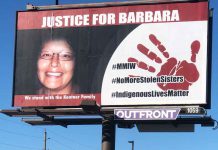
Bushby’s full parole in the Barbara Kentner case sparks outrage and questions about justice
THUNDER BAY — Brayden Bushby, convicted of manslaughter in the death of Barbara Kentner after throwing a trailer hitch at her from a moving vehicle in Thunder Bay, has been granted full parole, a decision Nishnawbe Aski Nation and Wabigoon Lake Ojibway Nation are condemning as a profound failure of justice.
The Parole Board of Canada granted Bushby full parole effective Aug. 13, 2026. The decision comes after a complicated correctional history that included an earlier period of day parole, its revocation for breaches, a return to custody and another period of conditional release.
There is an important timeline distinction: Bushby was granted day parole approximately two years after beginning his federal sentence, in August 2023. His full parole was granted in August 2026, approximately five years after he was sentenced in June 2021.
For Kentner’s family, Wabigoon Lake Ojibway Nation and Indigenous leadership across Northern Ontario, however, the issue is not simply how many years have passed.
Their concern is what the release says about accountability, rehabilitation and whether Indigenous victims can have confidence that the Canadian justice system places appropriate weight on the violence committed against them.
From a Thunder Bay Street to a Manslaughter Conviction
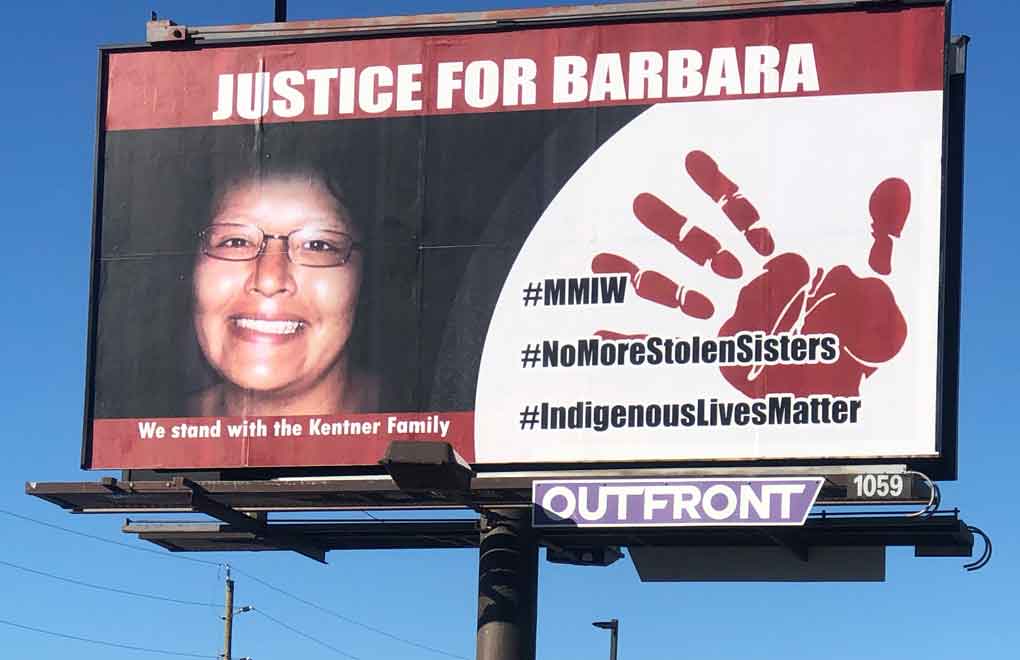
Barbara Kentner was 34 and a member of Wabigoon Lake Ojibway Nation.
In the early hours of Jan. 29, 2017, Kentner and her sister Melissa were walking along McKenzie Street in Thunder Bay when Bushby, then 18, threw a heavy trailer hitch from the passenger window of a moving vehicle.
Ontario Superior Court Justice Helen Pierce found that Bushby had been drinking heavily and had earlier said he wanted to drive around and yell at sex workers. He lifted himself through the vehicle window and threw the hitch at the two women, striking Kentner in the abdomen. Witness evidence heard by the court was that Bushby then said, “Yeah, I got one of them,” and laughed.
The impact ruptured Kentner’s small intestine.
She underwent emergency surgery and experienced further medical complications. Kentner died on July 4, 2017.
At trial, forensic pathology evidence established that the blunt-force injury from the trailer hitch caused the bowel rupture and significantly contributed to and accelerated Kentner’s death. Pierce found that causal connection proven beyond a reasonable doubt.
Bushby pleaded guilty to aggravated assault but contested whether his actions legally caused Kentner’s death. In December 2020, Pierce convicted him of manslaughter.
Sentencing Judge Emphasized Denunciation and Deterrence
Bushby was sentenced on June 7, 2021, to eight years in prison, less one month of credit for time already served, leaving a sentence of seven years and 11 months.
At sentencing, the Crown sought a term of eight to 12 years, arguing Bushby’s conduct approached what courts have described as aggravated manslaughter or “near murder.”
Pierce agreed that Bushby demonstrated a high degree of awareness that throwing a heavy trailer hitch at another person would cause harm.
The sentencing decision also made an important distinction regarding motive. The court did not find evidence establishing that Bushby selected Kentner because she was Indigenous. Pierce instead found his behaviour reflected bias against women and his intention to target women he perceived to be sex workers.
At the same time, the judge recognized that the killing had a much wider impact on Indigenous people in Thunder Bay, where violence and racism directed at Indigenous women had already generated serious concern.
That distinction remains important today. The criminal court’s finding about the motivation for the 2017 attack should not be rewritten based on Bushby’s later conduct. However, subsequent Parole Board assessments have raised separate concerns about attitudes and symbols associated with racism.
Day Parole Came After About Two Years
Bushby was first granted day parole in August 2023 after serving a little more than two years in federal custody.
At the time, the Parole Board considered him at relatively low risk of reoffending but denied full parole, saying that step was premature. Conditions included abstaining from alcohol and drugs, following treatment requirements and having no contact with Kentner’s family.
Day parole differs significantly from full parole. It is generally intended as a controlled transition into the community, often requiring the offender to return to a halfway house or other approved residence.
Full parole allows an offender to live in the community while remaining under the authority and supervision of the federal correctional system until the sentence expires.
Day Parole Revoked in 2024
Bushby’s first period of day parole did not proceed without serious problems.
The Parole Board revoked the release in 2024 after finding he breached several conditions.
Board documents reported that Bushby consumed alcohol despite a prohibition, associated with a woman known to police and connected to the drug subculture and demonstrated what the board described as poor and impulsive decision-making.
The board also raised concerns about a Confederate flag tattoo Bushby obtained while on conditional release. The board described the flag as widely associated with racist ideology and found Bushby’s explanation for the tattoo lacked credibility.
Bushby was returned to custody.
Swastika Incident Raised Further Questions
Concerns continued after Bushby returned to prison.
In August 2025, he was captured on institutional video surveillance cutting a swastika into a lawn, according to Parole Board material reported by APTN News.
His correctional team determined at the time that his risk could no longer be managed at minimum security, and he was temporarily returned to medium security. Bushby later characterized the incident as a stupid mistake and denied holding racist beliefs.
The board ultimately granted him another period of day parole in December 2025, determining that his assessed risk and a structured release plan outweighed continuing concerns about his behaviour and compliance.
Those events are now central to criticism of the decision to permit full parole.
Parole Board Concludes Risk Can Be Managed
In granting full parole, the Parole Board concluded Bushby’s release would not present an undue risk to society and that release would assist his reintegration as a law-abiding citizen.
The decision does not mean Bushby’s sentence has disappeared.
Under Canada’s Corrections and Conditional Release Act, full parole allows an offender to be at large while continuing to serve the sentence. The offender remains under federal supervision and must comply with conditions. Parole can be suspended or revoked if those conditions are breached or risk becomes unmanageable.
Bushby’s reported conditions include prohibitions on alcohol and non-prescribed drugs, restrictions on entering drinking establishments, requirements to follow treatment plans and restrictions on associating with people involved in criminal activity or substance abuse.
He is also prohibited from contacting Kentner’s immediate family and must report relationships and changes in relationships to his parole supervisor.
NAN: Decision Feels Like a ‘Profound Injustice’
Nishnawbe Aski Nation Grand Chief Alvin Fiddler said the decision has devastated Kentner’s family and Indigenous communities.
“This feels like a profound injustice,” Fiddler said.
NAN argues that granting full parole undermines the message Pierce delivered when sentencing Bushby — particularly the need for denunciation and deterrence.
Fiddler also pointed to the Parole Board’s own concerns about Bushby’s history, attitudes toward women, high-risk behaviour and possible racist attitudes.
NAN says those findings are difficult to reconcile with the conclusion that Bushby’s risk can now be safely managed in the community.
The organization also highlighted the board’s observation that Bushby had not demonstrated the degree of remorse NAN believes should be expected, saying the decision sends a dangerous message in a city where Indigenous residents have repeatedly raised concerns about racism and violence.
Wabigoon Lake Ojibway Nation Calls Release a ‘Miscarriage of Justice’
Wabigoon Lake Ojibway Nation has issued its own strong condemnation.
Kentner was a member of the Nation, and Chief and council said the community stands with her family in what it described as outrage and disbelief.
“The release of Brayden Bushby is a miscarriage of justice,” the Nation said.
Wabigoon Lake Ojibway Nation said the decision has retraumatized Kentner’s family and community and called on both the federal government and the Parole Board of Canada to confront what it describes as systemic discrimination against Indigenous victims within Canada’s justice system.
The Nation said Kentner’s memory will continue to guide its calls for truth, accountability and a justice system that values and protects Indigenous people.
What the Criminal Code Says About the Conviction
Bushby’s conviction was for manslaughter under section 236 of the Criminal Code.
Manslaughter is an indictable offence carrying a maximum sentence of life imprisonment. Where a firearm is used, the Criminal Code provides a four-year mandatory minimum. No firearm was involved in the Kentner case, so that minimum did not apply.
Unlike murder, manslaughter does not have one narrow sentencing range. Sentences vary widely because the offence covers circumstances ranging from relatively low moral blameworthiness to conduct approaching murder.
In Bushby’s case, the Crown argued that eight to 12 years was appropriate because of the dangerous and deliberate nature of the assault. The judge imposed eight years.
Bushby had also pleaded guilty to aggravated assault under section 268, which applies when an assault wounds, maims, disfigures or endangers the life of another person. Aggravated assault carries a maximum sentence of 14 years. His ultimate conviction for causing Kentner’s death was manslaughter.
Why Parole and the Original Sentence Can Appear to Send Different Messages
The anger surrounding Bushby’s release exposes a difficult feature of Canada’s justice system.
A sentencing judge and the Parole Board perform different legal functions.
A judge imposes a sentence based on principles that include denunciation, deterrence, proportionality, rehabilitation and protection of the public.
The Parole Board later considers whether an offender can serve part of that existing sentence in the community.
Under section 102 of the Corrections and Conditional Release Act, parole can be granted when the board concludes the offender will not present an undue risk to society through reoffending and that release will contribute to public protection by supporting lawful reintegration.
The law also says protection of society is the Parole Board’s paramount consideration, while requiring the board to make the least restrictive decision consistent with public safety.
Those principles explain the legal framework. They do not necessarily resolve the public controversy.
The Larger Question: Can People Maintain Confidence in the Justice System?
The Bushby decision raises a broader question that reaches beyond this individual case: What happens to public confidence when a parole decision appears, to victims and their communities, to conflict with the message delivered by the sentencing court?
Respect for a justice system cannot depend on every person agreeing with every ruling. Courts and parole boards are expected to make independent decisions according to law, not according to public anger.
But public confidence does depend heavily on whether decisions can be understood.
In this case, that means the Parole Board’s reasoning will face particularly close scrutiny because the record includes an earlier parole revocation, alcohol-related non-compliance, concerns about a Confederate flag tattoo and the later swastika incident.
The board’s legal responsibility is to assess current risk, not to impose a second punishment for conduct already considered by correctional authorities. Still, when previous behaviour appears to echo concerns surrounding the original offence, the public can reasonably expect a clear explanation of what changed and why the board now considers the risk manageable.
For Indigenous people in Thunder Bay and Northwestern Ontario, that issue is amplified by a much larger history.
Kentner’s death did not occur in isolation. Indigenous families and leaders have for years raised concerns about violence against Indigenous women, racism, policing, deaths of Indigenous people in Thunder Bay and unequal treatment by Canadian institutions.
When Wabigoon Lake Ojibway Nation says the release reinforces perceptions of systemic discrimination, that reaction becomes part of the justice system’s public-confidence problem whether or not the Parole Board agrees with the conclusion.
Parole Is Not the End of the Sentence
It is also important to distinguish parole from an acquittal, pardon or reduction of the sentence.
Bushby remains a convicted offender serving the sentence imposed by the Superior Court.
Full parole changes where and under what conditions the remainder of that sentence is served. He remains subject to federal supervision and can be returned to custody if his parole is suspended or revoked.
Most federal offenders serving determinate sentences are ultimately released before the expiry of their sentence, and statutory release generally occurs after two-thirds of a sentence unless specific legal grounds exist to detain an offender longer.
That distinction is important to understanding Canada’s correctional system — but it may provide little comfort to a family or community that believes the punishment imposed for the loss of a life has already been insufficient.
Barbara Kentner at the Centre of the Story
Amid debate about sentencing law, parole rules and risk assessments, the central fact remains that Barbara Kentner lost her life.
She was a mother, sister and member of Wabigoon Lake Ojibway Nation.
The court found beyond a reasonable doubt that Bushby deliberately threw a heavy trailer hitch at her from a moving vehicle and that the resulting injury significantly contributed to and accelerated her death.
For NAN and Wabigoon Lake Ojibway Nation, the full-parole decision is now another chapter in a case that has come to symbolize wider questions about violence against Indigenous women and whether the institutions responsible for administering justice command the confidence of the people they are meant to serve.
The Parole Board’s task is to determine whether Bushby’s risk can be managed according to Canadian law.
The challenge for the justice system is larger: demonstrating, through transparent and understandable decisions, why Canadians — including victims, their families and Indigenous communities — should have confidence in how that law is being applied.