85 wildfires remain active across Northwestern Ontario
THUNDER BAY — No new wildland fires were confirmed in Northwestern Ontario by the evening of Saturday, Aug. 15, but 85 fires remained active across the Northwest Fire Region, including seven classified as not under control.
Ontario’s Aviation, Forest Fire and Emergency Services reported cooler conditions and the possibility of rain across major fire-affected areas, helping crews working on the massive Rinker Lake Complex and the Atikokan-area fires. The Restricted Fire Zone covering the Northwest Region also remains an important restriction for residents, campers, outfitters and travellers.
As of 5 p.m. CDT on Aug. 15, the 85 active fires were classified as:
- Seven not under control
- Six being held
- Nine under control
- 63 being observed
The declining number of fires does not mean the wildfire emergency is over. Several very large fires remain uncontrolled, requiring crews, aircraft and equipment from Ontario and outside the province.
Rinker Lake Complex remains major firefighting operation
The Rinker Lake Complex, consisting of Thunder Bay 36, Dryden 34 and Dryden 35, remains one of the most significant wildfire operations in Northwestern Ontario.
FireRanger crews from Ontario, Alberta, Manitoba and Nova Scotia, along with firefighters from Mexico, continue suppression work across the complex. Crews are locating and extinguishing residual heat, smoke and isolated areas of open flame.
Fire activity was reported as low Saturday. Cooler temperatures and possible rainfall were expected to further reduce fire intensity and support suppression operations.
The three fires remain not under control:
- Thunder Bay 36 (THU036) — 301,240 hectares.
- Dryden 34 (DRY034) — 45,800 hectares.
- Dryden 35 (DRY035) — 30,201 hectares.
Together, the three fires cover approximately 377,241 hectares, although mapped fire sizes can change as crews obtain more accurate perimeter information.
Ontario’s current provincial wildfire information confirms the latest mapped size of DRY035 at 30,201 hectares.
For the Thunder Bay District, THU036 remains especially important because of its enormous footprint and the resources required to manage a fire of that size. Even when visible flames decline, crews can spend considerable time identifying deep-burning hot spots and securing sections of perimeter.
Mexican firefighters reinforce Atikokan operation
Firefighters are also continuing work on the Atikokan Cluster, consisting of Fort Frances 13, Fort Frances 14 and Fort Frances 15.
An additional 20 firefighters from Mexico joined the Fort Frances 14 operation Saturday, adding to the international personnel supporting Ontario crews.
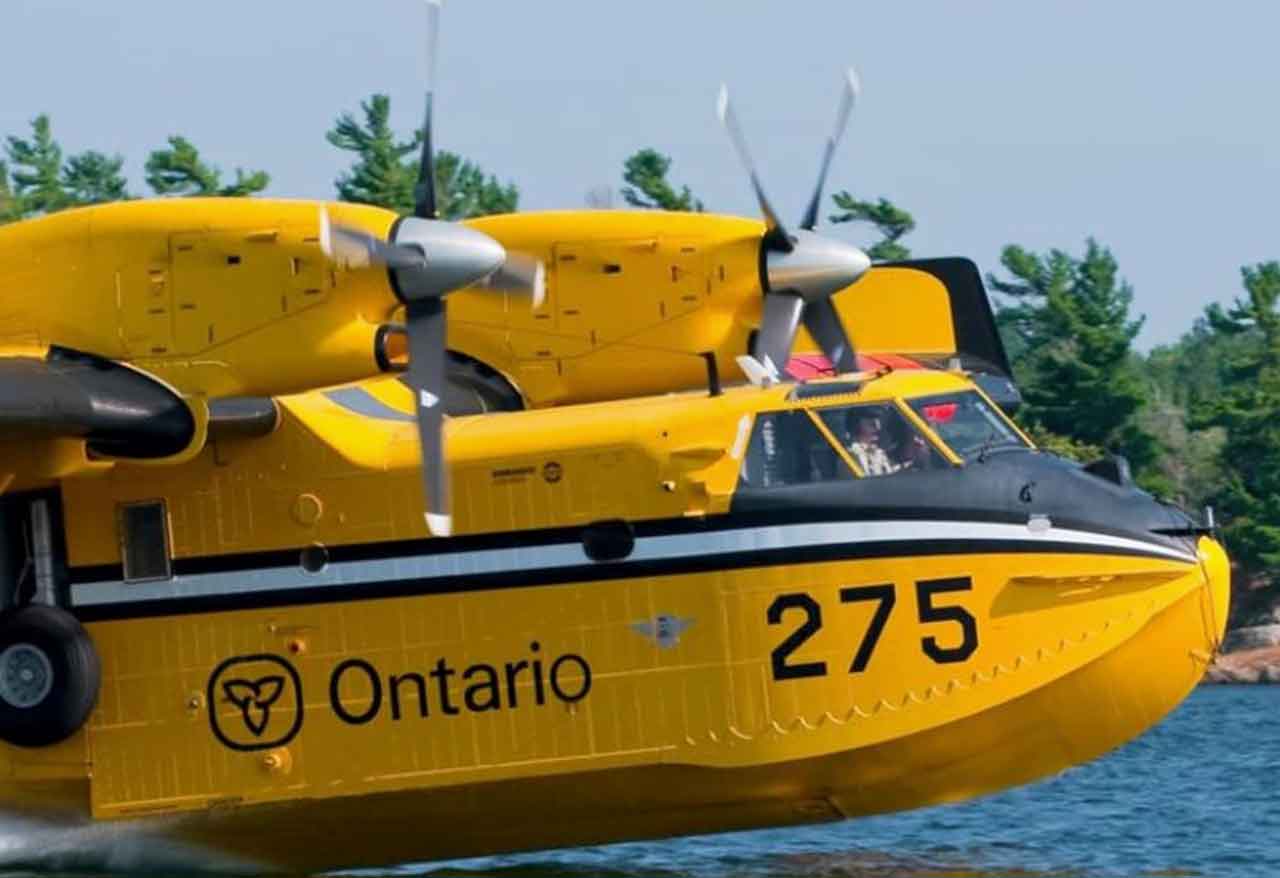
Firefighters are targeting hot spots identified through infrared scanning, with helicopters providing water-bucketing support where fire activity increases. Infrared scanning also continues on Fort Frances 15 to identify areas requiring additional helicopter support.
The fires are currently listed as:
- Fort Frances 13 (FOR013) — 25,313 hectares and being observed.
- Fort Frances 14 (FOR014) — 51,768 hectares and not under control.
- Fort Frances 15 (FOR015) — 42,273 hectares and not under control.
Ontario’s published information continues to list FOR014 at 51,768 hectares and FOR015 at 42,273 hectares.
Cooler weather, higher relative humidity and precipitation can help reduce fire behaviour, but stronger winds may still move smoke and contribute to isolated flare-ups. Deep-burning areas can also retain heat long after surface fire activity has declined.
Access restrictions lifted around Fort Frances 14
The Implementation Order that had restricted road and lake access in the Fort Frances 14 fire area was lifted Wednesday, Aug. 12, at 9 a.m.
Roads and lakes covered by that order are again available for use. People returning to the area are being asked to stay away from active firefighting operations and provide crews and aircraft with room to work safely.
The lifting of an access restriction should not be interpreted as meaning FOR014 is extinguished. The fire remained classified as not under control in the Aug. 15 update.
Residents, First Nations, tourism operators and people travelling through remote areas of Northwestern Ontario should continue checking provincial evacuation orders, alerts and implementation orders because conditions can change as fire behaviour and operational requirements change.
NOTAMs remain in place for Thunder Bay 36 and Fort Frances 14
Pilots should be aware that NOTAMs are in effect in the areas of Thunder Bay 36 and Fort Frances 14, northeast of Byers Lake.
These restrictions are in addition to the standard Canadian aviation rules governing flight near forest fires.
Section 601.15 of the Canadian Aviation Regulations prohibits unauthorized aircraft from operating over a forest fire area, or within five nautical miles of a forest fire, at less than 3,000 feet above ground level. Aircraft are also prohibited from entering airspace described in a forest-fire NOTAM unless an applicable exception or authorization applies.
That restriction is particularly important in Northwestern Ontario, where helicopters, waterbombers and other aircraft may be operating at low altitude in difficult conditions. Unauthorized aircraft — including recreational aviation — can interfere with suppression operations and create serious risks for firefighting crews.
Pilots should consult current NAV CANADA flight-planning information before operating near any active wildfire.
Restricted Fire Zone remains in effect
A provincial Restricted Fire Zone remains in effect across the Northwest Fire Region and a small portion of the Northeast Region.
The restriction took effect July 15 at 12:01 a.m. because of high to extreme fire hazard, increased wildfire activity and the overall number of fires requiring provincial resources.
Under a Restricted Fire Zone, outdoor fires are prohibited unless a specific exemption or authorization applies. Ontario says the prohibition includes grass fires, debris burning and campfires, including fires in outdoor fire grates, fireplaces and fire pits.
The restriction is aimed at preventing human-caused fires while provincial crews and aircraft remain committed to existing incidents.
For Northwestern Ontario residents and visitors, that means checking the rules before heading to camp, travelling into the backcountry or conducting work that could create an ignition source. Municipal restrictions may also apply.
Why cooler weather helps — but does not end the threat
Rain, lower temperatures and higher humidity can substantially reduce short-term wildfire intensity, giving ground crews an opportunity to strengthen control lines, extinguish hot spots and move equipment into areas that were previously difficult to work safely.
However, the enormous size of fires such as THU036 means suppression and monitoring can continue long after dramatic fire behaviour subsides.
For Northwestern Ontario, persistent large fires can affect aviation, forestry and resource operations, recreational access, tourism and transportation corridors. Smoke can also travel considerable distances from the actual fire perimeter, meaning communities far from an active fire may still experience hazy conditions.
The ongoing use of crews from other provinces and Mexico also demonstrates the scale of the 2026 response and the importance of mutual assistance during periods of intense wildfire activity.
How to report a wildland fire
Anyone who spots a wildland fire north of the French and Mattawa rivers should call 310-FIRE (3473).
For a wildland fire south of the French or Mattawa rivers, call 911.
People across Thunder Bay and Northwestern Ontario should continue monitoring Ontario’s official forest fire information and interactive fire map for changing fire locations, danger ratings, evacuation information and restrictions.