Hormone replacement therapy has been the cornerstone of menopause management for decades. It’s well-studied, broadly effective, and for many women, genuinely life-changing. But menopause is a more complex transition than any single intervention fully addresses, and the women who navigate it best are increasingly working with a broader toolkit.
Peptide therapy is becoming a significant part of that toolkit. Not as a replacement for hormone therapy, but as a set of targeted tools that can address specific downstream effects of the menopausal transition: the metabolic changes, the skin and joint changes, the shifts in sexual health and sleep quality, the slower recovery that comes with declining growth hormone.
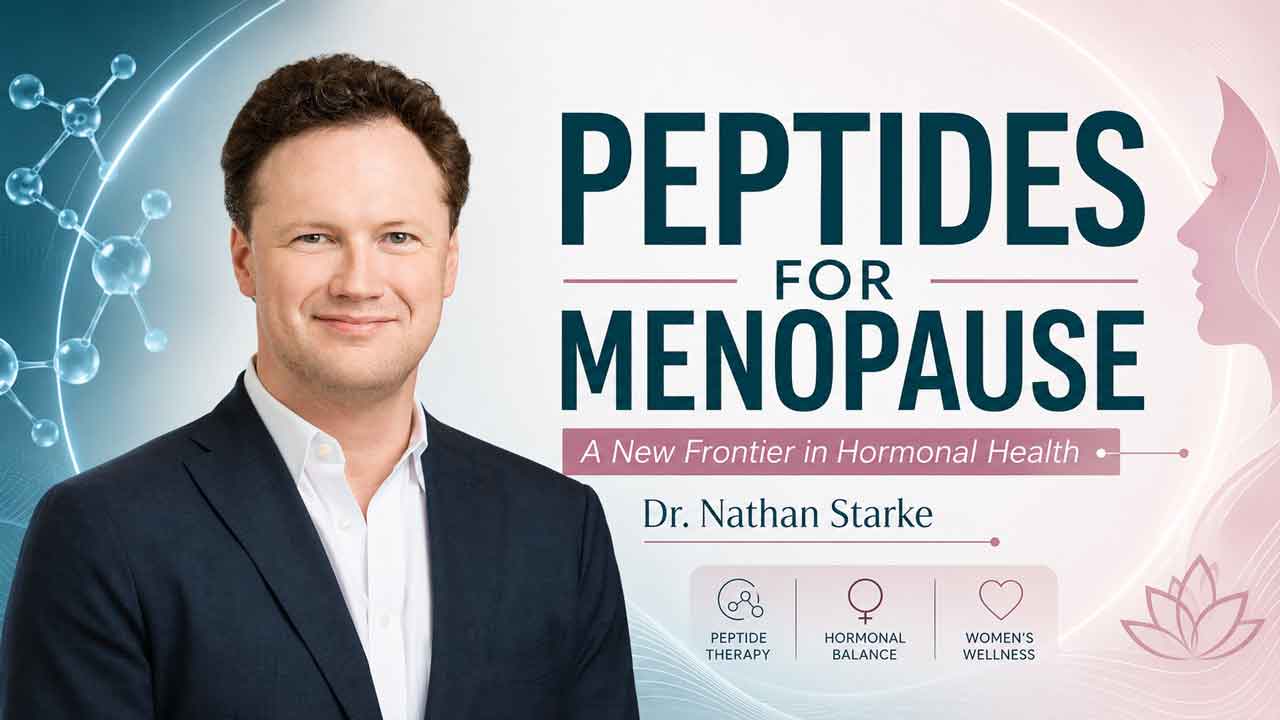
Dr. Nathan Starke, founder of Starke Medical Group and a fellowship-trained specialist in hormone optimization and sexual health, works with roughly equal numbers of male and female patients — and has increasingly brought the same evidence-informed approach to peptides that he applies across all of his clinical work.
“Women are much better at healthcare in general — talking about it, organizing it, seeking it out,” Dr. Starke says. “And the patients I see who are navigating perimenopause and menopause are often the most informed and most engaged patients I have. They’ve usually already done a lot of research. What I can offer is the clinical structure to make that curiosity safe and productive.”
What Menopause Does to the Body — Beyond Estrogen
Estrogen gets most of the attention in menopause conversations, and for good reason. Its decline affects bone density, cardiovascular function, cognitive health, vaginal tissue integrity, skin collagen production, and mood. These are not minor effects.
But the menopausal transition also coincides with a meaningful drop in growth hormone and IGF-1 — compounds that govern muscle maintenance, fat metabolism, tissue repair, and sleep quality. These have been declining since a woman’s mid-20s, but the combination of estrogen loss and growth hormone decline in the menopausal years produces a layered effect that HRT alone doesn’t fully address.
The women who feel best through this transition are typically managing multiple variables at once — which is exactly where peptide therapy becomes relevant.
Peptides for Menopause: Real Evidence for This Stage of Life
Collagen Peptides
The most accessible and the most studied. Estrogen plays a meaningful role in maintaining dermal collagen — skin thickness declines significantly in the years immediately following menopause onset. A 12-month randomized controlled trial found that oral collagen peptides at 5 grams daily significantly improved bone mineral density in postmenopausal women.
For women dealing with accelerated skin aging, joint discomfort, or early bone density concerns, collagen peptides are a reasonable, well-tolerated first option — available without a prescription, with a strong enough evidence base to be confident in.
Semaglutide (and other GLP-1 Receptor Agonists)
Semaglutide is technically a peptide, and for postmenopausal women dealing with metabolic changes and weight gain, the evidence behind it is some of the strongest in this field. A 2024 retrospective study, looking at 106 postmenopausal women on semaglutide, found that those also using hormone therapy lost approximately 30 percent more weight over 12 months than those on semaglutide alone — reaching around 16 percent total body weight loss. Combining semaglutide with hormone therapy appears meaningfully more effective than either alone for the metabolic consequences of menopause.
PT-141 (Bremelanotide)
Loss of libido is one of the most consistently reported symptoms of menopause — and one of the most consistently undertreated. Hormone therapy addresses some of the physical contributors, but the central desire component is a separate issue.
PT-141 works differently from anything else in this category. Rather than acting on blood flow or tissue, it activates melanocortin receptors in the brain’s arousal and desire circuitry. It’s FDA-approved for hypoactive sexual desire disorder in premenopausal women — the only peptide currently approved for a women’s sexual health indication — and physicians use it off-label for postmenopausal women dealing specifically with desire concerns rather than physical symptoms.
Dr. Starke brings particular expertise to this area. Sexual health — including the psychological and relational dimensions that make it difficult to discuss — is one of the areas where his clinical approach has always centered on making patients comfortable enough to actually have the conversation. “The challenge, but a great skill I’ve developed, is making patients immediately feel comfortable and at ease talking about things that are often difficult, personal, or have some stigma attached.” That applies here as much as anywhere.
CJC-1295 and Ipamorelin
For women concerned about loss of lean muscle, increased body fat, reduced energy, and the general physical decline that accompanies the growth hormone drop of midlife, these secretagogue peptides offer a way to address the GH axis without direct growth hormone injections. They stimulate the pituitary to release more of the body’s own growth hormone through natural pulses.
These are prescribed off-label — not FDA-approved for menopause management — and the evidence base is promising rather than definitive. Dr. Starke’s position is the same here as it is with any peptide: honest about what the science supports, attentive to how the individual patient responds, monitoring with regular labs rather than prescribing and disappearing.
GHK-Cu — Topical Skin Support
A naturally occurring tripeptide that declines with age, GHK-Cu is found in topical skincare products and has reasonable lab and topical study support for stimulating collagen synthesis, reducing inflammation, and promoting tissue remodeling. For women dealing with the skin changes that accompany estrogen loss, topical GHK-Cu sits at the more evidence-grounded end of cosmetic peptide ingredients. No prescription required; the evidence for topical benefit is more substantive than most ingredients in that category.
What Peptides Cannot Do
This deserves to be stated plainly. No peptide replaces hormone replacement therapy for women who are good candidates for it. HRT acts on the primary cause of the hormonal shift. Peptides, for the most part, address downstream effects — the metabolic changes, the growth hormone decline, the skin and joint changes, the sexual health concerns. They’re tools for specific gaps in the picture, not the picture itself.
The best outcomes — in Dr. Starke’s clinical experience and in the literature — come from layered approaches. Hormone therapy addresses the root. Peptides target what it misses. Diet, exercise, and sleep form the foundation everything else depends on.
Peptides for Menopause: Why the Care Model Matters
The same concern Dr. Starke voices about men pursuing peptides without medical guidance applies to women — perhaps more so in a space where online wellness culture has sometimes outpaced clinical rigor.
“What I offer is a structural alternative — proper evaluation, peptide compounds sourced from reputable pharmacies, and regular follow-up with labs and real conversations about how the patient is actually responding. The goal is to take something that often happens in the shadows and make it as safe and evidence-informed as possible.”
At Starke Medical, membership means direct access to Dr. Starke — not a portal, not a staff member — for the ongoing questions, adjustments, and monitoring that responsible peptide therapy requires. For women navigating menopause who feel like conventional medicine has offered them a limited menu of options, that kind of care relationship changes what’s possible.
The frontier is real. So is the need for a physician willing to take it seriously.