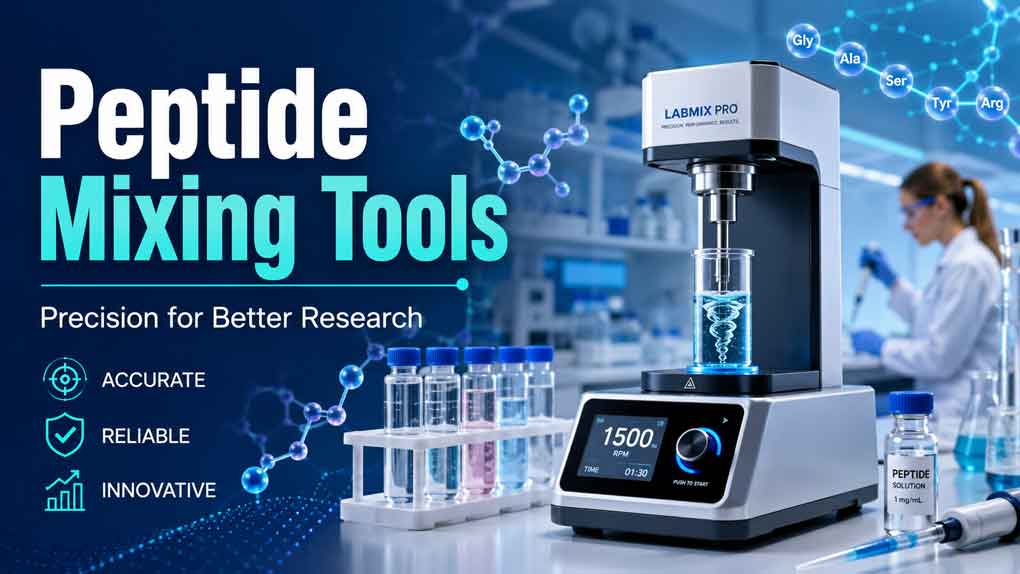
Peptides, short chains of amino acids, are critical to biochemical research. They are typically synthesized to replicate naturally occurring peptides and can be studied for a variety of purposes, such as drug development and hormone research. Given their significance, precise peptide preparation is pivotal for obtaining reliable results in research experiments. Peptide mixing tools have become an indispensable part of this preparation process, ensuring accuracy and consistency in peptide solutions. Below, we examine how these tools are transforming peptide-based research.
Understanding the Importance of Peptide Mixing in Research
Peptide synthesis is a delicate process that relies heavily on the proper mixing of amino acids and other reagents. Researchers must ensure that peptides are synthesized under strictly controlled conditions to prevent degradation and contamination. The stakes of getting peptide mixing right are high since the integrity of experimental outcomes is directly tied to it. Even small deviations can lead to significant variation in research findings, potentially compromising the validity of studies.
Accurate peptide mixing is also critical for reproducing study results. Scientific research often requires validation through replication, but inconsistent peptide preparation can lead to irreproducible results. This not only wastes valuable resources but also hampers progress in crucial research areas. A reliable research peptide mixing tool is essential for minimizing this risk by providing consistent, reproducible mixing protocols.
The concentration of peptides in a solution, if not accurately measured and mixed, can significantly alter the biological activity observed in experiments. Manual mixing is prone to human error, leading to variations in peptide concentrations. This can affect binding assays, cell culture assays, and other procedures that require precise concentrations for accurate interpretations of biological activity.
Moreover, efficient peptide mixing is necessary for high-throughput research applications, where large numbers of peptides are synthesized and tested. In such scenarios, the speed and accuracy of mixing become even more consequential. Modern peptide mixing tools not only improve precision but also significantly reduce the time required for peptide preparation, thereby boosting laboratory productivity.
Advances in Peptide Mixing Tools: Enhancing Precision and Efficiency
Technological advancements have given rise to sophisticated peptide mixing tools that deliver exceptional accuracy. These advanced devices can automate the mixing process, reducing the likelihood of human error. As a result, they can consistently produce peptide solutions of the desired concentration and volume, ensuring that each batch meets the exact specifications required for research.
Modern peptide mixers now feature programmable settings and digital interfaces. This leap forward enables researchers to precisely control mixing parameters like speed, duration, and temperature. Such control granularity is indispensable when working with sensitive peptides that may become unstable under specific conditions or require careful handling to maintain their structure and function.
The introduction of these tools signifies a shift toward more standardized peptide-mixing procedures. Automation facilitates adherence to strict laboratory protocols and the maintenance of rigorous quality control standards. These changes not only enhance the accuracy of the research but also contribute to the overall reproducibility of scientific studies across laboratories worldwide.
The varying requirements of peptide synthesis are also met by the customization options available with modern mixers. Whether it involves slow, careful mixing to prevent air bubble formation or rapid blending to initiate a reaction, the latest peptide mixing tools are versatile enough to accommodate researchers’ needs, providing an optimal environment for peptide synthesis.
Future of Peptide Synthesis: Innovations in Mixing Technology
Looking ahead, the future of peptide mixing tools is one of continuous innovation. Laboratories can expect the introduction of even more advanced features, such as real-time monitoring and feedback systems, which will enable greater control and real-time adjustments to the mixing process. These developments will be driven by the increasing complexity of peptide research and the need for ever-more precise synthesis methods.
Emerging trends in peptide mixing technology also include the integration of artificial intelligence and machine learning. These computational approaches could revolutionize the optimization of mixing parameters, enabling tools to adapt and learn from prior synthesis outcomes to improve efficiency and success rates.
Progress in microfluidics is poised to further refine peptide-mixing techniques. As research moves toward miniaturization, microfluidic devices can offer precise handling of small volumes, reducing waste and enhancing reaction kinetics. This is particularly advantageous for high-throughput screening and rapid peptide prototyping.
Peptide mixing tools are proving fundamental for optimizing research outcomes. By enhancing precision, efficiency, and replicability, these tools are not only refining current peptide-based research but also paving the way for groundbreaking discoveries. As technological advancements continue, peptide mixing tools will remain critical to the scientific exploration of peptides.