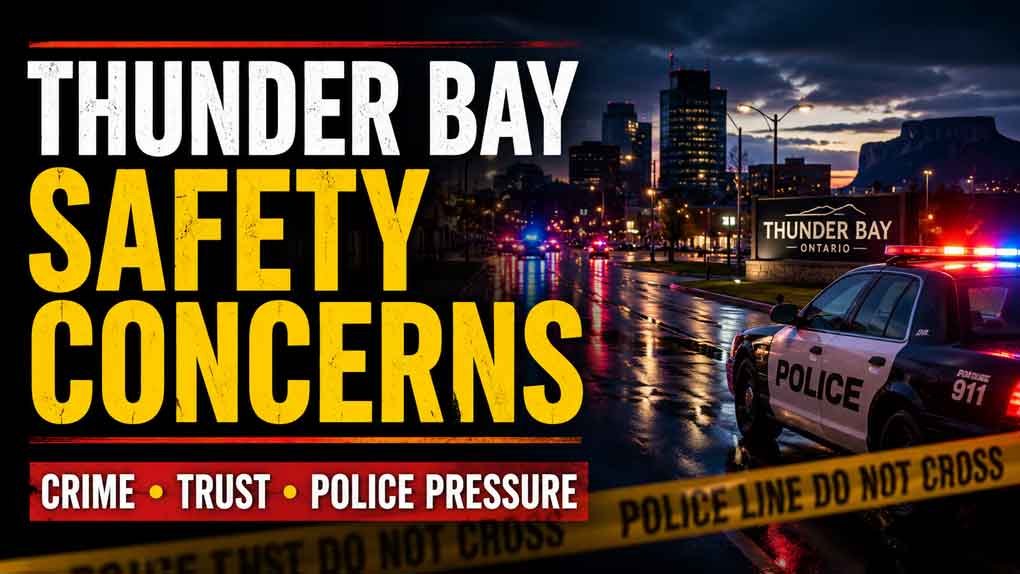
Thunder Bay Public Safety Concerns Grow Amid Violent Crime, Police Pressure and Trust Questions
THUNDER BAY — NEWS ANALYSIS — Many Thunder Bay residents are asking a hard question: does the city feel as safe as it used to?
It is not a new concern, and for many residents of our city, sadly the answer is no, Thunder Bay is not as safe as it used to be.
Over the past two decades, Thunder Bay has too often found itself near the top of national homicide-rate rankings. Because the city’s population is small compared with larger urban centres, a handful of homicides can sharply move the per-capita rate.
But that does not make the concern less real for families, neighbourhoods, business owners, seniors or front-line agencies.
The latest Statistics Canada data placed Thunder Bay at the top of Canada’s census metropolitan areas for homicide rate in 2024. The city recorded eight homicides that year, producing a rate of 6.08 per 100,000 people.
Thunder Bay also remains under pressure on violent crime. The city’s violent Crime Severity Index has been among the highest in Canada.
That index does not simply count incidents. It measures both the number of crimes and their seriousness.
For many residents, the statistics match what they feel on the street: more disorder, more violence, more open drug activity, more property crime and more uncertainty about in recent weeks whether police will arrive when called.
A recent series of incidents in the Cumberland Street North area point to the depth of the problems. A man was assaulted on North Cumberland Street and his backpack stolen. Police responded and a suspect was arrested.
Then a few days later a man walking toward Cumberland Street along the pathway at McVicars Creek reportedly was assaulted, and robbed of his jacket, smartphone and shoes. The report made social media, but not headlines.
Then there is the shoplifting across the city.
People are going into stores loading up merchandise and heading out the door. Store employees are being told by management not to try to intercept the thieves. Residents are reporting this to social media, and again left wondering what happened afterwards.
Across Thunder Bay, more and more businesses are locking their doors.
Customers have to knock to get in. That hardly sends a message of confidence to customers.
The Tim Hortons on May Street near the downtown Fort William BIA recently re-opened.
Seating has been removed, and the washrooms are no longer available. This restaurant before the expensive renovations was the scene of serious problems.
People would come into the establishment, and do drugs, bring in outside food, panhandle or insist customers give them money. There was an image posted on social media of an individual who brought in their own air fryer and was using it inside the restaurant.
The theft of bicycles across the city appears on the increase as well. People have taken to posting on social media in many cases rather than contacting the police.
Editors Note: If you experience the theft of your property, make sure you report it. Even if all you end up doing is an online report, record the incident.
Police Workload Is Heavy
Thunder Bay Police Service numbers show the pressure on officers and communications staff.
For the week of June 7 to June 13, police reported that officers responded to 1,160 calls for service. During the same week, 911 operations received 2,315 calls.
Those numbers matter. They show a police service dealing with a high volume of demand in a city facing complex social problems, including addiction, mental health crises, homelessness, poverty, violence and repeat offending.
But the numbers also raise another question: when calls keep rising, what happens to the people waiting for help?
That question is now being asked more openly by residents.
This past week, a local shop owner posted on Facebook that she had called police about a repeat shoplifter who became threatening, but that police did not respond.
In another Facebook post, a mother raised concerns that her family had been attacked on May Street and that, despite calling Thunder Bay Police three times, there was no police response.
NetNewsLedger has not independently verified the full details of those incidents.
Social media posts are not the same as police reports or court evidence. Still, they reflect a growing public frustration: people want to know that when they call for help, help is coming.
This represents a failure, not of the front line police officers, but of the Thunder Bay Police Service leadership and the Thunder Bay Police Services Board. It is also a full failure of City Council.
It is an area increasingly that City Council appears all too willing to delegate off.
Either to Administration staff, or to the Police Services Board. In an election year, where people are very frustrated over crime, it is a strong sign that there is a disconnect between the Council and residents of the city. However overall none of the candidates are taking the ball and running with it either.
Critics point to the drug strategy and homeless encampment direction as a big part of the problem. Thunder Bay is seeing increased encampment size as the weather warms.
Residents are noting increased crime. Police are stretched to the limit.
The frustration is apparent on both sides, however at the leadership level it appears that the mantra is all is well seems to be the status quo.
Seniors’ Safety Is Now a Major Concern
Recent cases involving seniors have added to public concern.
In February, Thunder Bay Police reported that an 81-year-old victim died in hospital following an alleged assault at an assisted living facility. A manslaughter charge was laid.
In March, police announced charges following an elder abuse investigation tied to a long-term care facility. Police reported that an 86-year-old resident sustained injuries while in the care of a staff member and later died. The investigation resulted in criminal negligence causing death charges.
A murder of a senior on College Street last year saw the suspect steal a car and end up in Terrace Bay, where he terrorized a home before being subdued by citizens is another point toward the growing problems not only in Thunder Bay but across the region.
These cases have left many residents worried about the safety of seniors, especially those living in care settings or vulnerable situations. Seniors, families and caregivers need confidence that abuse, neglect and violence will be investigated fully and transparently.
Trust in Thunder Bay Police Remains Fragile
Thunder Bay Police and the Thunder Bay Police Services Board have both faced severe scrutiny over the past decade.
The 2018 Broken Trust report found systemic racism within the Thunder Bay Police Service at an institutional level. The report examined police handling of sudden death investigations involving Indigenous people and made 44 recommendations.
That report remains central to public discussion about policing in Thunder Bay.
Thunder Bay Police point to high clearance rates as evidence that officers are solving serious crimes. Clearance rates measure whether police identify an accused person and laid or recommended charges.
However, some critics continue to argue that clearance rates alone do not answer deeper questions. If a death is not classified or investigated as a homicide in the first place, it will not be counted as a homicide clearance problem. That concern has been raised for years by families, Indigenous leaders, lawyers and community advocates.
This is where trust becomes essential. The public needs to believe not only that police are working hard, but that investigations are thorough, fair and free from bias.
Respect for the Criminal Justice System Dropping
One area that perhaps will start to change as a result of new long needed legislation could be in the courts. The new legislation on bail has just coming into effect.
Community Outreach Must Match Front-Line Confidence
Today, Thunder Bay Police held a pancake breakfast at the Balmoral Street headquarters to unveil new Indigenous artwork.
Public outreach matters. Indigenous art at police headquarters can be a meaningful step if it is part of deeper change, not a substitute for it.
The challenge for Thunder Bay Police is that symbols must be matched by service. Residents want to see calls answered, repeat offenders addressed, seniors protected, victims supported and investigations handled with care.
For Indigenous residents and families, trust will not be rebuilt through ceremony alone. It requires accountability, transparency, strong investigations, cultural safety and consistent follow-through on the recommendations that have already been made.
A City Looking for Reassurance
Thunder Bay is not alone in facing violent crime, addiction, homelessness and repeat-offender challenges. Cities across Canada are dealing with many of the same problems.
But Thunder Bay’s situation is different because of its size, geography and role as the service hub for Northwestern Ontario. The city supports people from across the region, including many who travel from remote First Nations for health care, education, court, shelter and family support.
That regional role puts pressure on policing, housing, hospitals, social agencies and the justice system.
The answer cannot be policing alone. Thunder Bay needs enforcement where public safety is at risk. It also needs prevention, mental health care, addiction treatment, supportive housing, youth programs, victim services and stronger partnerships with Indigenous communities.
But residents are also right to expect basic public safety.
When a business owner reports a threatening repeat shoplifter, that call matters. When a family says they were attacked and could not get a police response, that concern matters. When seniors die after alleged violence or neglect, those cases matter.
Thunder Bay Police face a difficult workload. That should be acknowledged. But residents also deserve clear answers about response times, call prioritization, staffing levels, investigative standards and what is being done to make the city safer.
The city does not need panic. It needs honesty.
Thunder Bay’s public safety challenge is real. So is the need to rebuild trust.