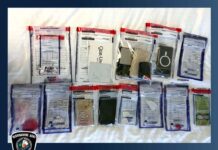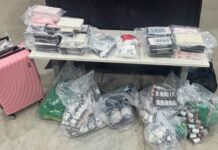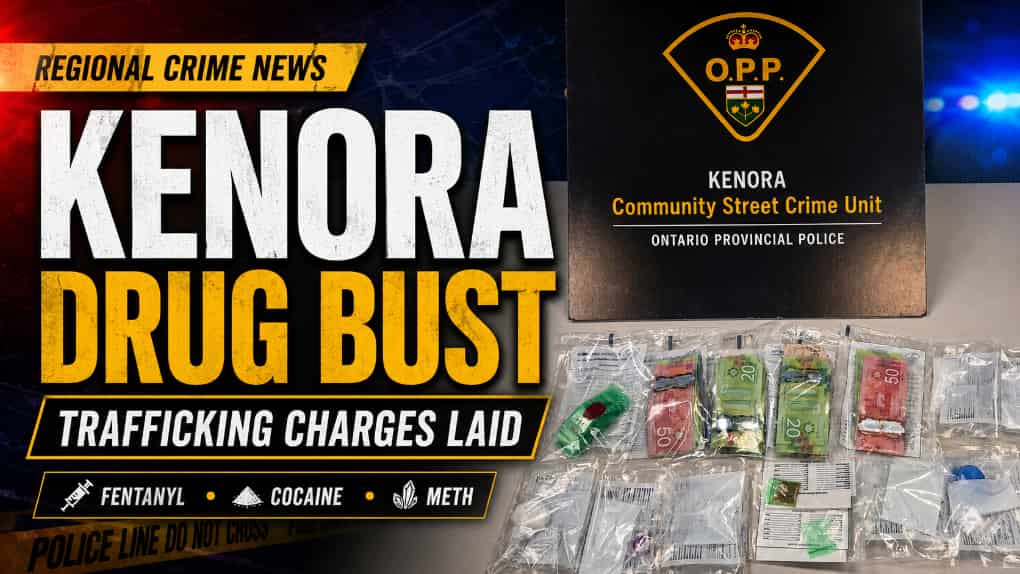
Kenora Drug Trafficking Investigation Leads to Criminal Code and CDSA Charges
KENORA, Ont. — A 37-year-old Kenora resident is facing multiple charges after Ontario Provincial Police say a spring drug trafficking investigation led to an arrest in the city.
Police say members of the Kenora OPP Community Street Crime Unit, assisted by the Kenora OPP Organized Crime Enforcement Bureau, began the investigation in spring 2026. One person was arrested at about 3:45 p.m. CDT on Friday, May 29.
Kenora resident charged after OPP investigation
Harley McLeod, 37, of Kenora, has been charged with:
Possession of proceeds of property obtained by crime over $5,000;
Failure to comply with a probation order;
possession of a Schedule I substance for the purpose of trafficking — methamphetamine;
possession of a Schedule I substance for the purpose of trafficking — cocaine;
possession of a Schedule I substance for the purpose of trafficking — morphine; and
possession of a Schedule I substance for the purpose of trafficking — fentanyl.
The accused is scheduled to appear before the Ontario Court of Justice in Kenora at a later date.
None of the allegations has been tested in court. McLeod is presumed innocent unless proven guilty in a court of law.
Legal context for the charges
Under Criminal Code section 354, possession of property obtained by crime involves possessing property or proceeds while knowing that all or part of it was obtained through an indictable offence in Canada, or conduct elsewhere that would amount to such an offence in Canada.
Section 355 sets out the penalty where the value is more than $5,000: if prosecuted by indictment, the maximum sentence is 10 years in prison; if prosecuted summarily, the general summary conviction penalty may apply.
Failure to comply with a probation order is covered under Criminal Code section 733.1. The offence applies when a person bound by a probation order, without reasonable excuse, fails or refuses to follow that order. If prosecuted by indictment, the maximum sentence is four years in prison; if prosecuted summarily, the general summary conviction penalty is a fine of up to $5,000, imprisonment for up to two years less a day, or both.
The drug-related charges fall under section 5(2) of the Controlled Drugs and Substances Act, which prohibits possessing a controlled substance for the purpose of trafficking. For Schedule I or II substances, section 5(3) makes the offence indictable and carries a maximum sentence of life imprisonment. Methamphetamine, cocaine, morphine and fentanyl are listed under Schedule I of the Act.
Actual sentences, if a conviction is entered, depend on the facts proven in court, the Crown’s position, the accused person’s record, the quantity and type of substance, aggravating or mitigating factors, and any applicable sentencing principles.
Regional impact in Northwestern Ontario
Drug trafficking investigations in Kenora carry regional significance because the city sits on key transportation routes linking Manitoba, northwestern communities and the rest of Ontario. Police enforcement in Kenora can affect public safety across the broader region, including nearby First Nations, smaller municipalities and highway corridors used for work, health care, travel and supply movement.
The presence of fentanyl, methamphetamine, cocaine and morphine in police allegations also reflects the continuing public safety and health concerns tied to illicit drug markets. Those concerns include overdose risk, addiction-related harms, property crime, exploitation and pressure on emergency services.
How to report suspicious activity
OPP say anyone who sees suspicious activity should call 911 in an emergency. Non-emergency reports can be made to the OPP at 1-888-310-1122.
Anonymous tips can be submitted through Crime Stoppers at 1-800-222-8477, also known as TIPS, or online through Ontario Crime Stoppers.