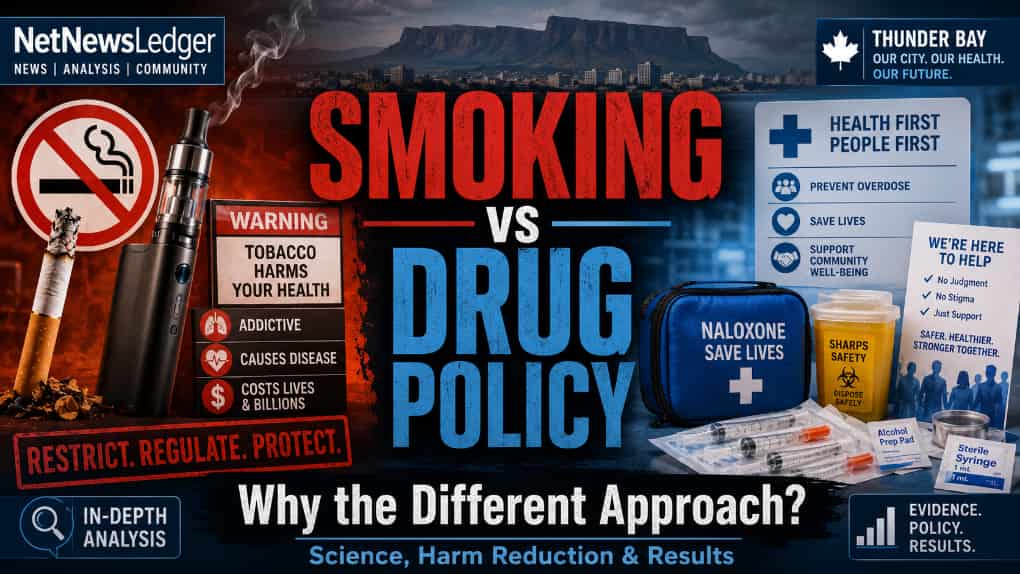
Why Tobacco Policy Looks So Different From Drug Policy — And What the Evidence Says
THUNDER BAY, Ont. — To many residents, there appears to be a contradiction in modern public health policy. Smoking and vaping are restricted, taxed, discouraged and pushed out of public spaces.
At the same time, governments and health agencies support needle exchanges, naloxone distribution, supervised consumption services and other harm-reduction programs for people using illegal drugs.
The difference is not that public health officials believe cigarette smoking is bad but illegal drug use is acceptable.
The difference is that the two crises are not the same. Tobacco policy is built around long-term population reduction of a legal commercial product. Drug policy, particularly in the fentanyl era, is built first around preventing people from dying today so they have a chance to enter treatment tomorrow.
The Short Answer: Tobacco Control Has Worked Better At Reducing Use. Drug Harm Reduction Has Worked Better At Reducing Immediate Death And Disease
Canada’s tobacco strategy is one of the clearest public health success stories of the past 60 years. In 1965, about half of Canadians aged 15 and older smoked. By 2024, Health Canada estimated 11 per cent of adult Canadians smoked, and Canada’s formal target is to reduce tobacco use to less than five per cent by 2035.
The drug crisis has not followed that pattern.
Between January 2016 and September 2025, Canada recorded 55,032 apparent opioid toxicity deaths. In the first nine months of 2025 alone, 4,162 apparent opioid toxicity deaths were reported, with most involving non-pharmaceutical opioids, fentanyl or fentanyl analogues, and many involving stimulants as well.
That does not mean harm reduction has failed. It means the goal being measured is different.
Tobacco policy asks: “Can we reduce the number of people who smoke?” Harm reduction asks: “Can we keep people alive, reduce infections, reduce public drug use, connect people to care and create a pathway to treatment?”

Tobacco Policy: A Long Campaign Against A Legal Product
The anti-smoking movement succeeded because it attacked smoking from several directions at once: taxes, age restrictions, advertising limits, graphic warnings, smoke-free workplaces, public education, lawsuits, product regulation, cessation support and social denormalization.
The World Health Organization says tobacco taxes are among the most cost-effective tools to reduce tobacco use. A 10-per-cent increase in tobacco prices is associated with about a four-per-cent reduction in tobacco consumption in high-income countries. WHO also says counselling and medication can more than double a smoker’s chance of quitting.
Canada’s approach also includes cessation supports, public education, retailer enforcement, updated health warnings, plain and standardized packaging measures, and Indigenous-led approaches to reducing commercial tobacco use.
The key point is this: tobacco is legal, manufactured, branded, distributed through licensed retailers and heavily regulated.
Governments can raise the price, restrict the packaging, ban ads, control sales and remove smoking from indoor public places. That makes a population-wide “endgame” strategy possible.
Vaping Shows Public Health Already Uses Harm Reduction In Tobacco Policy
The tobacco story is not only about banning and restricting.
Canada has also treated vaping, at least for adults who smoke, as a potentially less harmful alternative to cigarettes while trying to prevent youth nicotine addiction. Health Canada says the legal vaping market has helped some adults transition to a less harmful alternative, though vaping is not an approved cessation therapy and long-term risks remain under study.
That is important because it shows the two policy worlds are not as different as they first appear. Tobacco control also includes harm reduction. The difference is that tobacco harm reduction occurs inside a regulated legal market. Illicit drug harm reduction occurs in a poisoned, illegal and unpredictable market.

Drug Policy: The Fentanyl Era Changed The Emergency
With illegal drugs, the immediate risk is not only long-term disease. It is death within minutes.
Health Canada says supervised consumption sites provide a clean space where people bring their own drugs and use them in the presence of trained staff. The sites do not provide drugs. They are intended to prevent accidental overdoses, reduce infectious disease, connect people to health and social services, and provide referrals to treatment for those who are ready.
Canada’s drug strategy is not supposed to be harm reduction alone. The federal framework includes prevention and education, evidence, substance-use services and supports, and substance controls, including law enforcement and border tools aimed at illegal production, trafficking and the toxic illegal drug supply.
In plain language: the expert model is not “let people use drugs.”
It is “prevent use where possible, treat addiction where possible, reduce death and disease where use is still occurring, and enforce against the illegal supply.”
What The Evidence Says About Supervised Consumption And Needle Exchanges
The strongest evidence for supervised consumption services is not that they reduce overall drug use in the whole population.
The strongest evidence is that they reduce immediate harms for people already using drugs.
A 2025 Public Health Agency of Canada review reported that federally exempted supervised consumption sites in Canada responded to more than 60,000 overdose events between 2017 and 2024, with no reported on-site fatalities.
The same review noted evidence of improved access to housing, legal, health and treatment services, fewer non-fatal overdoses, lower emergency service use and fewer injection-related complications, while also finding that population-level effects on overdose mortality are mixed and depend on local context and service coverage.
The Canadian Centre on Substance Use and Addiction says supervised consumption sites do not provide drugs, are not shown to increase local crime, and are connected to fewer publicly discarded needles and less public drug use in some settings.
It also notes that these sites often supervise only a small share of all drug use in a neighbourhood, which helps explain why they cannot solve the entire overdose crisis on their own.
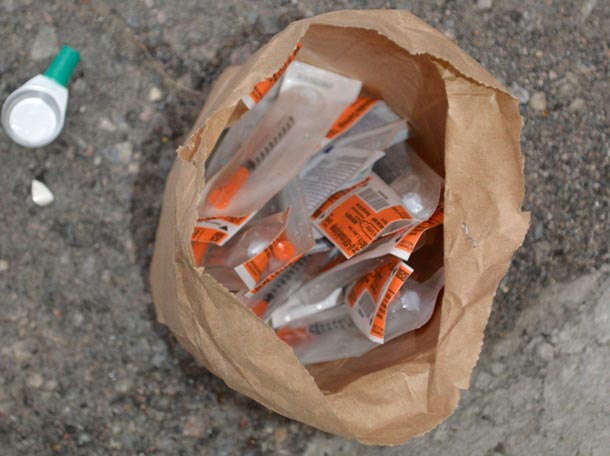
For needle and syringe programs, the evidence is also more about reducing disease than reducing drug use itself.
A 2022 review in the International Journal of Drug Policy found sufficient evidence that needle and syringe programs reduce HIV transmission among people who inject drugs, while opioid agonist therapy reduces HIV and hepatitis C transmission, and the combination of opioid agonist therapy and needle programs reduces hepatitis C transmission.
So Why Not Treat Illegal Drugs Like Smoking?
There are several reasons.
First, tobacco users usually know what product they are buying. People using illicit drugs often do not. The current drug supply can contain fentanyl, fentanyl analogues, benzodiazepines, xylazine or other contaminants, sometimes without the user knowing.
That makes overdose prevention an emergency service, not a lifestyle accommodation.
Second, tobacco restrictions protect the public from second-hand smoke and reduce smoking initiation over decades. A person who is opioid-dependent may not be able to stop immediately because of withdrawal, trauma, mental illness, homelessness or lack of treatment access. Telling that person simply to stop is not a treatment system.
Third, tobacco companies can be regulated. Illegal traffickers do not follow packaging laws, tax policy or warning-label rules. That means supply-side control requires policing, border enforcement and organized crime investigations, but it also means public health has to deal with the people harmed by that illegal market.
Fourth, stigma changes behaviour. When drug users are pushed into isolation, they are more likely to use alone. Using alone is one of the most dangerous conditions in the opioid crisis because no one is there to call 911 or administer naloxone.
The Hard Truth: Harm Reduction Has Not Reduced Drug Deaths Enough
Critics are right about one thing: Canada has not solved the drug crisis.
If the goal is to reduce drug deaths at the population level, the results are deeply troubling. National opioid deaths remain far above pre-crisis levels.
In Thunder Bay, the City said there were 80 opioid-related deaths in 2024, the highest per-capita rate in Ontario.
That should push the debate beyond slogans. Harm reduction is not enough. Treatment is not enough. Policing is not enough. Prevention is not enough. Housing is not enough. Each one fails when it is forced to carry the whole crisis alone.
A serious Thunder Bay strategy needs all of them: rapid access to detox, opioid agonist therapy, residential treatment, recovery housing, Indigenous-led healing, mental-health care, youth prevention, outreach, naloxone, needle recovery, supervised consumption or equivalent overdose-prevention options where permitted, and aggressive enforcement against traffickers bringing toxic drugs into the region.
What Thunder Bay Can Learn From Tobacco Control
The biggest lesson from tobacco control is consistency. Smoking rates fell because governments, health agencies, schools, workplaces and communities pushed in the same direction for decades.
Thunder Bay needs that same discipline on the drug crisis.
That means clear public targets: fewer overdose deaths, fewer discarded needles, faster treatment access, fewer people using alone, fewer people living unsheltered, fewer drug-trafficking networks operating in the city, and more people entering recovery.
The second lesson is that public messaging matters. Public health should not use language that sounds like drug use is safe. It is not. “Safer use” means less likely to die, not harmless. That distinction matters for parents, youth, business owners and people in recovery.
The third lesson is that community safety must be part of public health. Residents should not be asked to accept public disorder, discarded needles or violence as the price of compassion.
A credible harm-reduction system must include needle cleanup, neighbourhood accountability, security planning, outreach, police co-operation and clear data reporting.
The Bottom Line
The contrast between smoking policy and drug policy is real, but it is often misunderstood.
Canada reduced smoking by making a legal addictive product harder to market, harder to use in public, more expensive and less socially acceptable, while helping people quit. That strategy has worked.
Canada has not reduced illegal drug deaths in the same way because the drug crisis is driven by addiction, trauma, homelessness, mental illness, organized crime and a toxic illegal supply. Harm reduction does not mean approval. It means keeping people alive long enough for treatment, recovery and stability to become possible.
For Thunder Bay, the practical answer is not to choose between compassion and enforcement. The city needs both — and it needs the same long-term determination that helped turn smoking from normal to rare.