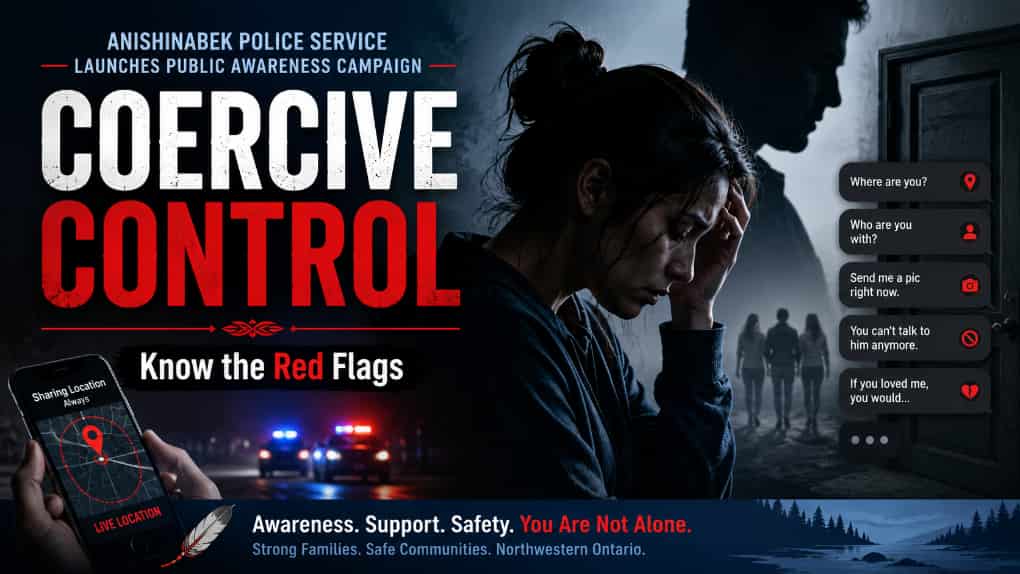
APS Campaign Warns Coercive Control Can Be a Red Flag for Domestic Violence
The Anishinabek Police Service is launching a public awareness campaign to help people recognize coercive control, a pattern of abusive behaviour that can isolate, intimidate and dominate survivors before or alongside physical violence. The campaign includes social media messages identifying “red flag” behaviours and new information on the APS domestic violence webpage.
For Thunder Bay and Northwestern Ontario, the message is especially important in communities where distance, housing pressures, transportation barriers and privacy concerns can make it harder for survivors to safely reach help.
What coercive control can look like
Coercive control is not a single argument or an isolated incident. APS describes it as repeated humiliation, intimidation, isolation, exploitation or manipulation used to make someone feel afraid, ashamed, anxious, unsure or trapped.
Warning signs can include cutting a person off from friends and family, tracking their location, monitoring their phone or social media, restricting money, controlling what they wear, preventing medical appointments, taking away car keys or using children to undermine a parent.
APS says the behaviour can occur in dating relationships, long-term partnerships, after separation, in caregiving situations, within families or in human trafficking.
What others may notice
People outside the relationship may see changes before a survivor is able to speak openly.
APS says possible signs include someone repeatedly cancelling plans, withdrawing from activities they once enjoyed, appearing anxious about a partner’s reaction, saying they “have to check” before making decisions, or avoiding people and places their partner does not like.
Why it matters locally
In Northwestern Ontario, coercive control can be intensified by geography. A person who is being monitored, denied money or prevented from using a vehicle may face greater danger when the nearest shelter, police detachment, health service or trusted family member is hours away.
The issue also has specific importance for Indigenous communities. Public Health Agency of Canada guidance notes that certain groups of women, including Indigenous women and women with disabilities, experience higher rates of violence than other women and are more likely to experience coercive control, fear of injury or death, and sexual violence.
Federal law is still evolving
The campaign comes as Parliament studies Bill C-16, the Protecting Victims Act. The bill proposes a new Criminal Code offence prohibiting a pattern of coercive or controlling conduct toward an intimate partner. Parliament lists the bill as being before a House of Commons committee after second reading, meaning the proposal has not yet completed the legislative process.
That legal context matters, but survivors do not need to wait for a new law to seek help. Existing Criminal Code offences may still apply where conduct includes assault, threats, criminal harassment, sexual violence, forcible confinement, extortion, mischief, trafficking or other criminal behaviour.
Where to get help
Anyone in immediate danger should call 911.
For help with controlling behaviour or intimate partner violence in Ontario, call the Assaulted Women’s Helpline at 1-866-863-0511 or text #SAFE, or #7233, from a Bell, Rogers, Fido or Telus mobile phone. The helpline also offers TTY support at 1-866-863-7868.
Indigenous people across Canada can contact the Hope for Wellness Helpline at 1-855-242-3310 for immediate support and crisis intervention. The service is available 24 hours a day, seven days a week, with phone and online chat options. Telephone support is available in English and French, with Cree, Ojibway and Inuktitut available on request, depending on availability.
In Thunder Bay, the Northwestern Ontario Women’s Centre lists regional supports, including Faye Peterson House and Beendigen for women and children seeking safe accommodation from abuse.
APS also directs people to its supports page, which includes culturally appropriate resources, crisis lines, healing lodges, treatment centres and shelters. The APS website includes a quick escape feature for people who need to leave a sensitive webpage quickly.