Thunder Bay Public Safety Survey Finds Residents Split on Safety, Concerned About Drugs, Disorder and Police Visibility
THUNDER BAY — A new Thunder Bay Police Service Board report suggests residents remain deeply divided over public safety in the city, with just over half saying they feel safe, nearly one-third saying they feel unsafe and many calling for more visible policing, faster response times and stronger action on drugs, property crime and violence.
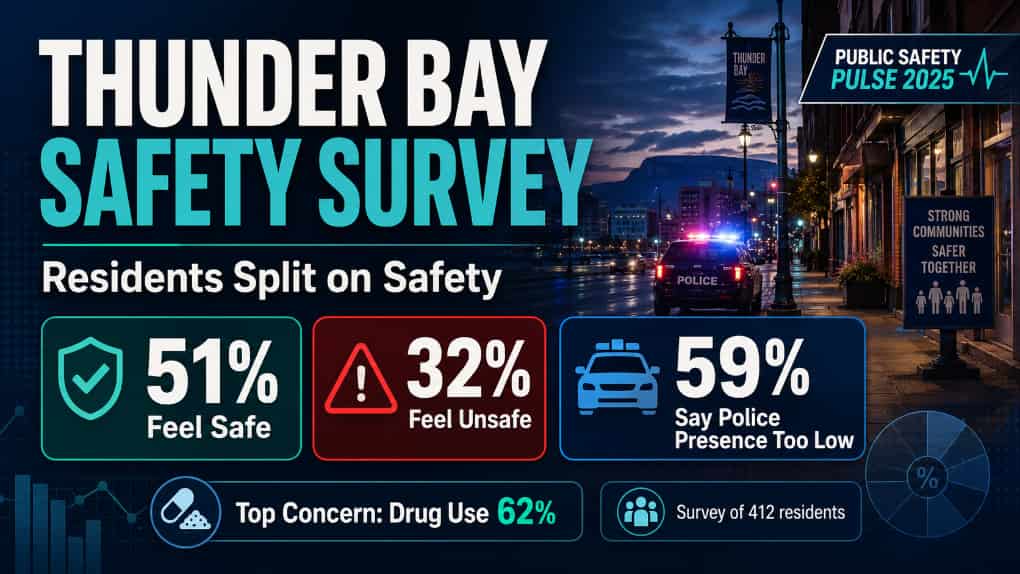
The February 2026 Public Safety Pulse report, prepared through Zencity, is based on a survey of 412 Thunder Bay residents conducted between Nov. 25, 2025, and Jan. 7, 2026.
The report says the survey was weighted to reflect the city’s population by age, gender, race and ethnicity. It measures public perception, not police-reported crime rates, but it provides a detailed look at how residents are experiencing safety in daily life.
Safety Perceptions Remain Split in Thunder Bay
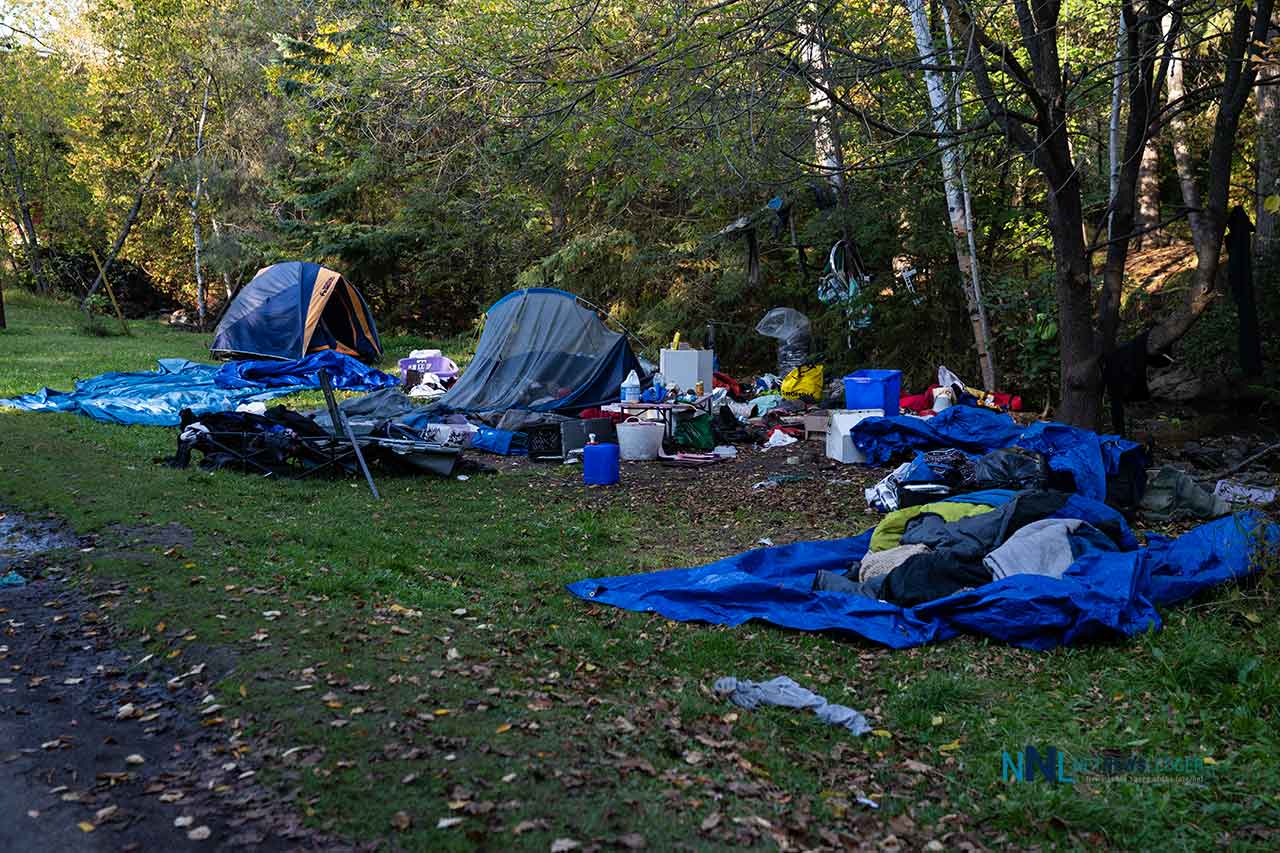
The report finds 51 per cent of residents feel safe in Thunder Bay, down from 55 per cent in 2024. Thirty-two per cent say they feel unsafe, while 18 per cent are neutral.
That split is important for city leaders, police, businesses and community organizations because perception of safety affects how people move through the city, whether they go out at night, where they shop, how they view downtown and whether they trust public institutions. It also can impact our city’s reputation as tourists and business travellers often make decisions on coming to Thunder Bay based on our city’s overall reputation.
The survey also found significant demographic differences. Women’s sense of safety dropped nine percentage points year over year, from 56 per cent in 2024 to 47 per cent in 2025. Residents earning between $50,000 and $149,999 reported a sharp decline in feeling safe, falling from 66 per cent to 53 per cent.
Among residents who said they feel unsafe, the leading reasons were disorderly behaviour and drug use or discarded needles, each cited by 87 per cent. Homelessness and encampments were cited by 77 per cent, while gangs were also cited by 77 per cent.
Drugs, Theft and Violence Top Public Concerns
When asked what issues they most want the Thunder Bay Police Service to address, residents placed drug use at the top of the list. Sixty-two per cent identified drug use as a priority, followed by theft, burglary and break-ins at 43 per cent, gangs at 40 per cent and violence at 37 per cent.
Those results reflect a pattern long visible in Thunder Bay: residents often connect public safety concerns to overlapping pressures involving addiction, homelessness, property crime, street disorder and violent offending.
The report also shows that residents do not see policing as the only solution. When asked what plays the most critical role in improving community safety, respondents identified police at 48 per cent, addiction services and support at 46 per cent, affordable housing at 46 per cent and mental health and wellness at 45 per cent.
That finding points to a broad public understanding that safety in Thunder Bay depends on more than arrests. It also depends on housing, treatment, prevention, crisis response, youth supports and neighbourhood-level trust.

Residents Want More Police Presence and Faster Response
The strongest message in the report is that many residents want to see police more often in neighbourhoods and public spaces.
Fifty-eight per cent said more police presence is one of the most important actions for keeping the community safe. Forty-four per cent cited improved response times. Twenty-one per cent said they want police to be more welcoming and approachable, while 20 per cent identified working with diverse people and communities.
Older residents were especially likely to call for more visible policing. Sixty-eight per cent of respondents aged 55 and older said more police presence was important, compared with 46 per cent of those aged 18 to 34.
When asked what police should prioritize, residents’ top choices were investigating and solving violent crimes and illegal firearms, at 49 per cent, and patrolling neighbourhoods and interacting with residents, at 48 per cent.
Responding to 911 calls was selected by 35 per cent, while enforcement of property crimes such as break-ins and theft was selected by 31 per cent.
Many Residents Say Police Presence Is Too Low
The report found 59 per cent of residents believe police presence in their neighbourhood is too low or far too low. That is a slight improvement from 64 per cent in 2024, but still shows a majority view that the current level of visible policing is not meeting public expectations.
Thirty-eight per cent said police presence is about right. Only two per cent said it is too high.
The open-ended survey responses reinforced the same theme. Residents asked for police to be visible outside of emergencies, to conduct more routine patrols and foot patrols, and to use presence as a deterrent in areas affected by nuisance behaviour or repeat problems.
The report also notes many residents framed gaps in service as a capacity issue, saying there are not enough officers available per shift. Some respondents also suggested adding mental health and addiction expertise alongside enforcement capacity.
One in Four Residents Reported Recent Victimization
The survey found 23 per cent of respondents said they had been a victim of something they thought was a crime in the past 12 months. Younger residents reported the highest victimization rate, with 30 per cent of those aged 18 to 34 saying they had been victimized, compared with 20 to 21 per cent among older age groups.
Indigenous respondents reported a higher rate of victimization, at 39 per cent, compared with 20 per cent among non-Indigenous respondents.
That finding is significant in Thunder Bay, where Indigenous people from across Northwestern Ontario come to the city for health care, education, court, shopping, travel and family services.
The report does not break down the nature of those incidents, but the difference in reported victimization should be treated as an important equity and safety issue for police, the city, Indigenous leadership and service agencies.
Safety Concerns Are Changing Daily Behaviour
The report shows public safety concerns are affecting how people live.
In the previous three months, 56 per cent of residents said they had increased home security measures, such as locking doors or making other changes. Forty-two per cent said they had avoided walking in their neighbourhood at night. Thirty-eight per cent avoided shopping at certain times or places, while 32 per cent avoided going out alone.
The gender gap is stark. Fifty-eight per cent of female residents said they avoided walking in their neighbourhood at night, compared with 25 per cent of male residents. Forty-nine per cent of female residents said they avoided going out alone, compared with 12 per cent of male residents.
Those numbers matter beyond policing. They affect local businesses, evening activity, downtown confidence, transit use, neighbourhood cohesion and residents’ overall quality of life.
Most Residents Remain Willing to Contact Police
Despite concerns, willingness to contact the Thunder Bay Police Service remains high. Eighty-four per cent of residents said they would be willing to contact police if they were a victim of crime or worried about something, up slightly from 82 per cent in 2024.
However, the report also shows hesitation among some groups. Lower-income residents were less willing to contact police, with 75 per cent saying they were willing, compared with 86 to 88 per cent among higher-income groups.
Among residents who were not fully willing to contact police, 54 per cent said greater trust and confidence in police would make them more likely to do so. Forty-four per cent said they want a clear message that their concern has been heard and recorded, while 42 per cent said faster response times would make them more willing to contact police.
Those findings suggest the issue is not only whether residents know how to call police. It is whether they believe calling will produce a response, whether they trust the service, and whether they feel they will be treated seriously.
Reporting Barriers Include Doubt That Anything Will Happen
The survey found most residents did not report a crime in the previous six months because nothing happened to them.
However, 16 per cent said they reported an incident, while 13 per cent said they experienced something they thought was a crime but did not report it.
Among those who did not report, the leading reason was perceived futility. Forty-one per cent said they did not think anything would happen if they reported. Thirty-seven per cent said the incident was not serious enough, 29 per cent did not trust that it would be taken seriously, and 24 per cent were worried about negative consequences.
This is an important challenge for TBPS. If residents believe property crime, street disorder or lower-level offences will not be addressed, those incidents may go unreported. That can weaken police data, reduce accountability for offenders and deepen public frustration.
Respectful Treatment Has Improved, But Equity Concerns Remain
Among respondents who had contact with a Thunder Bay Police Service officer or staff member in the previous 12 months, 85 per cent said they were treated respectfully to a large or some extent. That is up from 77 per cent in 2024.
However, broader views of fairness remain mixed. Forty-three per cent agreed that Thunder Bay police treat individuals with respect regardless of who they are, while 24 per cent disagreed and 27 per cent were neutral.
When asked whether police provide the same quality of service to all individuals, 37 per cent agreed and 30 per cent disagreed. Negative views were concentrated among residents earning less than $49,999 and among those aged 35 to 54.
These results show progress in individual interactions, but also point to continuing concerns about fairness, consistency and equal service across the community.
Public Awareness of Crime Prevention Is Weak
The survey found 57 per cent of residents feel informed about police activity such as arrests, missing persons, drug seizures and traffic enforcement. However, awareness drops when it comes to prevention.
Fifty-two per cent said they feel not very informed or not at all informed about crime prevention initiatives such as fraud prevention, youth outreach and gang-prevention presentations. Fifty-seven per cent said they are not very aware or not at all aware of policing initiatives such as special constables, school resource officers and community partnerships.
For a city dealing with fraud, youth safety, gangs, addiction-related harm and property crime, this is a major communications gap. Prevention work only reaches its full value when residents know it exists, understand how to access it and see results in their own neighbourhoods.
Service Ratings Are Mixed
The report shows a divided public view of Thunder Bay Police Service performance.
Forty-five per cent of residents said they are satisfied with enforcement of the law, compared with 23 per cent who were dissatisfied and 32 per cent who were neutral.
Satisfaction was highest among residents earning $150,000 or more and among those aged 55 and older. It was lowest among residents earning less than $49,999.
On response promptness, uncertainty was high. Twenty-seven per cent said they did not know how prompt TBPS is at responding to calls. Only six per cent rated response times as very prompt, while 20 per cent said responses are not prompt.
A majority — 53 per cent — rated officers as very or reasonably approachable. But only 32 per cent said TBPS builds relationships with community members and groups to a great extent or mostly. Twenty-nine per cent said TBPS works with the public to address concerns to a great extent or mostly, while 31 per cent said only “a little” and 12 per cent said “not at all.”
What This Means for Thunder Bay
The Public Safety Pulse report presents a city that is neither broadly confident nor uniformly fearful. Instead, Thunder Bay residents appear divided, practical and specific in what they want.
They want action on drugs, theft, gangs and violence. They want police to be more visible. They want faster response times. They want better communication and prevention information. They also want addiction services, housing, mental health supports and social services to be part of the safety response.
For Thunder Bay and Northwestern Ontario, the implications are regional. The city is the service hub for remote First Nations, surrounding municipalities, students, patients, workers, highway travellers and visitors. When residents perceive parts of the city as unsafe, that affects business confidence, tourism, downtown activity, hospital and court travel, student life and the ability of families from across the northwest to access services safely.
The report also reinforces that public confidence is built through daily experience. Visibility, follow-up, respectful treatment, fair service and practical communication may matter as much to residents as major enforcement announcements.
The Challenge Ahead for Police and City Leaders
The survey gives the Thunder Bay Police Service Board a clear set of public expectations. Residents are asking for a more visible, responsive and relationship-driven police service, while also acknowledging that public safety requires wider community systems.
The challenge is turning that feedback into measurable change. That could include clearer reporting back to residents, more neighbourhood-level visibility, better communication about prevention programs, more transparent response-time data, stronger partnerships with Indigenous and social-service organizations, and targeted strategies for repeat violence, property crime and drug-related disorder.
The report’s value will depend on whether it becomes more than a snapshot. Because the Public Safety Pulse is designed as an annual survey, it gives the board and the police service a way to measure whether residents feel safer, better heard and better served over time.