THUNDER BAY — Thunder Bay OPP say two alcohol-related incidents involving tractor-trailers were reported in the area over two days, raising public safety concerns about impaired driving and commercial motor vehicles on local roads.
The incidents matter across Thunder Bay and Northwestern Ontario because tractor-trailers operate on major transportation corridors, designated truck routes and urban roads where the size and weight of commercial vehicles can significantly increase the risk to other drivers, pedestrians and roadside workers.
May 7 Stop Leads to Impaired Driving Charges
According to OPP, a tractor-trailer was stopped May 7 for an alleged designated truck route offence.
During mandatory alcohol screening, police say the driver was arrested and charged with impaired operation, operation with a blood alcohol concentration over 80, dangerous operation, failing to provide a breath sample and having alcohol readily available in the cab.
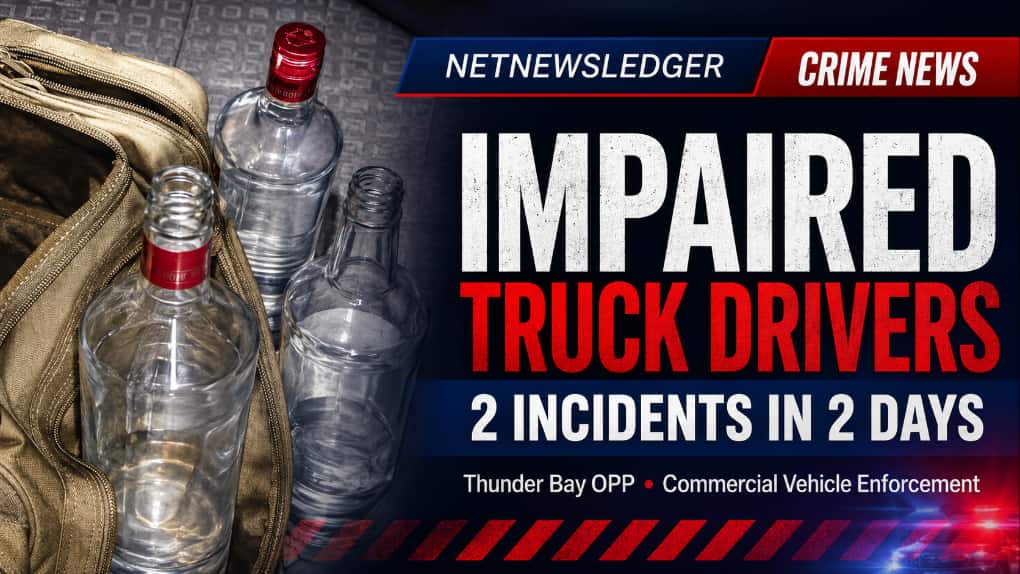
Officers reportedly located multiple open vodka bottles inside the truck cab.
The driver received a 90-day licence suspension and the vehicle was impounded for seven days.
The charges have not been proven in court. All accused individuals are presumed innocent until proven guilty in a court of law.
Second Tractor-Trailer Driver Suspended on Dawson Road
OPP also report that on May 6, another tractor-trailer driver on Dawson Road received a warn-range suspension and a seven-day licence suspension.
Ontario states drivers can face consequences if they are in the warn range, meaning a blood alcohol concentration between 0.05 and 0.079. Ontario also has a zero-tolerance rule for commercial drivers, meaning a person driving a vehicle that requires an A-F driver’s licence or a Commercial Vehicle Operator’s Registration cannot have alcohol in their system while driving.
OPP say commercial vehicle enforcement will continue in the area.
Criminal Code Context for the Charges
Impaired operation is covered under section 320.14(1)(a) of the Criminal Code. It applies when a person operates a conveyance while their ability to operate it is impaired to any degree by alcohol, a drug or a combination of both. Operation over 80 is covered under section 320.14(1)(b), which applies where a person has, within two hours of driving, a blood alcohol concentration equal to or exceeding 80 milligrams of alcohol in 100 millilitres of blood.
Failing or refusing to provide a breath sample is covered under section 320.15(1), which applies when a person, knowing a lawful demand has been made, fails or refuses to comply without a reasonable excuse. Mandatory alcohol screening is permitted under section 320.27(2) when a peace officer has an approved screening device and is lawfully exercising police powers.
Dangerous operation is covered under section 320.13(1) of the Criminal Code. It applies where a person operates a conveyance in a manner that, having regard to all of the circumstances, is dangerous to the public.
Typical Sentencing Ranges Available to Courts
For impaired operation, over 80 operation and failing or refusing to comply with a breath demand, the Criminal Code provides a maximum penalty of up to 10 years in prison if the Crown proceeds by indictment.
If handled by summary conviction, the maximum is a fine of up to $5,000, imprisonment for up to two years less a day, or both. Minimum penalties include a $1,000 fine for a first impaired or over 80 offence, with higher minimum fines for higher blood alcohol readings, and a minimum $2,000 fine for a first refusal offence. A second offence carries a minimum 30 days in jail, and subsequent offences carry a minimum 120 days.
For dangerous operation, the Criminal Code allows a maximum sentence of up to 10 years in prison if prosecuted by indictment, or summary conviction penalties if the Crown proceeds summarily. Courts may also impose driving prohibitions and other conditions depending on the facts of the case.
The Criminal Code also directs courts to consider certain aggravating factors for driving-related offences, including whether the offender was being paid to operate the vehicle and whether the offender was operating a large motor vehicle.
Why Commercial Vehicle Impairment Is a Serious Public Safety Issue
Commercial motor vehicles are essential to the Thunder Bay economy, moving fuel, groceries, forestry products, construction materials and other goods across Northwestern Ontario.
But impaired driving behind the wheel of a tractor-trailer can place many people at risk. A loaded transport truck requires more time and distance to stop, has larger blind spots and can cause severe harm in a collision.
For Thunder Bay, enforcement on Dawson Road, designated truck routes and regional highways is especially important because commercial traffic often shares space with commuters, school buses, pedestrians, cyclists and emergency vehicles.
Report Suspected Impaired Driving
Anyone who sees a suspected impaired driver should call 911 when it is safe to do so. Helpful details include the vehicle description, licence plate, direction of travel, road location and driving behaviour.
Do not follow a vehicle closely or put yourself at risk. Pull over safely before calling.