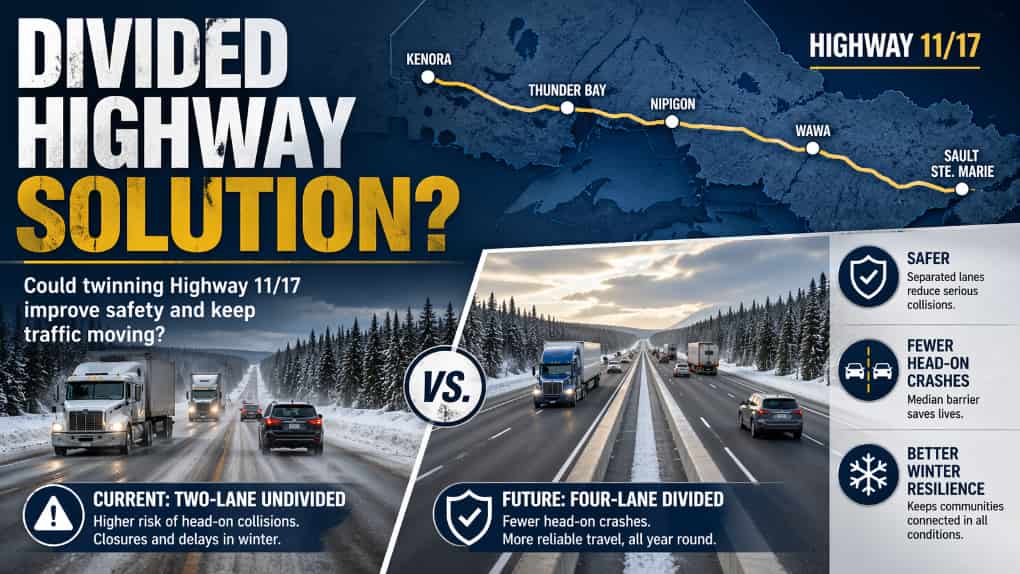
Analysis: A divided Highway 11/17 is the safest long-term answer — but it will take phased construction
Thunder Bay – NEWS – Over the past winter, it has seemed at times that regional highways have been closed all too many times. Each highway closure basically divides Canada in half. While there has been efforts from Ontario to fix some of the problems, the real issue is that Canada needs to have a two-way divided highway from coast-to-coast.
A divided highway would directly address the most dangerous weakness on Highway 11 and Highway 17: opposing traffic separated only by paint.
On a two-lane highway, one drift across the centre line can become a head-on collision. One jackknifed transport can block the entire route. One fatal crash can close the only east-west corridor for hours. A divided highway changes that risk profile.
The safety evidence is strong. The U.S. Federal Highway Administration says median barriers significantly reduce cross-median crashes, and its safety material cites a 97 per cent reduction in cross-median crashes where median barriers are installed on rural four-lane freeways.
A crash-modification study in the FHWA clearinghouse found that converting a two-lane roadway to a four-lane divided roadway was associated with about a 31 per cent decrease in crashes overall.
Another U.S. transportation study found conversion from typical two-lane roads to four-lane divided roads produced crash reductions of 40 to 60 per cent per kilometre.
What a divided highway would fix
A four-lane divided Highway 11/17 would help in five major ways.
First, it would reduce head-on collisions by physically separating eastbound and westbound traffic.
Second, it would reduce dangerous passing because drivers would no longer need to pull into oncoming traffic to pass transports, snowplows or slower vehicles.
Third, it would improve incident management. If one side of the highway is blocked, police and MTO may be able to use the other carriageway, planned median crossovers or controlled detours to keep some traffic moving.
Fourth, it would improve snow-clearing logistics because plows could work separated lanes with more room, fewer opposing-traffic conflicts and better staging.
Fifth, it would strengthen the national supply chain. Highway 11/17 is not just a northern road; it is the main all-Canadian east-west highway link between Eastern and Western Canada.
What it would not fix by itself
A divided highway would not eliminate winter closures completely.
Whiteouts, freezing rain, snow squalls, crashes involving multiple transports, vehicle fires, hazardous-material spills and police investigations can still close divided highways.
Manitoba, Saskatchewan and Alberta still close divided highways during extreme weather.
But the difference is resilience. A divided highway gives emergency responders more options and reduces the chance that one mistake becomes a fatal head-on crash or a full corridor shutdown.
Why Ontario has not already done it
The challenge is cost, terrain and distance.
Northern Ontario is not prairie-flat. The Highway 11/17 corridor includes rock cuts, lakes, rivers, wetlands, rail crossings, steep grades, bridges, protected areas and long stretches with limited nearby construction access. Twinning between Thunder Bay and Kenora, Thunder Bay and Sault Ste. Marie, and the Highway 11 northern route would be a multi-decade, multi-billion-dollar project.
That is why Ontario is also testing the 2+1 highway model north of North Bay. A 2+1 road uses three lanes, with a centre passing lane alternating direction every few kilometres, often with a median barrier. Ontario’s pilot on Highway 11 in Nipissing District is now in design and environmental assessment.
The Northern Policy Institute has argued that 2+1 roads can deliver strong safety benefits at lower cost than full twinning, especially on lower-volume northern highways. Its analysis says 2+1 roads should include a median barrier in Northern Ontario.
The best answer is not 2+1 versus twinning — it is both
For Highway 11/17, the practical solution is staged.
Use full four-lane divided highway where traffic volumes, crash history and national-corridor importance justify it first. That should include the Thunder Bay-to-Shabaqua section, the Kenora-to-Manitoba section, and the most dangerous or closure-prone sections near Nipigon, Schreiber, Marathon, Wawa, Batchawana Bay and major grades.
Ontario already has planning or construction tied to four-laning Highway 11/17 west of Thunder Bay toward Shabaqua, and the province has also advanced Trans-Canada twinning work between the Manitoba boundary and the Kenora bypass.
Use 2+1 with barriers on long rural stretches where full twinning will not be funded soon. That would still reduce unsafe passing and many head-on risks while giving drivers regular passing opportunities.
In other words: 2+1 should be the interim safety standard. Full twinning should remain the end goal for the national corridor.
What the policy should be
Ontario and Canada should treat Highway 11/17 like national infrastructure, not only a provincial northern highway.
A realistic plan would include:
- A federal-provincial Highway 11/17 twinning fund.
- Immediate four-laning of the highest-risk sections.
- 2+1 barrier highways on lower-volume sections while twinning is planned.
- More truck rest areas, inspection stations and storm-staging zones.
- Better winter maintenance, real-time road-condition data and variable-message signs.
- Faster incident clearance with heavy tow contracts staged along the corridor.
The bottom line: a divided highway is the safest and most durable solution. It would not stop every winter closure, but it would reduce the worst crashes, shorten many disruptions and make the corridor far more resilient.
For Northwestern Ontario, the question should not be whether Highway 11/17 deserves divided-highway treatment. It should be which sections get built first, how quickly, and whether Ottawa helps pay for a corridor that serves the whole country.