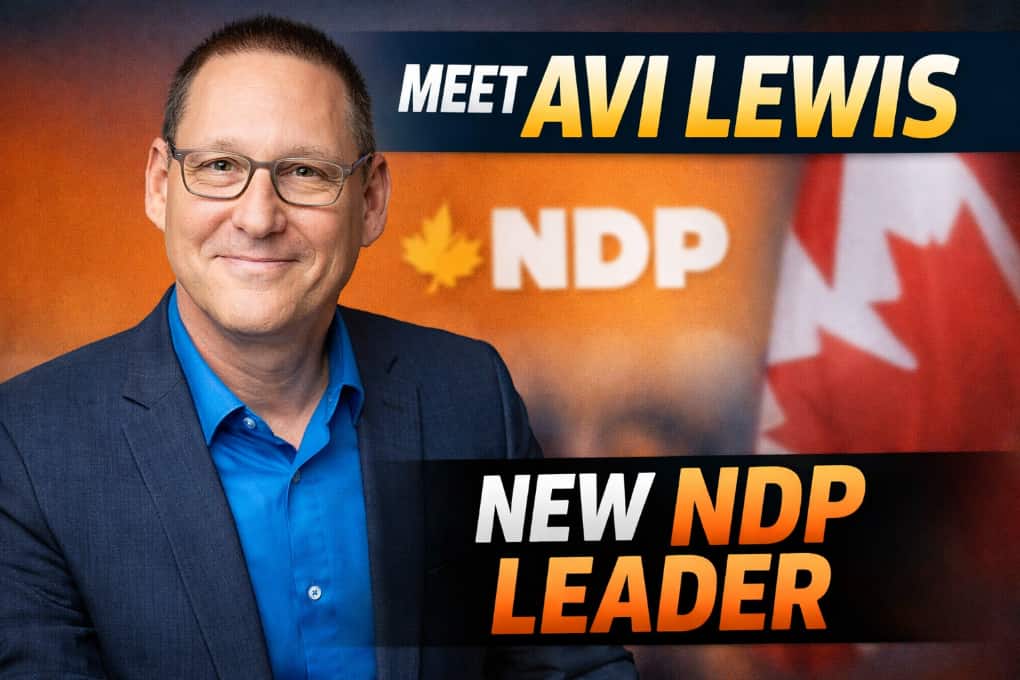
Who is Avi Lewis? New NDP leader now faces the harder task of introducing himself to Canadians
THUNDER BAY – POLITICS – Avi Lewis is the new leader of the federal New Democratic Party, elected Sunday in Winnipeg with 56 per cent of the vote on the first ballot. For Thunder Bay and Northwestern Ontario, the result matters because the party is trying to rebuild after being cut to seven seats in the 2025 federal election, a number that later fell to six after Nunavut MP Lori Idlout crossed to the Liberals.
That is the backdrop to Lewis’s victory.
He is not taking over a party in growth mode. He is taking over a party that needs to explain itself again to voters, including in Northern Ontario, where the federal NDP performed poorly last year even as New Democrats still retain some provincial strength.
Who is Avi Lewis?
Lewis comes to the leadership from journalism, documentary filmmaking, teaching and activism more than from electoral office. Before winning the leadership, he had run twice for the federal NDP and failed both times to win a House of Commons seat. In Vancouver Centre in 2025, he finished third with 12.6 per cent of the vote.
A familiar name in Canadian progressive politics
His surname is well known in New Democratic circles. Lewis is the grandson of former federal NDP leader David Lewis and the son of Stephen Lewis, the former Ontario NDP leader who later served as Canada’s ambassador to the United Nations. His mother is journalist and author Michele Landsberg. Lewis lives in Vancouver with author Naomi Klein and their son.
That family background helps explain why longtime New Democrats know him far better than many Canadians do. He has been around progressive politics and media for decades, but until now he has not been the person carrying a national party brand on the federal stage.
From broadcaster to activist to educator
Before entering leadership politics, Lewis built a public profile in television. He hosted Citytv and MuchMusic’s The NewMusic, CBC Newsworld’s CounterSpin, The Big Picture with Avi Lewis and On the Map, and later worked with Al Jazeera on Fault Lines and Inside USA.
He is also a documentary filmmaker. University College at the University of Toronto notes his work on The Take, while his campaign biography points to This Changes Everything and his collaboration with U.S. Rep. Alexandria Ocasio-Cortez on Message from the Future.
More recently, UBC said Lewis joined its geography department in 2021 as an associate professor focused on social and political change, communication and documentary filmmaking.
What kind of politics does he represent?
On his leadership website, Lewis pitched a sharper left-wing turn for the NDP, centred on worker power, climate justice, public ownership and a larger social safety net.
His policy page called for rent caps, tenant protections, one million public homes and a “For Indigenous, By Indigenous Housing Strategy,” while framing the campaign as a fight for “the 99 per cent.”
That message helped him win the race decisively. But it also signals where the political tests will come. Lewis has long been associated with climate-justice politics, and even on the day of his win Alberta NDP Leader Naheed Nenshi publicly warned that Lewis’s approach was “not in the interests of Alberta.”
That kind of pushback matters in a country where debates over energy, jobs and resource development can quickly divide federal and provincial New Democrats.
Why Thunder Bay and Northwestern Ontario should pay attention
For readers in Thunder Bay, the most important point is not simply who Lewis is, but what he has inherited. In the 2025 federal election, the NDP took 6.8 per cent in Thunder Bay—Rainy River and 7.1 per cent in Thunder Bay—Superior North. That is not a base any leader can take for granted.
At the same time, the Ontario NDP still holds Thunder Bay—Superior North provincial seat through Lise Vaugeois. That split suggests something important for Lewis: there is still space in Northwestern Ontario for New Democratic politics, but the federal wing has become much weaker than the provincial one.
Rebuilding here will mean more than repeating national slogans. It will mean explaining how his politics on affordability, housing, climate and public services fit Northern realities.
That challenge is likely to be especially sharp in Northwestern Ontario, where voters often measure federal parties against practical questions: the cost of living, health-care access, housing shortages, Indigenous partnership, infrastructure and whether policy helps or hurts work tied to resource and transportation economies.
Lewis’s supporters will say his emphasis on public investment and economic justice speaks directly to those pressures. Skeptics will want proof that a climate-first message can also speak convincingly to jobs and development. That tension is now part of his leadership from Day 1.
The road ahead
Lewis won the leadership cleanly, with 39,734 votes from 70,930 valid ballots cast. What he has not yet won is a seat in Parliament, or a broad national profile outside progressive and media circles.
Those are now his next two tests.
For NetNewsLedger readers, that is the real introduction. Avi Lewis is a veteran broadcaster, filmmaker, teacher and activist from one of Canada’s best-known NDP families. He now leads a diminished federal party that is trying to become relevant again.
Whether he can translate that résumé into support in Thunder Bay and across Northwestern Ontario is the question that starts today.