Carney is reshaping Canada’s answer to Trump’s trade shock — and that could redefine Canada-U.S. ties
Thunder Bay – POLITICS – Since U.S. President Donald Trump returned to office in 2025, Washington has used tariffs and trade threats as instruments of national strategy, including new duties on Canadian goods, steel, aluminum and autos. The long-term Canadian question is no longer only how to absorb that pressure.
It is whether Ottawa can reduce its vulnerability to it.
Prime Minister Mark Carney has made that shift central to Canada’s response through his Jan. 20, 2026, speech at Davos and through major trade and investment moves with China and the European Union.
For Thunder Bay and Northwestern Ontario, that matters because the region’s port, rail links, forestry base and emerging critical minerals economy all depend on reliable access to external markets.
Why this matters in Northwestern Ontario
The local stakes are practical, not theoretical.
The Port of Thunder Bay says it supports more than 900 direct jobs, generates about $370 million in annual economic impact and remains the top export port on the Seaway. FedNor says 41 potential mines are projected to start in Northwestern Ontario by 2033, and that 31 of Northern Ontario’s 38 single-industry communities were First Nation reserves in 2021.
That means prolonged trade instability can hit Northwestern Ontario through shipping volumes, forestry and mining investment, and through the vulnerability of smaller resource-dependent communities.
Carney’s Davos speech signalled a strategic break with old assumptions
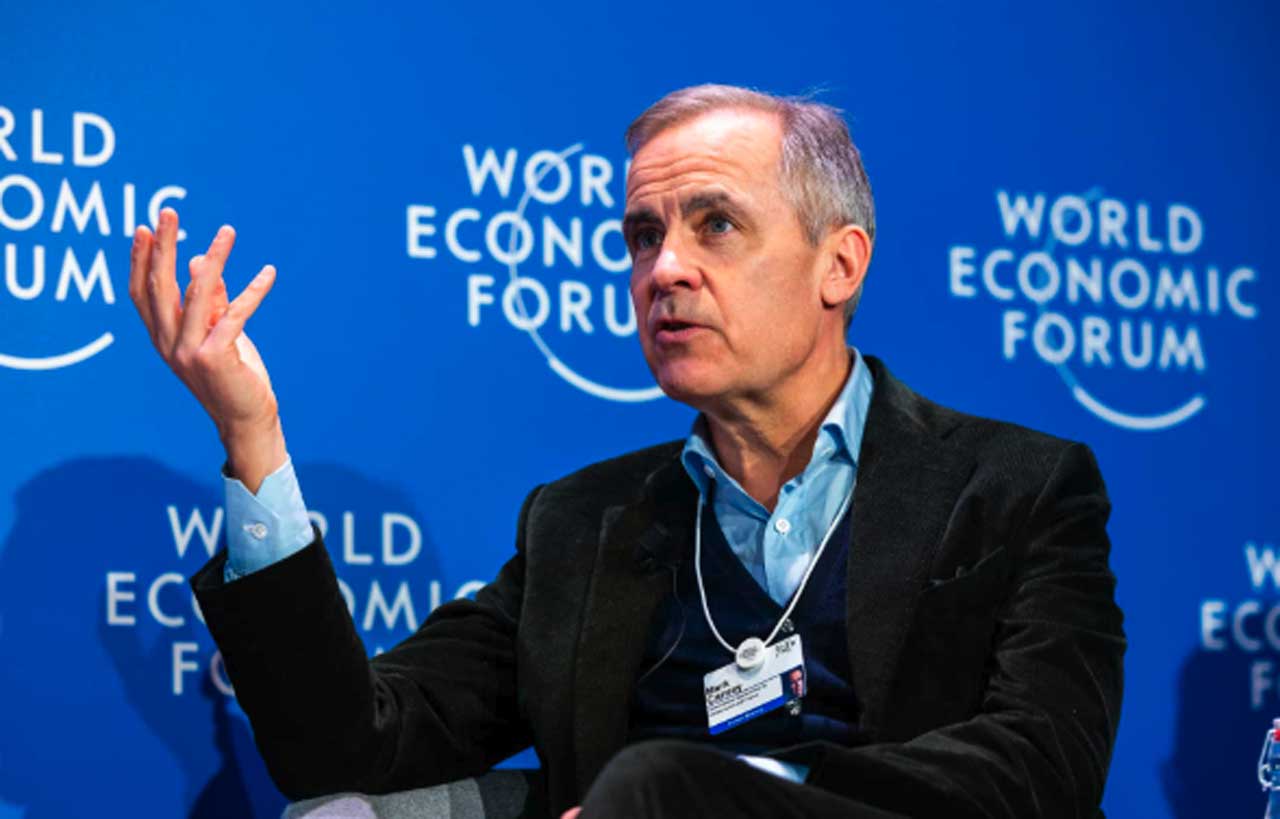
At Davos on Jan. 20, Carney said the world was facing a “rupture” in the old order and argued that middle powers such as Canada had to stop assuming the rules-based system would protect them automatically.
The message was that Canada should build strength at home while widening its network abroad. The Prime Minister’s Office framed the Davos visit as part of a broader push to diversify trade and attract investment after new international deals, and Reuters reported Trump publicly rebuked Carney the next day, telling him Canada should be “grateful” to the United States. The exchange underlined that Carney’s approach is not just economic policy. It is already affecting the tone of Canada-U.S. relations.
His China mission was about diversification, but with clear limits
In Beijing on Jan. 16, Carney’s office announced a new Canada-China strategic partnership focused on energy, agri-food and trade. Ottawa said the visit was the first by a Canadian prime minister since 2017 and said the two sides secured co-operation measures touching energy, wood products, food safety and other sectors.
The government also said the arrangement could unlock new export opportunities and help resolve long-standing agricultural trade barriers. For a region like Northwestern Ontario, where forestry, transportation and resource exports remain central, that kind of diversification could create alternative demand and investment channels outside the U.S. market.
But the China file also shows the limits of Carney’s strategy. Reuters reported Trump threatened 100 per cent tariffs if Canada pursued a free-trade deal with China, and Carney responded that Canada would respect its CUSMA commitments and had no intention of signing a free-trade agreement with a non-market economy.
In other words, Carney is trying to use China as part of a diversification strategy without crossing the lines that could trigger an even harsher U.S. response. That may give Canada more room to manoeuvre, but it also points to a colder, more conditional relationship with Washington.
The European Union is the steadier hedge
Carney’s Brussels trip in June 2025 may prove more important over the long term than the China mission. In Brussels, Canada and the EU launched the New EU-Canada Strategic Partnership of the Future, opened talks to deepen co-operation in trade and economic security, digital policy and climate competitiveness, and signed a Security and Defence Partnership that Ottawa described as the first step toward Canada joining SAFE, the EU’s defence procurement framework.
Ottawa and Finance Canada both describe the EU as Canada’s second-largest trading partner after the United States, while Global Affairs Canada says trade under CETA has grown 58 per cent since 2016.
That matters because Europe offers Canada something China cannot: diversification with a like-minded bloc that already has a trade architecture with Canada in place. For Thunder Bay, that aligns with the port’s long-standing role as a Seaway gateway to European markets and with Northwestern Ontario’s push toward value-added mining, manufacturing and export logistics. Carney’s EU strategy suggests Ottawa wants Canada to be less dependent on a single customer and more anchored in a wider group of democratic commercial partners.
What Carney changes in the long-term economic outlook
The broad economic trend remains difficult. Statistics Canada says Canada’s share of merchandise exports going to the United States fell from 75.9 per cent in 2024 to 71.7 per cent in 2025. The Bank of Canada says U.S. tariffs have had a persistent negative effect on the Canadian economy and projects that by the end of 2026, GDP will be about 1.5 per cent lower than it would have been in the bank’s January 2025 baseline. The bank also says tariffs and uncertainty are weighing on jobs, productivity and business expansion.
Carney’s answer is to speed up the restructuring already underway by pushing capital, trade and diplomacy toward new markets. That may reduce Canada’s long-term exposure to U.S. political shocks, but the Bank of Canada’s outlook suggests the transition will still be costly and slow.
What this means for Canada-U.S. relations
The most likely long-term result is not a break with the United States, but a more guarded and legalistic partnership. CUSMA remains central, and its formal joint review begins July 1, 2026. Canada still needs stable access to the U.S. market, and the United States remains by far its largest trading partner.
But Carney’s Davos speech, the China reset and the EU partnership all point in the same direction: Ottawa is preparing for a future in which access to the U.S. market cannot be treated as politically automatic.
That should modestly reduce Washington’s leverage over time, but it could also produce more disputes whenever Canadian diversification runs against U.S. strategic or commercial priorities.
The Northwestern Ontario view
For Thunder Bay and the Northwest, Carney’s strategy could bring both opportunity and pressure. A broader European and Indo-Pacific trade push could strengthen the case for port investment, better east-west trade corridors, more value-added processing and stronger links between regional mines and Southern Ontario battery manufacturing.
At the same time, the Bank of Canada’s warning about weaker investment and slower growth shows that diversification is not a quick substitute for the U.S. market. Regions tied to commodities, transportation and industrial supply chains may feel the stress of that transition first.
In Northwestern Ontario, where single-industry and Indigenous communities remain especially exposed to external shocks, the success of Carney’s strategy will depend on whether trade diplomacy is matched by infrastructure, power, rail, road and project certainty at home.
The clearest conclusion is that Carney is changing the frame of the debate. Under Trump, Canada is no longer reacting only with counter-tariffs and dispute mechanisms. It is also trying to redesign its place in the global economy. That could make Canada more resilient over time, and it could open new opportunities for regions such as Northwestern Ontario. But it also means Canada-U.S. relations are likely entering a period where trust matters less, hedging matters more and every major trade decision carries geopolitical consequences.