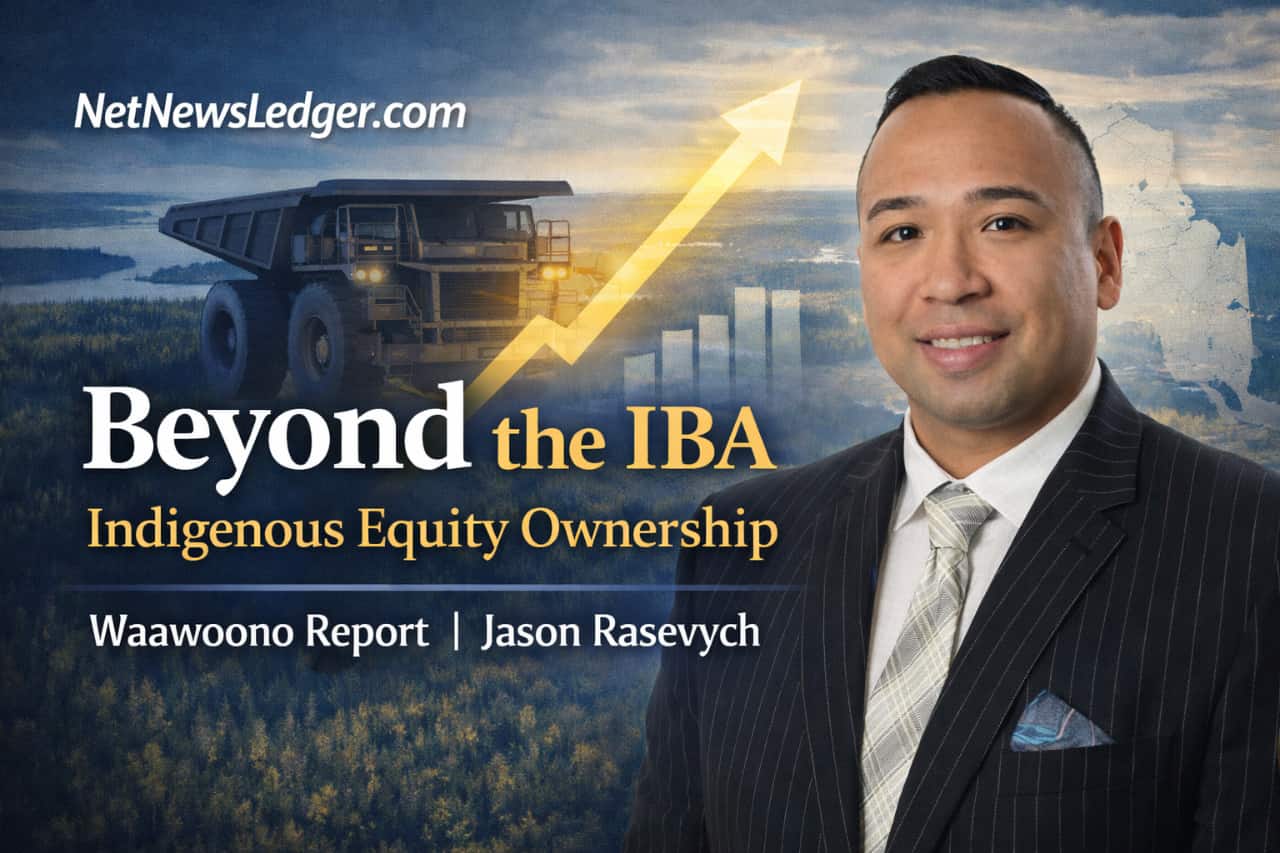
Waawoono Report Calls for First Nations to Move Beyond IBAs Toward Ownership and Sovereign Wealth
THUNDER BAY — A Thunder Bay-based Indigenous consultancy is calling for First Nations to move beyond traditional impact benefit agreements and toward direct equity ownership, sovereign wealth funds and long-term control of resource revenues.
Waawoono Consultancy, supported by the Anishnawbe Business Professional Association, has released Beyond the IBA: Volume II: Architecting Indigenous Sovereign Wealth. The report argues that First Nations should use major settlement funds, loan guarantees and investment structures to become owners and institutional investors in mining, energy, infrastructure and clean-technology projects rather than passive recipients of fixed payments.
Why This Matters in Thunder Bay and Northwestern Ontario
The report lands in a region where mining, transmission lines, critical minerals, forestry, transportation corridors and treaty rights are deeply connected.
For First Nations across Treaty 3, Treaty 5, Treaty 9 and the Robinson Superior and Robinson Huron treaty areas, the question is not only whether development happens, but who owns it, who governs the revenue and how benefits are protected for future generations.
Thunder Bay is central to that discussion. The city is a service, transportation, legal, financial and political hub for many northern resource projects. Decisions made around mine financing, power transmission, road access and Indigenous equity participation can directly affect jobs, procurement, training, housing, community infrastructure and long-term wealth creation across Northwestern Ontario.
Report Warns Against Passive Agreements
The report builds on Waawoono’s earlier work, which argued that conventional impact benefit agreements are no longer enough for First Nations seeking economic self-determination.
Jason Rasevych, president of the Anishnawbe Business Professional Association, says the next step is ownership. “The era of passive Indigenous participation in the Canadian economy has ended,” Rasevych said in the release. “True sovereignty requires not just a seat at the table, but ownership of the table itself.”
The report says First Nations should consider moving from royalty-style arrangements into equity ownership, infrastructure investment and Indigenous sovereign wealth funds that can manage capital over generations.
Settlement Funds and the ‘Prudent Investor’ Concern
Waawoono points to what it describes as a major capital moment for First Nations, including more than $25 billion connected to specific claims, the $23.34-billion First Nations Child and Family Services class action settlement, and major treaty-related settlements including $10 billion for Robinson Huron and $3.6 billion for Robinson Superior.
The report argues that many settlement trusts are limited by provincial trust rules and conservative investment mandates. Waawoono describes this as a “prudent investor” trap, where funds may be directed toward low-risk public equities and government bonds while restricting access to private-market opportunities, community lending or direct infrastructure ownership.
The report proposes Indigenous sovereign wealth funds as one possible alternative, saying they could be structured through Nation-led governance, long-term investment mandates and international principles for transparency and accountability.
Case Studies Include Watay Power, Oneida Energy and Cedar LNG
The report highlights several examples of Indigenous ownership and investment models.
They include Wataynikaneyap Power, where 24 First Nations hold a 51 per cent majority equity stake in a $1.9-billion transmission project connecting remote communities to the Ontario power grid.
The report also points to the Oneida Energy Storage Project, a 250-megawatt battery storage project involving Six Nations of the Grand River Development Corporation, and Cedar LNG, a majority Indigenous-owned liquefied natural gas project led by the Haisla Nation.
Other examples include Project Reconciliation, Minodahmun Development LP and the Royal Bafokeng Nation in South Africa, which Waawoono presents as models for separating political governance from long-term financial management.
Regional Implications for Mining and Critical Minerals
The report is especially relevant to Northern Ontario’s mining future, including potential critical minerals development, Ring of Fire-related infrastructure and new transmission or road corridors.
For Indigenous communities, equity ownership can mean more than revenue-sharing. It can include board representation, procurement authority, environmental oversight, training pathways, local hiring, and the ability to shape whether projects proceed and under what conditions.
For industry, the report signals that companies may face growing expectations to negotiate ownership and long-term partnership structures rather than rely on older benefit-payment models.
For Thunder Bay, the shift could increase demand for Indigenous finance, legal, engineering, environmental, training and governance services.
Webinar Scheduled for May 27
Waawoono will host a public online session to discuss the report.
The “Beyond the IBA” Lunch and Learn webinar is scheduled for Wednesday, May 27, 2026, from noon to 1 p.m. EDT. Registration is open at Waawoono’s website.
The session is expected to focus on how First Nations can assess existing trusts, consider sovereign wealth structures and prepare for direct investment in major projects.
About the Organizations
The Anishnawbe Business Professional Association is a Thunder Bay-based non-profit, member-based organization serving First Nation businesses across Treaty 3, Treaty 5, Treaty 9, and the Robinson Huron and Robinson Superior treaty areas.
Waawoono Consultancy is an Indigenous-owned firm based in Thunder Bay that provides advisory services focused on corporate finance, Indigenous governance and economic sovereignty.