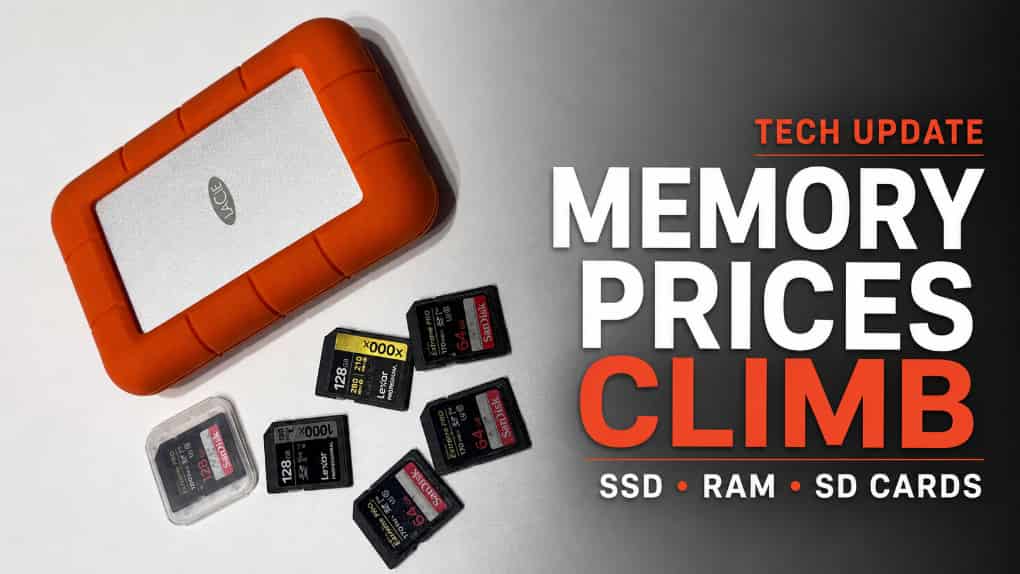
Memory Prices Are Rising: What Thunder Bay Buyers Should Know Before Upgrading
Thunder Bay – TECHNOLOGY – Computer memory prices are climbing sharply, and the increases are likely to keep showing up on store shelves in the months ahead.
For Thunder Bay households, schools, small businesses, First Nation administrations, creators, repair shops and industrial operators, that means higher costs for RAM, solid-state drives and SD memory cards — and fewer bargains than buyers became used to during the last down cycle.
AI Demand Is Pulling Memory Supply Away From Consumers
The main pressure is coming from the global race to build artificial intelligence data centres. Those systems require huge volumes of DRAM, high-bandwidth memory and NAND flash storage.
As major chipmakers direct more factory capacity toward server and data-centre products, less supply is available for consumer SSDs, laptops, cameras, phones, dash cams and memory cards. Less supply and increased demand if you think back to high school economics class means prices are going up.
Market research firm TrendForce says conventional DRAM contract prices are expected to rise 58 to 63 per cent quarter over quarter in the second quarter of 2026, while NAND flash contract prices are expected to rise 70 to 75 per cent. NAND flash is the core storage technology used in SSDs, USB drives and SD or microSD cards.
The price shock follows an already steep first quarter. TrendForce reports conventional DRAM contract prices were expected to rise 90 to 95 per cent in the first quarter of 2026, while NAND flash contract prices were expected to rise 55 to 60 per cent. PC DRAM prices were projected to more than double quarter over quarter.
Why SD Cards, RAM and SSDs Are All Affected
Although SD cards, RAM modules and SSDs are different products, they draw from overlapping semiconductor supply chains.
RAM prices are being pushed higher by tight DRAM supply. TrendForce reported that consumer DRAM contract prices are forecast to rise 45 to 50 per cent quarter over quarter in the second quarter of 2026, with legacy DDR4 and lower-density products particularly tight.
SSDs and SD cards are tied to NAND flash. NAND capacity is increasingly being allocated to enterprise SSDs for AI and data-centre customers, while consumer applications are being squeezed. That means PC builders, laptop makers and retail storage brands are competing for a smaller pool of available components.
The effects are visible beyond internal computer parts. Tom’s Hardware, citing price-history checks, reported in April that many memory cards and USB flash drives had more than doubled from 2025 levels, with a median increase of 123 per cent across products it checked.
The Six-Month Outlook: Higher Prices, Fewer Deals
The most likely trend over the next six months is continued price pressure.
The sharpest increases may not arrive at every retail shelf at once, because stores and distributors may still have older inventory. But as that inventory is replaced, wholesale increases are likely to be reflected in retail pricing.
For Thunder Bay consumers, that means a RAM upgrade, a two-terabyte SSD, a high-speed camera card or a stack of microSD cards may cost noticeably more later in 2026 than it does now. Sale pricing may still appear, but it is less likely to return to the deep-discount levels seen when the memory market was oversupplied.
Notebook prices are also exposed. Current estimates project that rising memory and CPU costs could push the retail price of a mainstream notebook originally priced at US$900 up by nearly 40 per cent if manufacturers and retailers preserve margins.
The One-Year Outlook: Elevated Prices Into 2027
Over the next year, the market looks more likely to stay tight than to return quickly to low prices.
Samsung Electronics, the world’s top memory chipmaker by sales, expects a severe supply shortage to deepen in 2027 as AI-related demand continues. Samsung also said it has signed multi-year binding supply contracts with customers seeking to lock in memory supply.
SK Hynix, another major memory producer, has also said AI chip demand exceeds manufacturing capacity. Some DRAM prices jumped nearly 83 per cent in the first quarter, while some NAND products rose about 160 per cent, citing TrendForce data. Analysts told Reuters that the pace of increases may ease after the second quarter, but constrained supply is expected to continue until new capacity comes online.
That matters because semiconductor factories and advanced packaging capacity cannot be added quickly. Even when companies increase capital spending, new production often takes more than a year to affect supply. Micron has raised its 2026 capital spending plan as it responds to AI-driven demand, however additional DRAM wafer output from one acquired plant is expected beginning in the second half of 2027.
What This Means In Northwestern Ontario
The price increases will not only affect gamers and computer hobbyists. In Northwestern Ontario, storage and memory are part of daily operations for municipal offices, schools, health-care providers, First Nation governments, small businesses, repair shops, photographers, drone operators, transport companies, mines, forestry firms and emergency-service fleets.
Many remote and northern operations rely on local inventory, shipping windows and dependable replacement parts. A higher price for SSDs or RAM can make routine computer refreshes more expensive. More costly SD and microSD cards can affect dash cams, trail cameras, body cameras, security systems, drones and field data collection.
For Indigenous communities and northern service providers, higher technology costs can add pressure to already expensive procurement and shipping. A computer part that is only moderately more expensive in southern Ontario can become a larger budget issue when freight, limited local availability and urgent replacement needs are added.
Is Now The Time To Stock Up?
For buyers with a known need over the next six to 12 months, the practical answer is yes — but stock up carefully, not emotionally.
Households planning a computer upgrade, students needing laptop storage, photographers needing reliable cards, or small businesses planning workstation maintenance may be better off buying essential RAM, SSDs or memory cards now rather than waiting for a broad price retreat.
For businesses, schools and organizations, the better strategy is controlled forward buying: purchase what is likely to be used within the next year, standardize parts where possible, check warranty terms, and avoid tying up cash in excess inventory that may become obsolete or sit unused.
The main exception is discretionary buying. A consumer who does not need more storage or memory should not treat this like an investment. Memory markets are cyclical, and prices can fall when new supply arrives or demand weakens. The current evidence points to higher prices in the near term, but not a permanent one-way market.
Buying Advice For Local Consumers And Businesses
Buy sooner for confirmed needs. Prioritize RAM and SSD upgrades for devices that are still worth extending. For SD and microSD cards, avoid no-name cards and suspiciously cheap listings, as counterfeit or low-end media can be costly if data is lost.
For organizations, review technology budgets before summer purchasing. Schools, municipal departments, First Nation offices and small businesses should consider whether fall computer refreshes, security-camera storage, field tablets or backup drives can be ordered earlier.
The bottom line: prices are likely to remain under upward pressure for at least the next six months and may stay elevated into 2027. Buying essential memory now is reasonable. Panic buying is not.