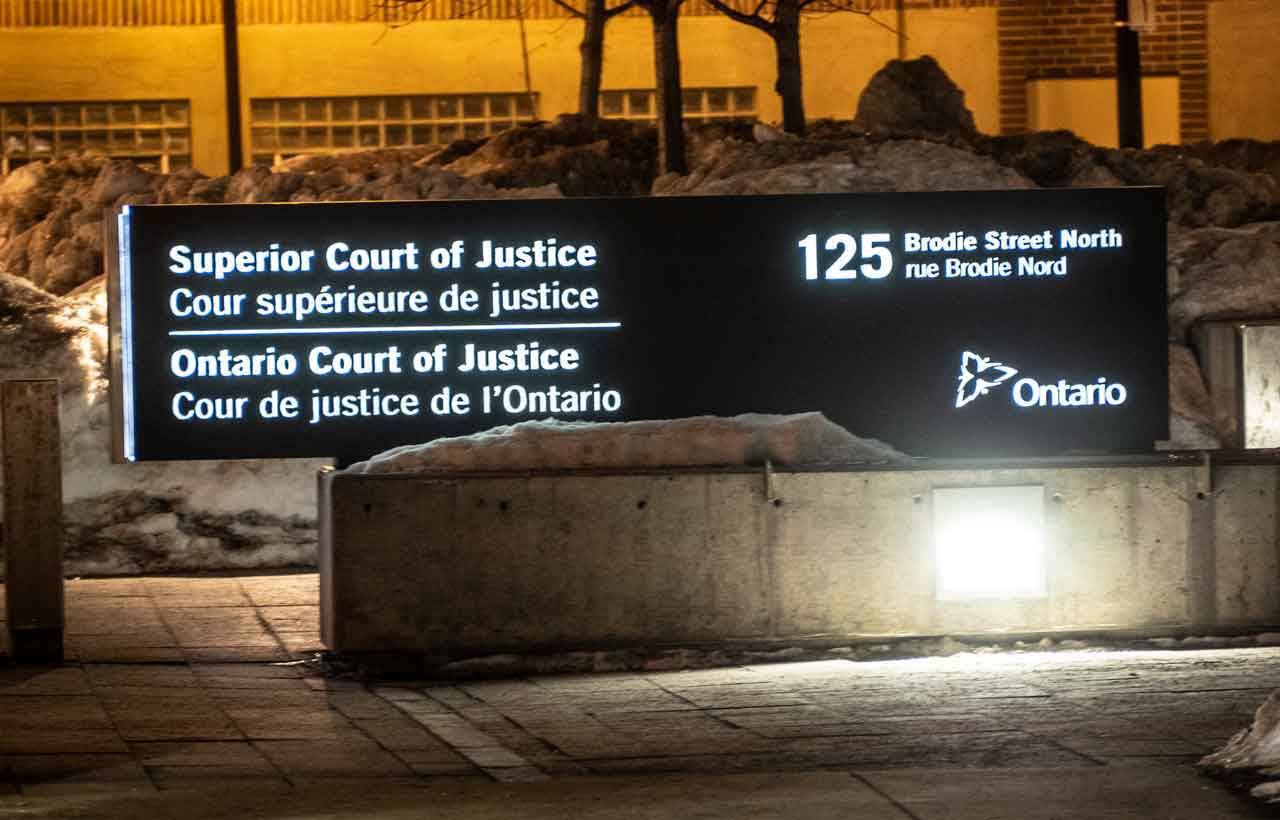
Gursharan Singh will return to court for sentencing after a judge found his excessive speed amounted to dangerous driving causing death
THUNDER BAY — LEGAL UPDATE – A transport truck driver has been convicted of dangerous operation causing death in a January 2023 collision on Highway 17 west of Marathon that claimed the life of another motorist.
In Thunder Bay, Justice Bruce Fitzpatrick found Gursharan Singh guilty after concluding that Singh’s speed in the seconds before the crash was a marked departure from the care expected of a reasonable driver in the same circumstances.
Sentencing will take place on a later date.
The collision happened at about 10:27 a.m. on Jan. 28, 2023, west of the Steel River Bridge. Singh was driving a fully loaded Freightliner tractor-trailer when it crossed the centre line and collided with a Ford Expedition.
A 64-year-old occupant of the passenger vehicle died.
Another person in that vehicle was taken to hospital with minor injuries, while Singh was taken to hospital with injuries that police initially described as undetermined.
The trial heard evidence from two Ontario Provincial Police officers who attended the scene. The court also reviewed dash-camera footage and evidence about the truck. No mechanical failure was identified in the Freightliner.
Evidence showed the transport travelling at about 110 km/h before slowing to about 105 km/h in an 80 km/h zone. The truck began to jackknife and entered the opposing lane. The Expedition’s driver moved onto the shoulder in an attempt to avoid it.
The Crown argued Singh’s speed was dangerous on a downhill, curved winter highway where warning signs and an 80 km/h limit called for caution. Prosecutors also pointed to the truck’s all-season tires and argued speed contributed to the loss of control.
The defence argued the Freightliner bounced over the bridge’s westerly expansion joint about four seconds before impact, causing an immediate loss of control. It also argued that gaps in mechanical and environmental testing left the Crown unable to prove the required marked departure from reasonable driving.
Fitzpatrick rejected that explanation. He found the reduction from 110 to 105 km/h occurred as the truck jackknifed, and noted signs warned drivers about bumps at the bridge’s expansion joints. The warning called for Singh to reduce speed, the judge found, rather than maintain an excessive pace through the area.
The conviction and possible sentence
Singh was convicted under section 320.13(3) of the Criminal Code.
The offence applies when a person operates a conveyance in a manner that is dangerous to the public, having regard to all the circumstances, and that operation causes another person’s death. A dangerous-driving conviction does not require proof that the driver intended to kill or injure someone. In this case, the court found the driving met the criminal standard of a marked departure from reasonable care.
The offence is prosecuted by indictment. Section 320.21 sets life imprisonment as the maximum penalty. That maximum is the legal ceiling, not an indication of the sentence Fitzpatrick will impose.
The statutory minimum depends on Singh’s qualifying record: a $1,000 fine for a first offence, 30 days in jail for a second offence and 120 days in jail for each subsequent offence.
The Criminal Code also directs sentencing judges to treat operation of a large motor vehicle as an aggravating circumstance. Driving for pay is another listed aggravating factor when it is established on the evidence.
Fitzpatrick may impose a Criminal Code driving prohibition in addition to the main sentence. Because dangerous operation causing death carries a potential life sentence, the prohibition may last for any period the judge considers appropriate, plus the full period of any imprisonment. The court must also address the victim surcharge and consider restitution where a victim seeks compensation for readily ascertainable losses.
No sentencing position from the Crown or defence was available in the material reviewed. Those submissions, Singh’s personal circumstances, any prior record, victim-impact evidence and comparable cases are among the matters that may shape the eventual sentence.