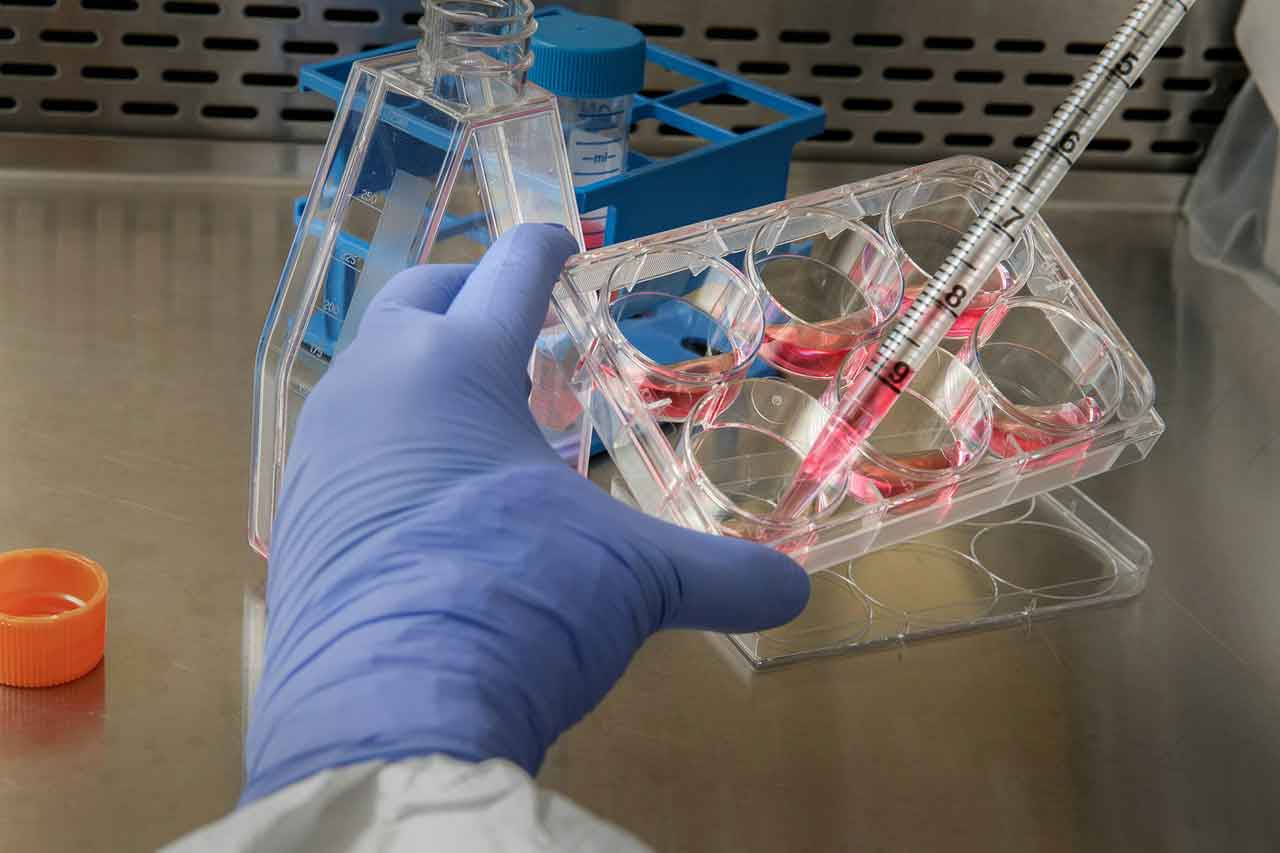
Short answer: peptides stick to tube walls, pipette tips and plate surfaces, and the proportion lost rises sharply as concentration falls. At the low concentrations typical of a working solution, adsorption can remove a large share of the nominal amount before the sample reaches the assay.
- Loss scales with surface-area-to-volume ratio, so small volumes in large containers are the worst case.
- Hydrophobic and strongly charged sequences adsorb most readily.
- Low-binding consumables, carrier additives and fresh preparation are the three standard countermeasures.
- The effect is measurable in a laboratory’s own hands and should not be taken on faith either way.
Why does a dilute peptide solution lose concentration?
Because the peptide partitions between the solution and the container surface, and the surface has a finite binding capacity that does not shrink when the solution gets more dilute. At a concentrated stock the amount of peptide bound to the wall is trivial next to the amount in solution. At nanomolar concentrations the two can be comparable.
Transfer multiplies the problem. Each pipette tip presents a fresh surface, each new tube presents another, and a serial dilution performed through several vessels can lose material at every step. The nominal concentration at the end of that chain is an arithmetic result, not a measured one.
Which peptides are worst affected?
Hydrophobic sequences, because the interaction with plastic is largely hydrophobic. Sequences with strong net charge, because they interact with charged sites on glass and on treated surfaces. Longer sequences generally more than short ones, since there is more molecule available to make contact.
This is predictable from the sequence, which is one reason the full sequence belongs on the product documentation rather than just a product name. Where a supplier publishes the sequence and the lot analytical record together, as Bluum Peptides does per product, a laboratory can anticipate the handling risk before the first dilution rather than discovering it in a flat dose-response curve.
What are the practical countermeasures?
Low-binding consumables first. Tubes, tips and plates manufactured or treated to reduce protein and peptide adsorption exist precisely because the effect is real, and for low-concentration work they are not a luxury.
Carrier additives second, where the assay tolerates them. A low concentration of an inert carrier protein, or a small amount of a non-ionic surfactant, occupies the binding sites on the surface so that the peptide stays in solution. Both have to be checked against the assay, since a carrier protein can interfere with a protein-based readout and a surfactant can affect membranes and cell viability.
Preparation discipline third. Prepare dilute working solutions immediately before use rather than storing them. Minimise the number of transfers. Use a container sized to the volume rather than a small volume in a large tube. Pre-rinsing a tip with the solution before the measured transfer reduces the loss on that tip, at the cost of a little material.
How can a laboratory tell whether it is losing material?
By measuring, which is simpler than it sounds. Prepare a dilution in the normal way, hold a portion in the intended container for the intended period, then quantify it against a freshly prepared reference. The difference is the loss in that laboratory’s own consumables with that laboratory’s own sequence.
Running the same comparison in standard and low-binding tubes turns a general warning into a local number, and that number is what justifies the cost of changing consumables. It also settles a recurring argument, because the magnitude varies enough between sequences that neither “it does not matter” nor “it ruins everything” is reliably true.
What should go in the methods section?
The consumables used, any carrier or surfactant in the dilution buffer with its concentration, and whether working solutions were prepared fresh. Those three details are frequently the reason two laboratories using the same lot at the same nominal concentration obtain different effective concentrations, and omitting them makes the discrepancy unexplainable.
Frequently asked questions
At what concentration does peptide adsorption start to matter?
There is no universal threshold, because it depends on the sequence, the surface and the surface-area-to-volume ratio. As a working rule the effect becomes significant as solutions move into the low nanomolar range and should be measured rather than assumed in that region.
Are glass vials better than plastic for peptides?
Neither is universally better. Glass binds charged sequences through its surface chemistry; untreated polypropylene binds hydrophobic ones. Low-binding treated consumables are designed to reduce both, and the right choice depends on the sequence.
Does adding carrier protein change the experiment?
It can. A carrier protein reduces adsorption loss but may interfere with protein-based readouts or binding measurements, so it needs a control rather than blanket adoption.
Can adsorbed peptide be recovered from the container?
Partially, with a suitable wash, but recovery is incomplete and poorly reproducible. Preventing the loss is far more reliable than attempting to reverse it.
This article is provided for research and informational purposes only. The materials discussed are laboratory reagents intended for in vitro and preclinical research use. Nothing here describes or endorses use in humans, and no claim is made regarding any outcome, benefit, or application beyond laboratory research.