The problem: Academic Publishing has too much friction
Every author knows the shape of the journey, even before they’ve submitted a single manuscript: submit, wait, follow up, wait, review, revise, wait, production, publish. The steps aren’t the issue. Research is supposed to be rigorous, and rigor takes time. The issue is everything that happens around those steps, the parts that have nothing to do with scholarly quality and everything to do with process design.
Researchers frequently encounter the same frustrations: editorial timelines that stretch without explanation, no visibility into where a manuscript actually sits, emails that go unanswered for weeks, a persistent reviewer shortage that quietly extends every timeline, desk rejections with no real explanation attached, submission requirements that differ from journal to journal, publishing costs that aren’t always easy to understand, reviewers who do serious intellectual labor with limited formal recognition, and a publishing journey that’s fragmented across multiple touchpoints.
None of these are new complaints. What’s changed is that researchers increasingly expect the systems around their work to be as rigorous as the work itself. Femington’s starting premise is that these frictions aren’t isolated problems. They’re symptoms of publishing infrastructure that can be designed better for the people submitting and evaluating research. That means the fix isn’t one feature. It’s a full rethink of the publishing experience, friction by friction.
Not all friction is bad.
Peer review takes time because expertise takes time. Revisions exist because research needs scrutiny. Editorial judgment exists because not every manuscript should be published.
The problem is unnecessary friction: uncertainty about where a manuscript is, unanswered questions, opaque decisions, unclear costs, and processes that force authors to spend time navigating the system instead of improving their research.
That’s the friction Femington is committed to removing.
- The first friction: “Where is my paper?”
The most common question an author asks after submission isn’t about the science. It’s about status. Has it been assigned? Is it under review? Did someone actually read the email I sent last week?
Femington’s answer starts with structure. The author-facing workflow tracks a manuscript through five explicit, named stages: submission, review, revisions, copyediting, and publication, rather than a single opaque “under consideration” status that could mean anything from “in an editor’s inbox” to “with three reviewers for six weeks.” Before a manuscript ever reaches reviewers, editors also run it through a scope, quality, and policy-compliance screening, a check that happens whether or not it shows up as its own line in the workflow, so authors know their manuscript was evaluated on the right criteria before review even began.
That structure is deliberate. Rather than promising a specific number of days, a promise that inevitably breaks for some subset of manuscripts and erodes trust faster than silence would, Femington commits to naming the stage a manuscript is in and what determines its movement to the next one. Predictability doesn’t require a countdown clock. It requires an author never having to wonder which of the five stages their paper is actually sitting in.
- The second friction: editorial silence
Status transparency solves one problem. Responsiveness solves a related but distinct one. Authors shouldn’t have to wonder whether an email actually reached anyone, whether their manuscript is quietly stalled, or whether something has gone wrong and nobody has told them.
This is less about technology and more about a communication standard the publisher holds itself to. Femington’s authors page frames this explicitly as one of its core commitments: structured timelines paired with proactive process transparency, rather than a system that only responds when an author chases it.
What makes this workable in practice is ownership rather than a stopwatch: a defined channel that reaches an editor, not a general inbox that disappears into a queue, and an expectation, held internally, not just stated publicly, that author queries get acknowledged rather than absorbed into silence. The commitment isn’t a number of hours. It’s that no author should have to send a second follow-up just to confirm the first one arrived.
- The third friction: opaque editorial decisions
Rejection is not, on its own, the problem. Every serious journal rejects manuscripts. That’s part of what makes acceptance mean something. The problem is uncertainty: not knowing why, not knowing whether the decision was about scope or quality or something fixable, and not knowing whether there’s any path forward.
Femington’s editorial model is explicit that this judgment sits with subject-matter editors, not automated filters or volume-driven triage. This means a manuscript’s fate is tied to relevance and merit, rather than an automated submission filter. That’s a meaningful design choice because authors need to understand the basis of an editorial decision, particularly when a manuscript does not proceed to peer review.
What editorial screening actually checks for is scope fit, structural readiness, and policy compliance. These are three distinct questions, each with a different answer for an author trying to understand what went wrong. A rejection tied to scope means a different journal might be the right home for the work. A rejection tied to structure or policy compliance means something fixable stood in the way before the science was even evaluated. Naming which of these applies, rather than issuing a single undifferentiated “not accepted,” is what turns a desk rejection from a dead end into information an author can actually use.
- The fourth friction: finding reviewers
This is the friction most authors never see directly, and it’s often a significant driver of delay. Every extra week a manuscript sits “in review” can involve reviewer availability: an invited expert who’s overcommitted, a niche subfield with a thin bench of qualified evaluators, or a reviewer who accepts and then goes quiet.
Femington’s reviewer program is built around a defined eligibility pool: PhD holders and doctoral candidates, postdoctoral researchers, industry and independent researchers with a peer-reviewed publication record, and university-affiliated faculty. Reviewers are evaluated for relevant subject expertise rather than seniority alone. The process itself is staged and explicit: invitation, evaluation, a structured review report that recommends, not decides, acceptance, revision, or rejection, confidential submission, editorial consideration of that input, and re-review where a revision needs a second look. Reviewers are also told plainly that they provide recommendations, not the final decision. This keeps accountability with editors, where authors expect it to sit.
What matters is that each step stays legible on its own terms, so an author or reviewer can always see how one stage feeds into the next rather than treating the process as a single black box between “submitted” and “decided.”
On recognition, Femington offers reviewers something concrete rather than a thank-you email: formal reviewer certificates as documentation of service, optional annual public acknowledgment on the website, and a stated path toward editorial or advisory roles for reviewers who consistently deliver strong evaluations. Recognition is one way publishers can acknowledge the time and expertise reviewers contribute to the publishing process.
- The fifth friction: the author experience
Step back from any single pain point and ask a more basic question: what if publishing infrastructure were designed around the author’s experience of going through it, rather than around the publisher’s internal workflow?
Many editorial systems are optimized primarily around the publisher’s internal workflow. This isn’t inherently wrong, but it’s a different design brief from making the process legible for the person submitting their research. Femington frames its author-facing principles around exactly that gap: editorial judgment over automated triage, independence from commercial publishing conglomerates so editorial decisions stay discipline-driven rather than revenue-driven, peer review that prioritizes constructive, actionable feedback over gatekeeping for its own sake, and timelines that are communicated upfront rather than discovered by asking.
Put together, those are less a feature list than a stance: predictability, clear requirements, accessible support, and the assumption that the relationship with an author doesn’t end the moment a paper is accepted. Post-publication support, including corrections, fair handling of retractions, and ongoing discoverability, is part of the same commitment, not an afterthought.
The Femington Approach
- Clear stages
Authors can see where their manuscript is in the publishing workflow. - Human editorial judgment
Subject-matter editors, rather than automated filters, make editorial decisions. - Transparent communication
Authors receive structured updates rather than having to repeatedly chase their journal. - Constructive peer review
Reviewers provide actionable recommendations while editors retain responsibility for the final decision. - Transparent publishing costs
APCs, waivers, discounts, and publishing policies are clearly communicated. - The sixth friction: publishing costs
The lazy version of this section would be “Femington is cheaper.” That’s not a durable claim, and it’s not really what authors are asking for. What they’re asking for is to understand what they’re paying for before they commit to a journal, not after the invoice arrives with line items nobody explained.
A genuinely transparent cost conversation covers the article processing charge itself, whether waivers or discounts exist and who qualifies, when the fee applies, what services are included, and how open-access licensing terms affect what an author can do with their own published work afterward. Femington states it operates under a transparent and flexible APC framework, with a dedicated APC and Sustainability policy. The substance of that policy is where this conversation should live in practice, since specificity is what separates “transparent” as a marketing word from transparent as a lived experience.
- The bigger idea: publishing shouldn’t be a black box
The goal isn’t to make academic publishing faster at any cost. Speed alone is not the goal. The goal is to make the process more predictable, more transparent, and more accountable at every stage where an author currently has to guess.
That distinction matters enormously for how Femington should be understood. It shouldn’t sound like we publish faster than everyone else. That’s a difficult claim to evaluate without context, because speed alone says little about the quality or rigor of the publishing process. It should sound like we’re redesigning the parts of publishing that create unnecessary friction, while keeping the parts- rigorous review, real editorial judgment, and the possibility of rejection- that make publication mean something. Femington’s own framing backs this up: editorial independence, subject-expert screening instead of automated triage, COPE-aligned ethics, and indexing and preservation commitments, including Google Scholar, CrossRef DOIs, and LOCKSS/CLOCKSS archiving. The journals are also building momentum within the broader scholarly publishing landscape, with an expanding publication record and increasing visibility as their indexing presence continues to grow across major services such as Scopus. These commitments exist precisely so accepted work stays discoverable and permanent, not just published, but built to last.
The Femington philosophy
Academic publishing will always involve waiting, review, rejection, revision, and rigorous editorial judgment. Those aren’t problems to eliminate. They’re what makes a publication credible in the first place. The friction around them is the actual problem: the silence, the guesswork, the opacity, the sense that the process is happening to an author rather than with them.
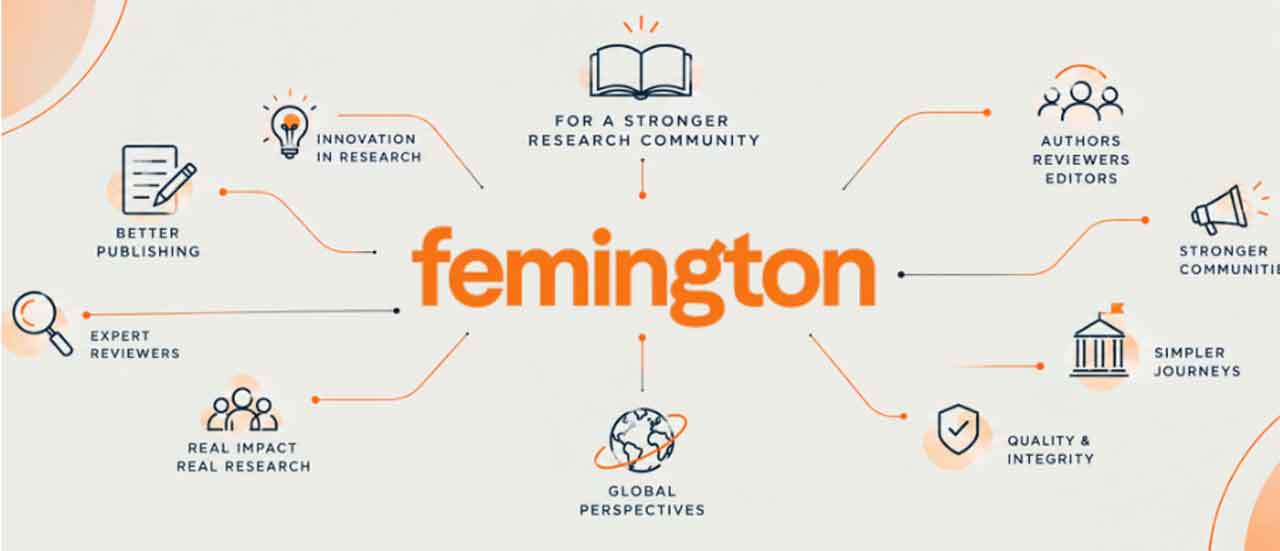
That’s what Femington stands for: removing unnecessary friction while preserving the rigor that makes academic publishing matter.