New Australian data documents the continuing cost of forced child removal, a Swedish election debate puts Sámi land rights against critical-mineral development, and Nishnawbe Aski Nation presses Ottawa to bring its infrastructure ambitions to remote First Nations.
THUNDER BAY – INDIGENOUS NEWS – The leading Indigenous news stories for Tuesday, September 8, 2026, reach from Australia and Sápmi to Ottawa, Nunavut and Northwestern Ontario.
Across those regions, a common question is emerging: when governments make decisions about health, land, policing, trade and infrastructure, are Indigenous Peoples being treated as rights-holders and decision-makers or as communities expected to absorb the consequences?
Here is the NewsHawk briefing NetNewsLedger readers need to know.
International Indigenous News
Australia: New study measures the continuing harm experienced by Stolen Generations survivors
A major new Australian government study released Tuesday shows that Stolen Generations survivors and their descendants continue to experience sharply poorer health, disability, mental-health and financial outcomes.
The Australian Institute of Health and Welfare estimates that about one in seven Indigenous Australians aged 50 and older was a Stolen Generations survivor in 2022-23. Almost half of Indigenous adults were descendants of people removed from their families.
After adjustments for age, sex and remoteness, survivors were 2.7 times as likely as other Indigenous Australians of the same age to have a severe or profound disability. Descendants were 1.3 times as likely as other Indigenous adults to report high psychological distress.
The findings are especially significant because they document intergenerational effects rather than treating forced removal as a closed chapter of history. The report points to the need for culturally safe, trauma-informed health care, mental-health services, aged care and greater financial security.
Why it matters here: The Australian experience will be familiar to many First Nations, Inuit and Metis families in Canada. Both countries used state-backed systems to remove Indigenous children. The new data reinforces why survivor testimony, culturally grounded care and long-term accountability remain essential.
Sweden: Sámi rights move to the centre of a critical-minerals election fight
With Sweden voting on September 13, the future of Sámi reindeer herding and ancestral land use has become part of a national argument over mining and industrial development in the country’s north.
Reporting from Kiruna says Sweden’s Christian Democrats have called for reduced reindeer numbers, less protection for reindeer husbandry as a national interest and a larger state role in land decisions. Sámi leaders warn that the political rhetoric portrays their constitutionally protected culture as an obstacle to economic development.
The immediate flashpoint is the proposed expansion of state-owned miner LKAB’s operations to the Per Geijer deposit. LKAB describes Per Geijer as one of Europe’s largest rare-earth-element deposits and says the processing-concession process is underway. The company says consultation continues and that it is seeking ways to reduce impacts on reindeer herding.
Members of the Gabna Sámi community say the project could sever migration routes between calving grounds, mountain areas and forest lands. The dispute shows how the global race for minerals used in defence, electric vehicles and clean-energy systems can place new pressure on Indigenous territories.
Why it matters here: Northern Ontario faces a similar test. Calling a mineral “critical” does not settle questions about consent, jurisdiction, cumulative impacts or who shares in the benefits. Those questions must be addressed before construction, not after damage has occurred.
United States: Court removes an education barrier facing Canadian-born Jay Treaty students
A United States federal court has vacated an Education Department policy that required Canadian-born American Indian students to provide immigration documents, such as a Green Card, before accessing federal student aid.
According to Native News Online, the September 1 ruling found the policy arbitrary and beyond the department’s authority under the U.S. Higher Education Act. Before the disputed policy was introduced in January 2025, students could use records including band cards, birth records or Tribal affidavits.
The case was brought by Mohawk students whose community and family connections cross the Canada – United States border. The Saint Regis Mohawk Tribe welcomed the decision as a victory for education access.
Why it matters here: Colonial borders divide many Indigenous nations. The ruling is therefore more than a student-aid decision; it is an important test of whether modern administrative rules respect the cross-border rights and realities of Indigenous Peoples.
National Indigenous News
Canada’s counter-tariffs take effect and Indigenous small businesses face added pressure
Canada’s new counter-tariffs on United States goods took effect at 12:01 a.m. Tuesday. The measures apply rates of 15, 25 and 50 per cent to products covering $27.6 billion in imports, including steel, dairy products, appliances, agricultural equipment, pulp and paper, and electronics.
The Department of Finance says the measures match U.S. duties imposed on Canadian products after bilateral trade talks broke down.
For Indigenous entrepreneurs, the danger runs in both directions. Exporters are already facing steep U.S. duties, while Canadian counter-tariffs may raise the cost of imported tools, machinery and other inputs.
Tabatha Bull, president of the Canadian Council for Indigenous Business says that smaller Indigenous-owned companies particularly those selling to American customers online will need fast, accessible financial support. CCIB represents about 2,300 members.
What to watch: Ottawa has announced broad trade-support programs, but the practical question is whether small and remote Indigenous firms can qualify quickly, navigate the applications and receive help before cash-flow problems become layoffs or closures.
Innu Nation calls for Indigenous-led policing after violent arrest in Labrador
Innu Nation Grand Chief Jodie Ashini is renewing calls for an Innu-led police service after video circulated showing a forceful RCMP arrest in Sheshatshiu Innu First Nation.
The video appears to show officers punching the man and using a conducted-energy weapon during the arrest. The incident has been referred to Newfoundland and Labrador’s civilian police oversight agency, the Serious Incident Response Team. No final finding has been made, and the circumstances remain under investigation.
Ashini said that the incident demonstrates the need for a police service grounded in Innu language, culture, relationships and approaches to de-escalation. She said the issue has been part of land-claim and self-government talks for decades.
The debate extends far beyond Labrador. Public Safety Canada data cited in the report showed that 36 First Nation and Inuit police services served 157 communities in 2024, leaving many communities dependent on outside forces.
Indigenous MPs condemn campaign promoting residential-school denialism
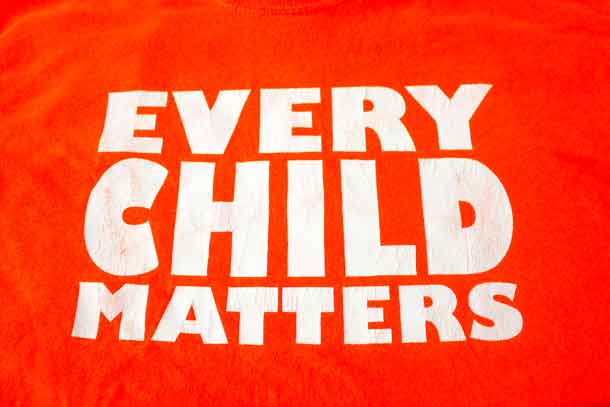
Indigenous members of Parliament have condemned an online merchandise campaign that uses Orange Shirt Day to promote residential-school denialism.
Conservative MP Billy Morin and members of the Liberal Indigenous Caucus denounced the campaign for exploiting survivor trauma and spreading division ahead of the National Day for Truth and Reconciliation on September 30.
The dispute is part of a wider increase in efforts to minimize or deny documented residential-school abuses and deaths. The Truth and Reconciliation Commission gathered thousands of survivor statements and documented the identities or deaths of more than 4,000 children who did not return home.
What readers should know: Debate over individual search sites must not be used to erase the established historical record. Reporting should distinguish carefully between anomalies identified through ground-penetrating radar, confirmed burials, archival evidence and survivor testimony, while respecting that communities control their own investigative work.
Nunavut raises foster-parent support payments by 45 per cent
The Government of Nunavut is increasing foster-parent payments by 45 per cent, the first increase since 2020.
The annual support will range from $30,700 to $34,401 per child, depending on the community’s cost of living. Retroactive payments will cover April 1 through August 31.
The increase will help with food, clothing, housing, school supplies and activities. It also comes after repeated Auditor General warnings about weaknesses in Nunavut’s child-welfare system, including incomplete screening and unreliable data.
The funding increase is important, but adequate payments are only one measure of success. Keeping Inuit children connected to family, community, language and culture must remain central to care decisions.
Northwestern Ontario and Regional Indigenous News
NAN tells Ottawa: Bring the same infrastructure ambition to remote First Nations
Nishnawbe Aski Nation is challenging Prime Minister Mark Carney to match Ottawa’s $4.7-billion passenger-rail investment with large-scale action on infrastructure in remote First Nations.
Following Prime Minister Carney’s Thunder Bay announcement on new VIA Rail cars, NAN Grand Chief Alvin Fiddler said investments intended to build a stronger Canada must include First Nations communities.
More than 30 First Nations in Northern Ontario still have no year-round road access. They depend on winter roads that are becoming less reliable as temperatures rise. NAN also says the 29 remote airports serving its communities are critically underfunded.
Community runways average about 3,500 feet, NAN says, while 5,000-foot paved runways are needed to safely handle aircraft used for medical travel, emergency evacuations and essential supplies. NAN estimates that upgrading those airports would cost between $1.2 billion and $1.5 billion.
Why this is a major regional file: Airport and road conditions affect the price of food, access to health care, wildfire evacuation capacity, construction costs and economic development. Infrastructure is not simply a spending issue; it is a safety, equality and self-determination issue.
Regional wildfire recovery remains an Indigenous emergency-management issue
Ontario reported no new wildland fires in the Northwest Region by the evening of September 7, but 56 fires remained active: five were being held, 14 were under control and 37 were being observed.
Those numbers mark an improvement from the peak of the summer emergency, but the policy questions raised by evacuations and community losses have not gone away. First Nations leaders have called for stronger warning systems, direct funding, culturally safe evacuation supports and a greater role for First Nation governments in emergency planning.
Readers can follow the Ontario forest-fire situation and NetNewsLedger’s Northwest Region update. Conditions and fire status can change quickly.
Kenora-area community services take focus this week
Two service-focused events are scheduled in Treaty #3 territory on Wednesday, September 9.
The Naotkamegwanning First Nation Resource Fair runs from 10 a.m. to 3 p.m. at Peshigoneb Community Hall, with information about housing, health and wellness, support services, jobs, education and training.
Grand Council Treaty #3 is also holding a three-day First Nations Mental Health First Aid training session in Kenora beginning September 9. Registration is closed, but the session underscores continuing regional demand for community-based mental-health knowledge and crisis response.
The NewsHawk Bottom Line
Tuesday’s stories show that reconciliation cannot be measured only through statements or one-time announcements.
In Australia, the health data show how forced removal continues across generations. In Sweden and the United States, courts, elections and mineral policy are testing whether Indigenous rights have practical force. In Canada, tariffs, policing, child welfare and historical denialism are putting pressure on communities in different ways. Across Northern Ontario, the infrastructure gap remains immediate and measurable.
For NetNewsLedger readers, the question to keep asking is straightforward: who holds authority, who receives the investment, and who carries the risk when governments act?
This briefing is an editorial selection based on public impact, timeliness and relevance to Indigenous and Northwestern Ontario readers. It is not an exhaustive list. Source material was reviewed as of Tuesday, September 8, 2026. This article was prepared under NetNewsLedger’s journalistic standards.