August 25, 2026: U.S. Tariffs, Iran Tensions, Ring of Fire Roads and Thunder Bay Labour Deal Lead the News
THUNDER BAY — It is August 25, 2026 and there is a lot going on in the news that NetNewsLedger Newshawks need to know.
First off, a sharp escalation in the Canada-U.S. trade dispute, continuing instability around the Strait of Hormuz and a major step toward building roads into Ontario’s Ring of Fire are leading the news agenda Tuesday, Aug. 25, 2026.
For Thunder Bay and Northwestern Ontario, the connections are immediate. U.S. tariffs threaten mining, forestry, manufacturing and cross-border supply chains; instability in the Middle East can feed into diesel, gasoline, aviation and shipping costs; and new road construction north of Aroland First Nation is moving the Ring of Fire debate from planning toward physical infrastructure.
Closer to home, Community Living Thunder Bay workers are returning after a strike lasting almost 13 weeks, while the municipal election field is now set and the long-discussed Thunder Bay Expressway rebuild is moving toward its next stage.
This morning report reflects information available early Tuesday. Several international, trade and wildfire files remain fluid.
The NewsHawk Morning Brief — Tuesday, Aug. 25
The five stories NewsHawks should put at the top of the morning file are:
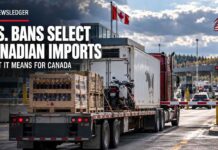
- Canada-U.S. trade relations: New 50 per cent U.S. tariffs are now in force on roughly $28 billion worth of Canadian goods, with Canada preparing dollar-for-dollar retaliation beginning Sept. 8.
- Iran and the Strait of Hormuz: Washington has widened sanctions while Iran threatens retaliation and another tanker incident raises concern around one of the world’s most important energy corridors.
- Ring of Fire infrastructure: Ontario and Aroland First Nation say major work is underway on almost 100 kilometres of Anaconda and Painter Lake roads.
- Northwestern Ontario wildfires: The latest available provincial fire update lists 63 active fires in the Northwest, including six not under control.
- Thunder Bay: Community Living Thunder Bay’s strike has ended, while the city’s 2026 municipal election campaign moves into its next phase.
INTERNATIONAL — Iran sanctions and Strait of Hormuz instability keep energy markets on edge
The Middle East remains the international story with the clearest potential economic consequences for Northwestern Ontario.
The United States expanded sanctions against Iran Monday, targeting 60 individuals, entities and vessels while warning countries and companies that continued business with Iran could eventually put their access to the U.S. financial system at risk.
Iran responded Tuesday by threatening retaliation. At the same time, an oil tanker was struck and disabled by an unidentified projectile near the entrance to the Strait of Hormuz, according to maritime authorities.
The scale of the disruption is significant. Reuters reports oil movements through Hormuz were running at about five million barrels a day Monday, compared with more than 20 million barrels a day before the war. Reuters also calculates that countries affected by conflict now account for more than 43 per cent of global oil production.
For Thunder Bay and the Northwest, the issue is not simply the posted price of crude oil.
Higher or volatile petroleum prices can work through trucking, aviation, mining equipment, forestry operations, construction and the cost of supplying remote First Nations. Northern communities are particularly exposed because food, fuel and other essential goods often travel long distances by truck or aircraft.
A single day’s oil-market movement does not automatically translate into an equivalent change at Thunder Bay gasoline pumps, but a prolonged disruption to Gulf exports would increase pressure throughout the transportation economy.
INTERNATIONAL — Ukraine sees a new window for U.S.-mediated peace efforts
Ukraine says it has developed a short proposal with U.S. and European officials aimed at restarting efforts to end Russia’s war.
President Volodymyr Zelenskiy told reporters that Ukraine sees an opportunity for U.S. mediation extending into the summer of 2027. The proposal reportedly includes a ceasefire and discussion of a U.S.-suggested free economic zone in the Donbas region administered by a third party.
The Kremlin has already questioned whether such an arrangement would be workable, maintaining its claim over occupied Ukrainian territory.
The development follows Ukraine’s Independence Day Monday, when European leaders renewed commitments to military support. Prime Minister Mark Carney also spoke with German Chancellor Friedrich Merz Monday, with both leaders reaffirming support for Ukraine and discussing deeper Canada-Germany cooperation in defence, energy, artificial intelligence and critical minerals.
For Northwestern Ontario, the war remains connected to fertilizer, grain, energy, defence spending and critical-mineral supply chains. Thunder Bay also has longstanding cultural and family connections to Ukraine through its Ukrainian-Canadian community.
Any genuine peace process could eventually reduce some commodity-market uncertainty, but there is no agreement yet and substantial differences remain between Kyiv and Moscow.
INTERNATIONAL — China continues construction in the disputed South China Sea
New satellite imagery reviewed by Reuters shows additional construction on Yagong Island near Antelope Reef in the disputed Paracel Islands.
Analysts told Reuters the installations could eventually support radar or early-warning systems. Nearby Antelope Reef has been expanded into an artificial island almost six kilometres long, including a stretch analysts say could potentially accommodate a runway. China has not acknowledged that it is constructing a military base and says development in the area includes civilian purposes such as scientific research and weather monitoring.
The South China Sea is one of the world’s most strategically important shipping corridors and is claimed in whole or in part by several governments.
For Canada, a more heavily militarized South China Sea matters because Canadian trade with Asia depends on stable maritime routes. For Northern Ontario’s mining sector, tensions involving China also matter because critical minerals, processing capacity, batteries and advanced manufacturing have become central components of the wider geopolitical competition.
NATIONAL — Canada-U.S. trade talks have collapsed and 50 per cent tariffs are now in force
The Canada-U.S. trade dispute is the dominant national economic story.
After negotiations broke down Friday, the United States imposed 50 per cent tariffs on roughly $28 billion worth of Canadian goods. Prime Minister Mark Carney suspended negotiations, saying last-minute U.S. demands were unfair and uneconomic.
Canada has announced that it will respond dollar for dollar beginning Tuesday, Sept. 8. Ottawa says its measures will focus on sectors including steel, dairy, appliances, agricultural equipment, pulp and paper and electronics.
U.S. President Donald Trump escalated the dispute again Monday, threatening 50 per cent tariffs on Canadian-made cars, trucks and auto parts beginning Jan. 1, 2027.
This is especially important in Northwestern Ontario.
Forestry products, minerals, manufactured equipment and machinery often move through integrated North American supply chains. Thunder Bay manufacturers such as Alstom also operate in an economy in which components, metals and finished products can cross the border.
Regional leaders are already warning that mining, forestry and manufacturing could be among the sectors most exposed.
The secondary effects may ultimately matter as much as the tariffs themselves: weaker investment, delayed projects, higher equipment prices, exchange-rate movements and higher costs for businesses that depend on American inputs.
NATIONAL — Ottawa and the premiers prepare retaliation and worker supports
Carney met virtually with provincial and territorial premiers following the breakdown in negotiations.
The Prime Minister’s Office says governments discussed the planned counter-tariffs as well as additional support for Canadian businesses and workers affected by U.S. measures. Further details are expected.
Ottawa is also emphasizing internal trade, new international markets and accelerated “nation-building” projects as part of its response.
That policy direction could carry significant consequences for Northern Ontario.
A federal push to diversify Canadian exports creates a stronger argument for infrastructure linking mines, forestry operations, railways, highways and the Port of Thunder Bay to markets beyond the United States.
The immediate question for the Northwest will be what worker, business and industry support Ottawa ultimately offers — and whether forestry, mining suppliers and northern manufacturers qualify quickly enough to prevent layoffs or cancelled investment.
NATIONAL — Canada commits more than $11 billion for six new Coast Guard icebreakers
The federal government announced Monday that it plans to spend more than $11 billion to build six new Canadian Coast Guard icebreakers.
The vessels will be constructed by Quebec shipbuilder Chantier Davie and replace aging heavy and medium icebreakers.
While the ships will not be built in Thunder Bay, the investment is part of a much larger national focus on Arctic sovereignty, northern transportation and domestic industrial capacity.
For Northwestern Ontario, the broader significance is the increasing federal willingness to treat northern infrastructure, critical minerals, transportation and sovereignty as interconnected national priorities.
That same policy environment could affect future investments in roads, rail, electricity transmission and mineral processing across Ontario’s North.
REGIONAL — Ring of Fire road work moves from proposal toward construction
Ontario and Aroland First Nation announced Monday that major upgrades are underway on the Anaconda and Painter Lake roads north of Aroland.
Preliminary work began June 30.
The project covers 97 kilometres and includes bridge work, drainage improvements, road realignment, widening and replacement of 62 culverts. Ontario says the roads are scheduled to open to secondary-highway standards by November 2030.
The corridor would eventually connect Highway 643 near Aroland with a larger proposed road network including the Marten Falls Community Access Road, Northern Road Link and Webequie Supply Road.
Ontario argues the network is essential for connecting remote First Nations to the provincial highway system and opening critical-mineral deposits in the Ring of Fire.
The development must also be understood within a continuing debate among Indigenous communities.
Aroland, Webequie and Marten Falls First Nations have entered agreements or partnerships intended to advance road infrastructure and economic opportunities. Other Indigenous voices remain strongly opposed to parts of the development.
Friends of the Attawapiskat River, a grassroots group whose members come from several Treaty 9 communities, has asked Federal Court to review Ottawa’s approval of the Webequie Supply Road. The group argues the project threatens peatlands, waterways and Indigenous rights. Those claims are now part of a legal proceeding and have not been determined by the court.
For Thunder Bay, the Ring of Fire could influence engineering, construction, aviation, mining services, equipment supply, training and transportation for decades.
The central issue will continue to be whether development can proceed with meaningful Indigenous participation, environmental protection and lasting benefits for the communities whose traditional territories are affected.
REGIONAL — 63 wildfires remain active across Northwestern Ontario
Northwestern Ontario’s wildfire emergency has eased considerably from its July peak, but the season is not over.
The latest available Northwest Region update, covering conditions Sunday evening, lists 63 active fires. Six were not under control, four were being held, 10 were under control and 43 were being observed.
The massive Rinker Lake Complex remains active.
Thunder Bay 36 was listed at approximately 301,240 hectares, Dryden 34 at 45,800 hectares and Dryden 35 at 30,088 hectares. All three remained not under control, although officials reported low fire activity.
There were 184 personnel assigned to the complex, including Ontario and Mexican firefighters, flight crews, engineers and other support staff.
One new fire, Nipigon 101, was reported near Pauloski Lake northwest of Onaman Lake.
The regional Restricted Fire Zone was lifted last week as conditions improved, but active fires of this size remain important for remote travel, forestry operations, aviation and First Nations that have already experienced major evacuations this summer.
Recovery will remain a significant story even after the flames are controlled. Evacuated communities may face housing, infrastructure, health and supply-chain challenges long after the 2026 fire season ends.
LOCAL — Community Living Thunder Bay strike ends after almost 13 weeks
Community Living Thunder Bay and OPSEU/SEFPO Local 740 have reached an agreement ending a strike that began in May.
The union and employer jointly confirmed Friday that a settlement had been reached and said their focus is now on restoring full service.
Local reporting says workers accepted annual wage increases of three per cent in each of the next three years, along with improvements in vacation, benefits and compensation connected with sleep shifts. The return to normal operations is expected to be gradual because supported residents and staff must transition back into regular service arrangements.
The dispute highlighted a broader issue facing developmental services across Ontario: recruitment, retention and compensation in work that provides essential support for people with intellectual disabilities.
For families relying on Community Living Thunder Bay, the immediate news is that the disruption is ending and regular services can begin rebuilding.
LOCAL — Thunder Bay municipal election campaign is officially underway
Nominations for Thunder Bay’s Oct. 26 municipal election closed Friday.
Local reporting puts the final field at 10 candidates for mayor and 46 candidates seeking council seats.
The campaign will now move from nominations to policy.
Major issues likely to dominate include policing and community safety, homelessness, addiction and mental-health services, road and infrastructure spending, taxation, housing development, public transit and the city’s role in regional economic projects.
The election also comes as Thunder Bay faces consequential decisions about growth, aging infrastructure and its position as the service, transportation and industrial hub for Northwestern Ontario.
For NewsHawks, the next step should be watching for detailed platforms rather than campaign slogans — particularly costed proposals explaining how candidates would pay for their priorities.
LOCAL — Thunder Bay Expressway rebuild moving toward contract award
Another long-running Thunder Bay infrastructure file is moving forward.
Following the Association of Municipalities of Ontario conference says the Ministry of Transportation plans to award the design-build contract next month for the first 13 kilometres of the Thunder Bay Expressway reconstruction.
The broader project has been valued at about $450 million and is intended to replace six signalized intersections with interchanges.
The expressway forms part of the Trans-Canada Highway and is one of the most important freight corridors in Northwestern Ontario.
That makes the project more than a local traffic issue.
Mining equipment, forest products, groceries, fuel and east-west freight all move through Thunder Bay. Improvements that reduce bottlenecks and collision risks can affect commercial transportation across the entire region.
What NewsHawks should watch through Tuesday
The Canada-U.S. tariff dispute has the greatest potential to generate new developments during the day. Ottawa has promised additional support measures, while Washington’s latest auto threat adds another layer of uncertainty.
Oil markets and shipping reports from the Strait of Hormuz also deserve close attention. A serious escalation there could quickly become a cost-of-living and transportation story for Northwestern Ontario.
Regionally, watch for updated wildfire numbers and any additional details on the Ring of Fire road schedule, environmental approvals or Indigenous responses.
In Thunder Bay, the municipal campaign is now moving into the period when voters should begin seeing clearer positions on policing, homelessness, infrastructure, taxation and economic development.
The common thread running through Tuesday’s news is infrastructure and economic security. From oil tankers in the Persian Gulf and trade routes across the U.S. border to mining roads north of Aroland and highway work through Thunder Bay, decisions made far outside city limits continue to shape what it costs to live, move goods and build businesses in Northwestern Ontario.